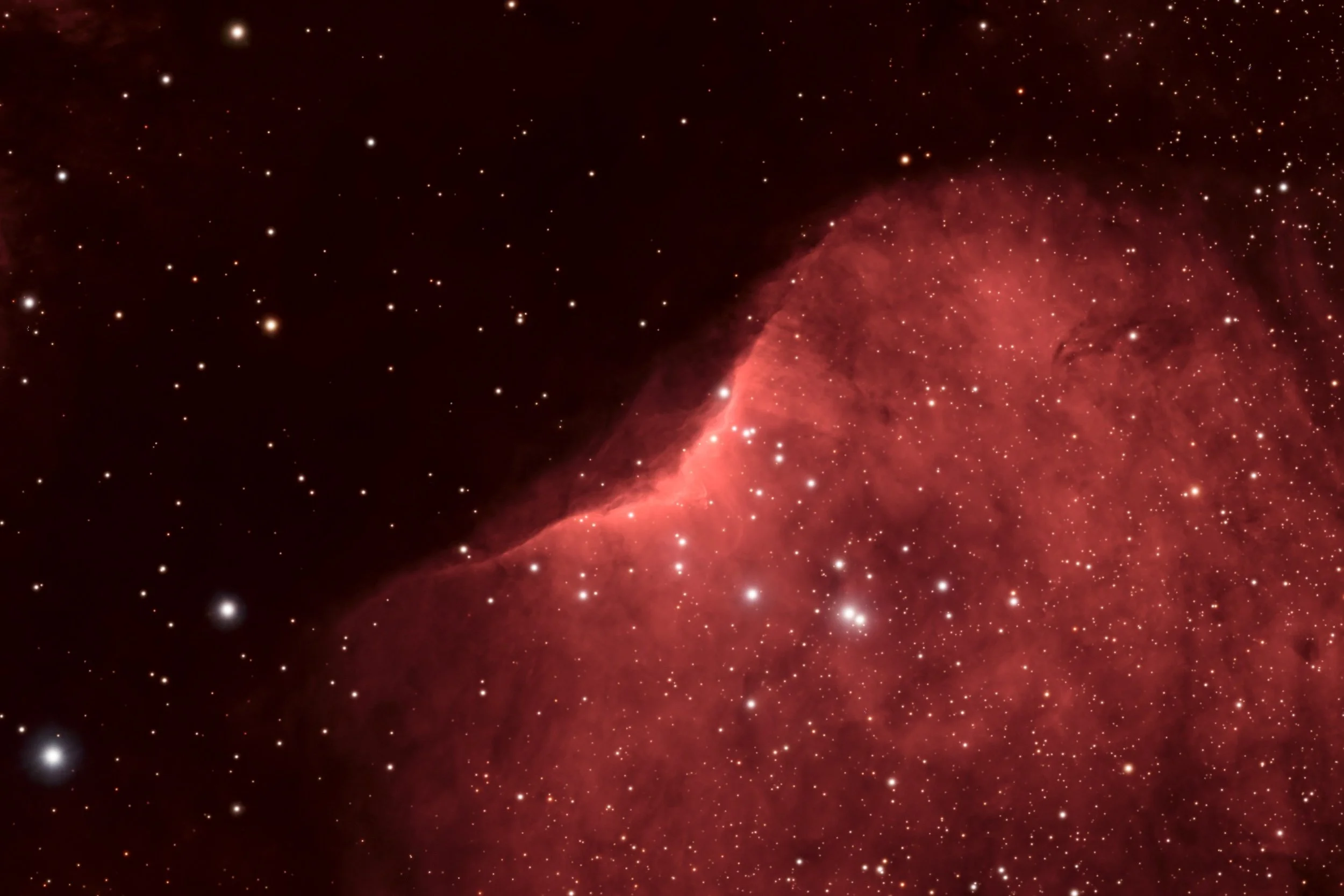
Sh2-140
Sh2-140
2° 4’ x 1° 23’ | 0.78”/px | 9576 × 6388 px
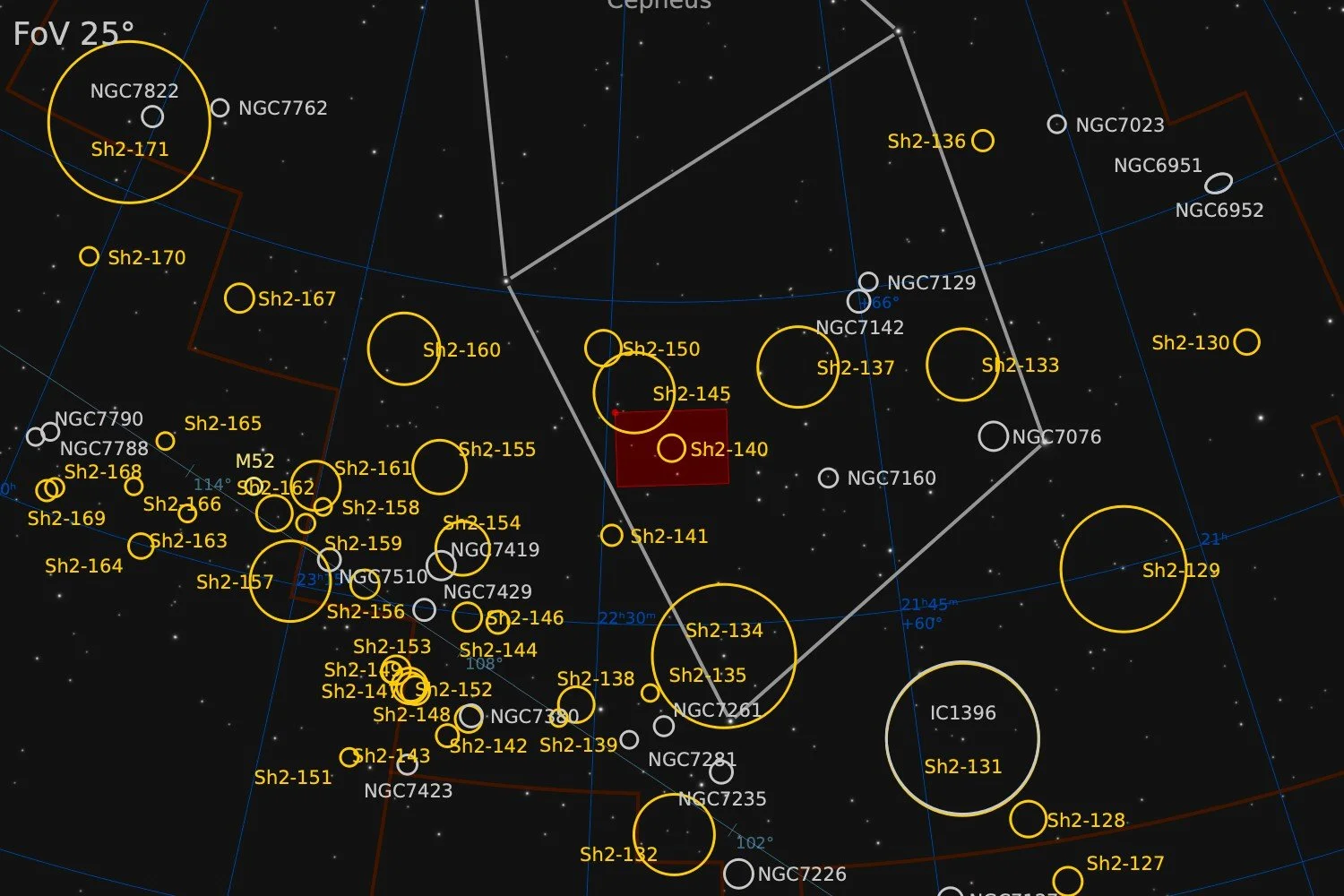
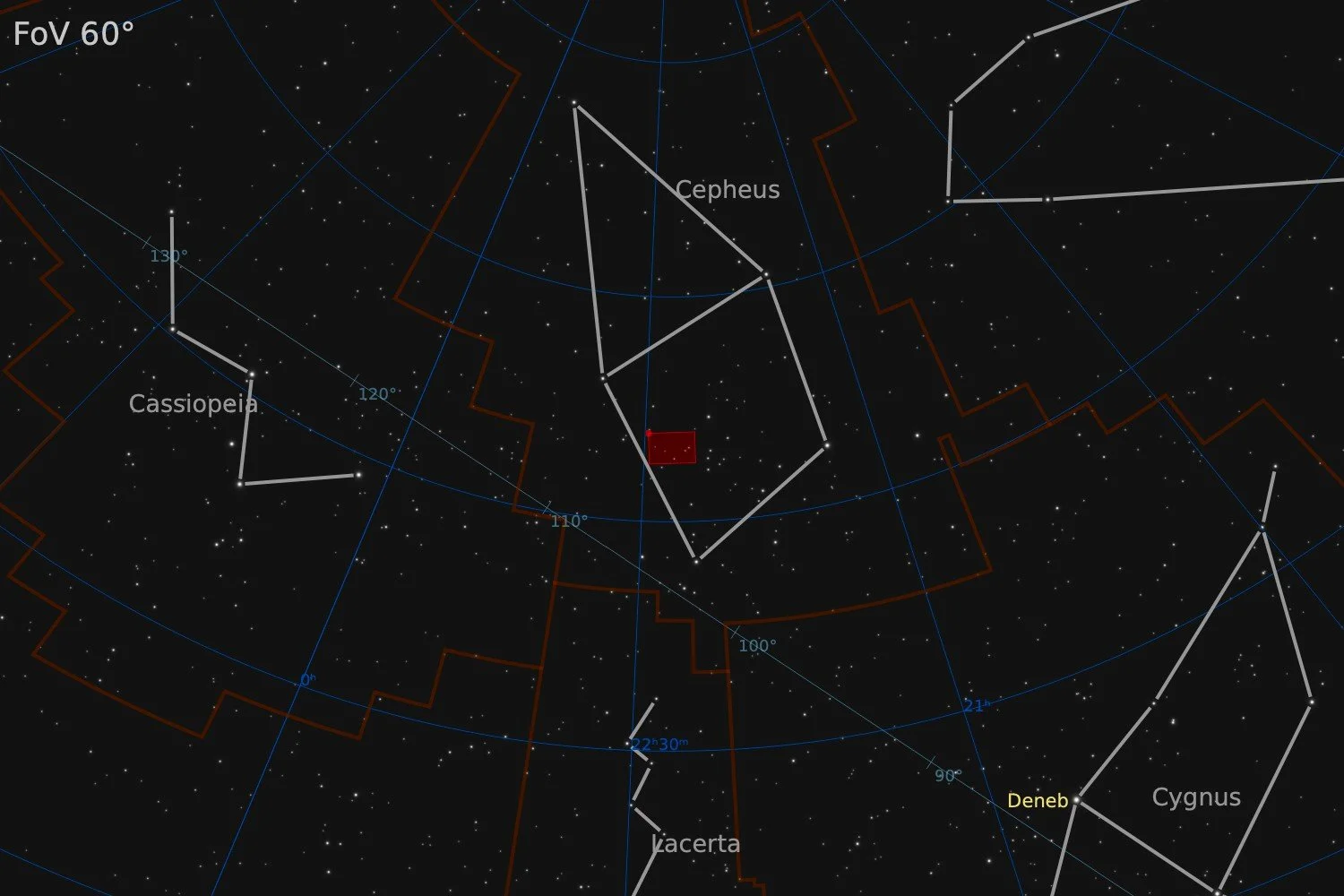
Cepheus
RA 22h 19m 05s Dec +63° 17’ 20” | 2°
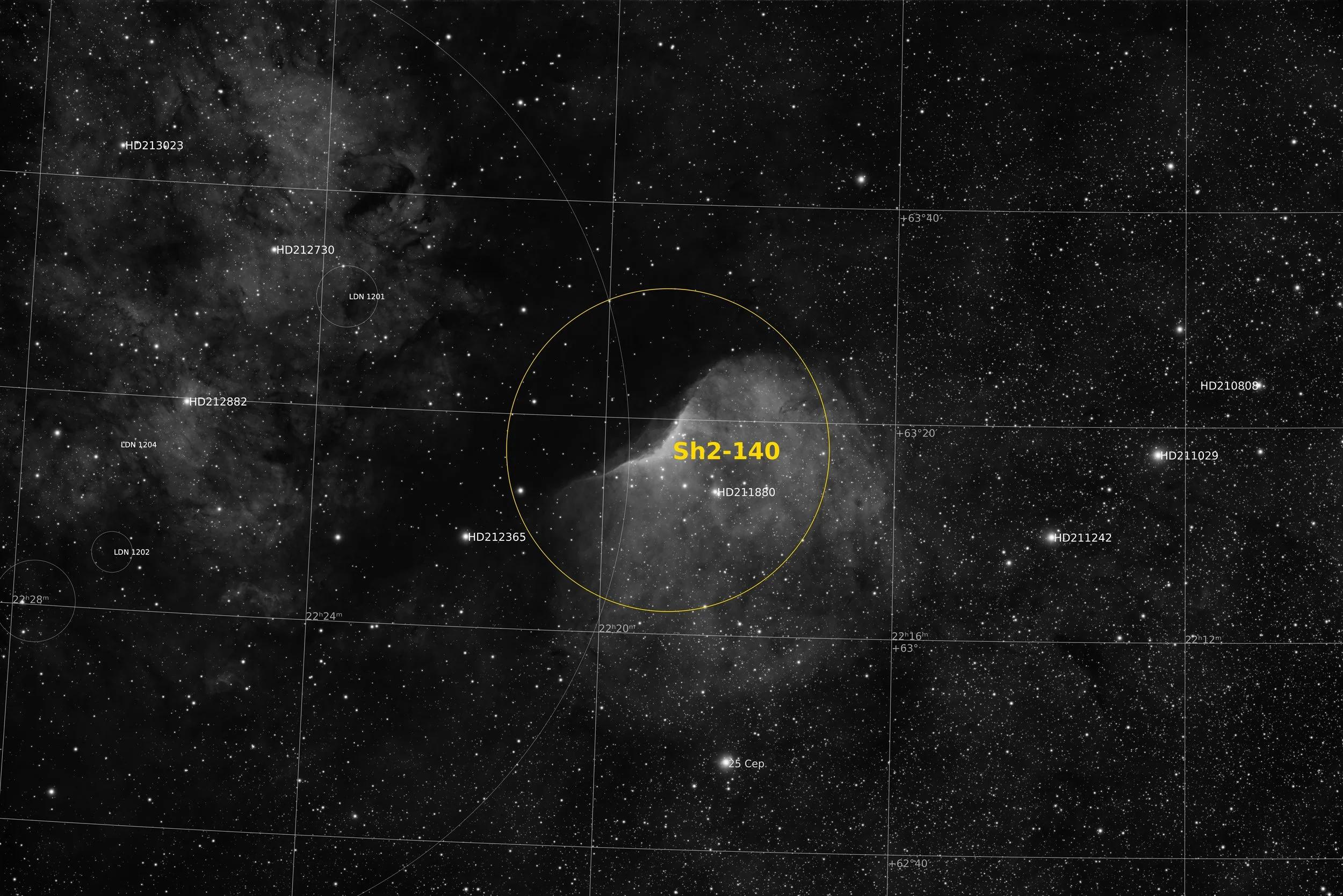
Sh2-140 is an emission and reflection nebula located in the constellation Cepheus, near the border with Lacerta. It is part of the Sharpless catalogue, a systematic survey of HII regions compiled by American astronomer Stewart Sharpless and published in 1959. The nebula lies at a distance of approximately 2,900 light-years from Earth and is associated with a dense molecular cloud known as L1204, which forms the darker backdrop against which the brighter nebulosity is seen. The illuminating source is a hot young star designated HD 211880, whose ultraviolet radiation ionises the surrounding gas and drives the characteristic emission glow. The visible nebula spans roughly 10 light-years across, though the associated molecular cloud extends considerably further. Sh2-140 is a well-studied region of active star formation. Infrared and radio observations have revealed multiple deeply embedded young stellar objects and protostars within the molecular cloud that are invisible at optical wavelengths. The region contains a small cluster of young stars still in the process of clearing their surrounding material, and it has been observed extensively with infrared observatories including Spitzer and Herschel.
Source: Claude.ai
Data Acquisition
Data was collected during 3 nights in April 2026, using a 130cm refractor telescope with full-frame camera from the backyard in The Netherlands. Data was gathered using a 3nm Ha filters and standard LRGB filters. A total of approximately 18 hours of data was finally combined to create the final image.
Location Backyard Observatory in Groningen, The Netherlands (53°N 6°E)
Sessions
Frames
Equipment
Telescope
Mount
Camera
Filters
Guiding
Accessoires
Software
Takahashi TOA-130 (1000mm @ f/7.7), Pegasus Astro Motor Focus kit v2
10Micron GM1000HPS, EuroEMC S130 pier
ZWO ASI6200MM Pro, cooled to -15 ºC
Antlia 2” Ha (3nm) and RGB unmounted, ZWO EFW 7-position
Unguided
Fitlet3, Pegasus Ultimate Powerbox v2, DeepSkyDad Flat panel, MBox
Linux Mint, KStars/Ekos, INDI Library, Mountwizzard4, PixInsight 1.9.3
Processing
All processing was done in Pixsinsight unless stated otherwise. Default features were enhanced using scripts and tools from RC-Astro, SetiAstro, GraXpert, CosmicPhotons and others. Images were calibrated using 50 Darks, 50 Flats, and 50 Flat-Darks, registered and integrated using WeightedBatchPreProcessing (WBPP). The processing workflow diagram below outlines the steps taken to create the final image.
The MultiscaleAdaptiveStretch (MAS) tool was used for stretching all images, including the stars-only image. As I get more practise with the tool, it generally produces nice results and has just enough flexibility to fine-tune the stretching process for each individual situation.
The starless RGB image has very little information in it, and is almost entirely black. There is a small bit of blue-ish nebulosity to the right of Sh2-140 that I tried to highlight, but it is very marginal. The Ha channel therefore is responsible for both the red colour and most of the luminance. There are different ways of doing this, and for this image the ImageBlend script was used several times. The filter- and blend-parameters used are indicated in the process flow below. The first step is to add the Ha as a colour layer. With the filter parameter set to colour, a hue can be selected. In this case 360 was used. The second step is to blend the Ha a second time, but now only used to replace the lightness. In a third run of ImageBlend the stars were put back in. There are many variables in this process and slight changes can have significant effects, so this is definitely a trial-and-error process.
Other than these specific steps, the rest of the processing used a fairly standard approach, outlined below.
Processing workflow (click to enlarge)
This image has been published on Astrobin.