M105
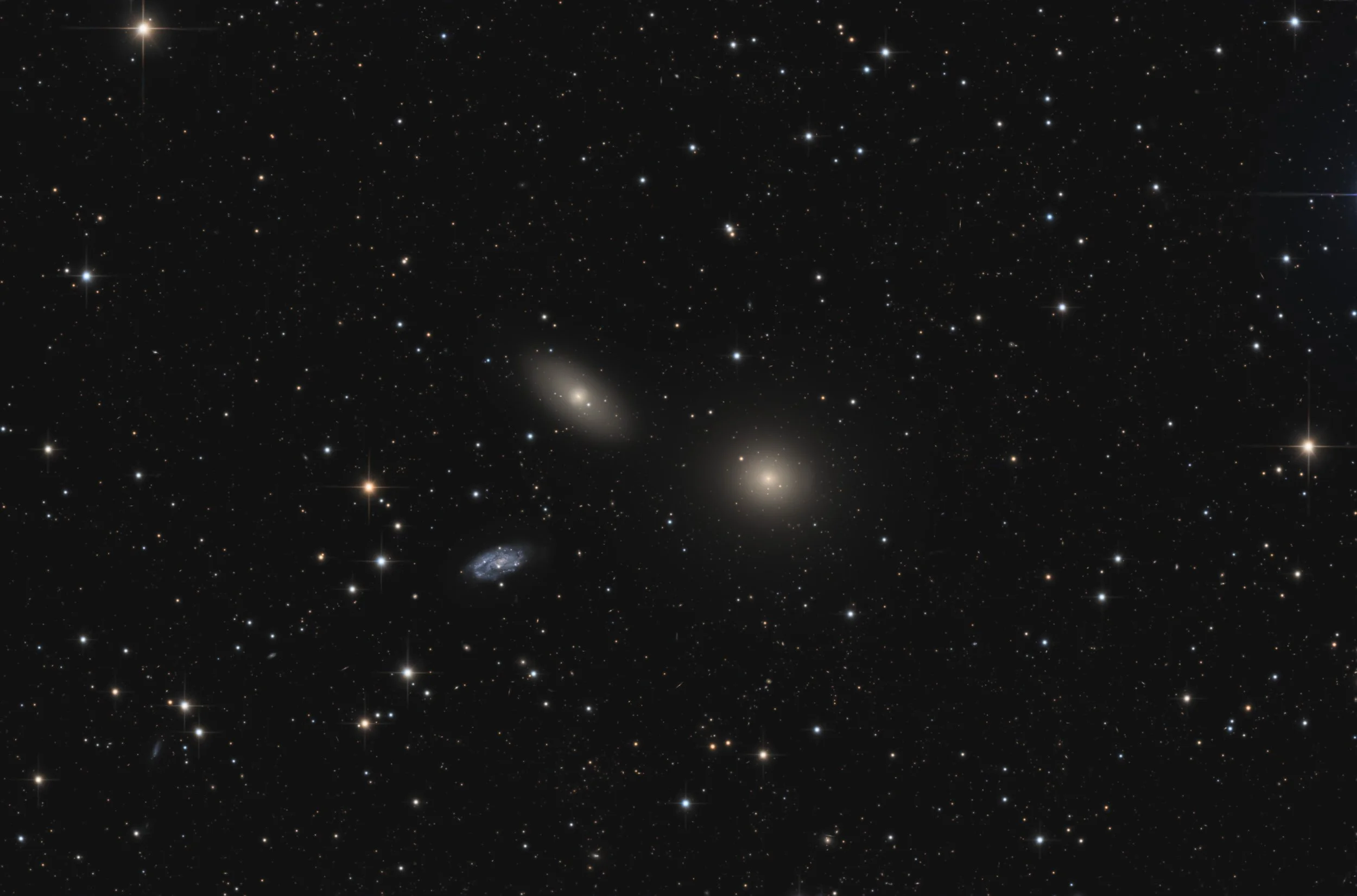
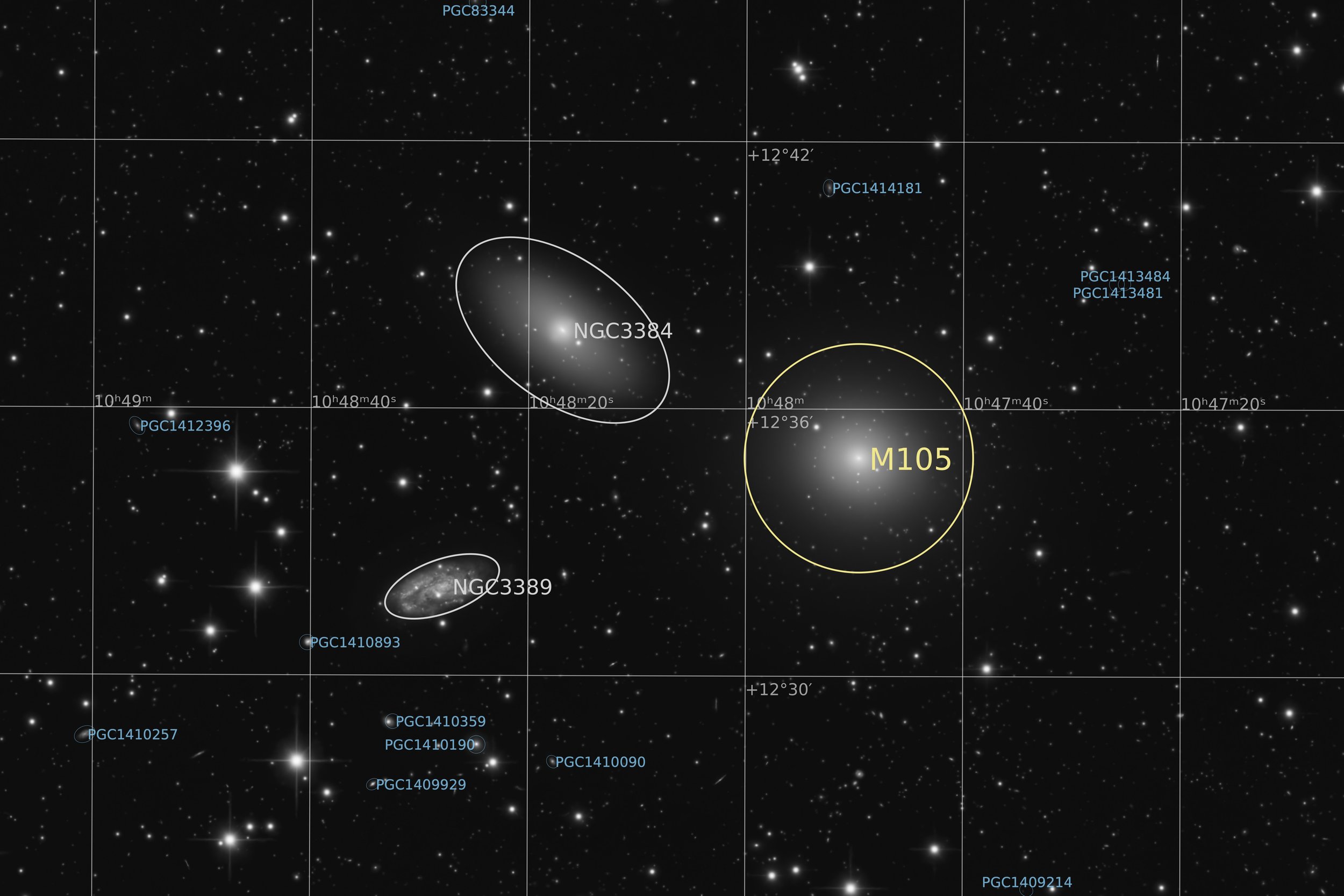
Messier 105/NGC 3379, NGC 3384, NGC 3389
30’ x 20’ | 0.3”/px | 6000 × 4000 px
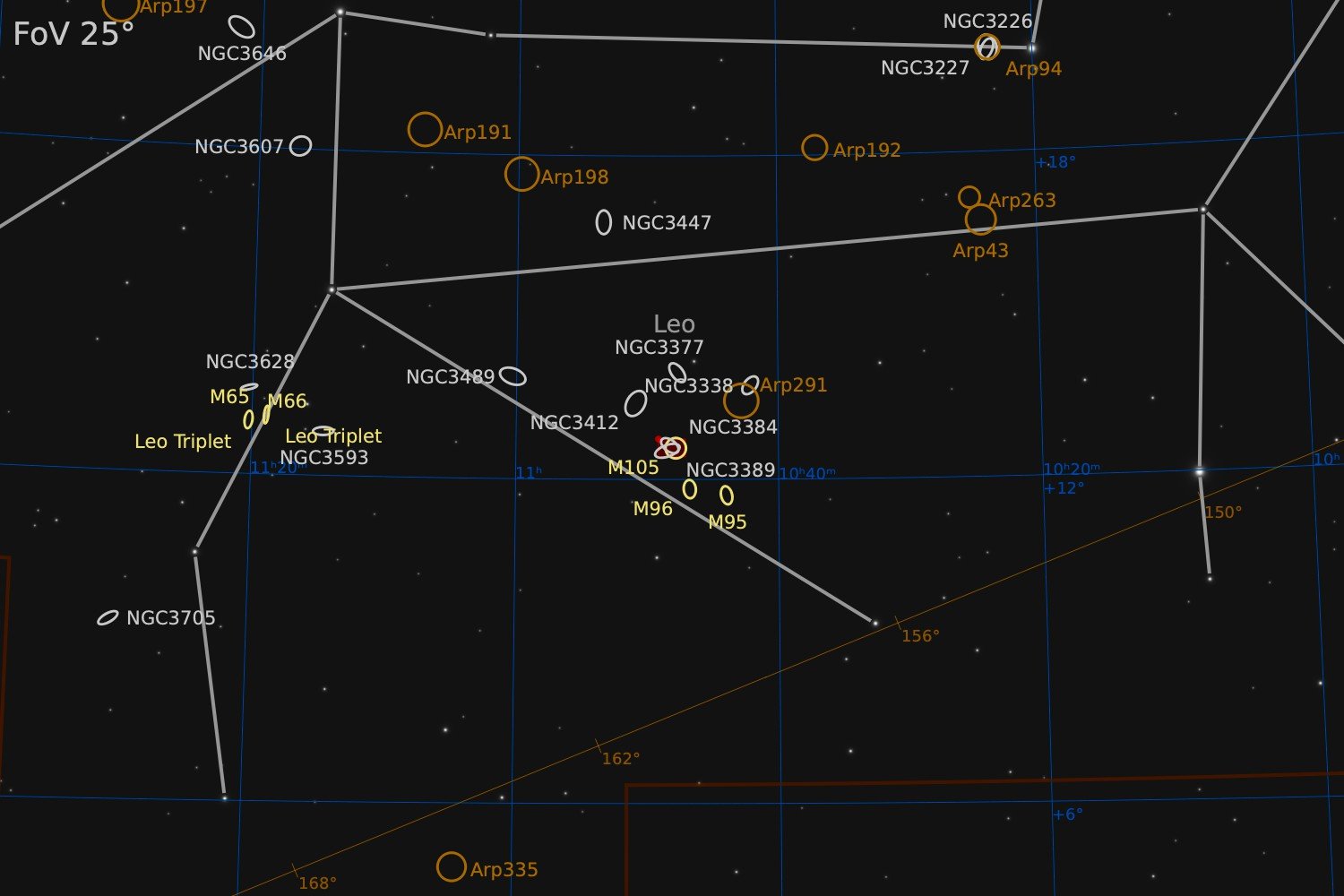
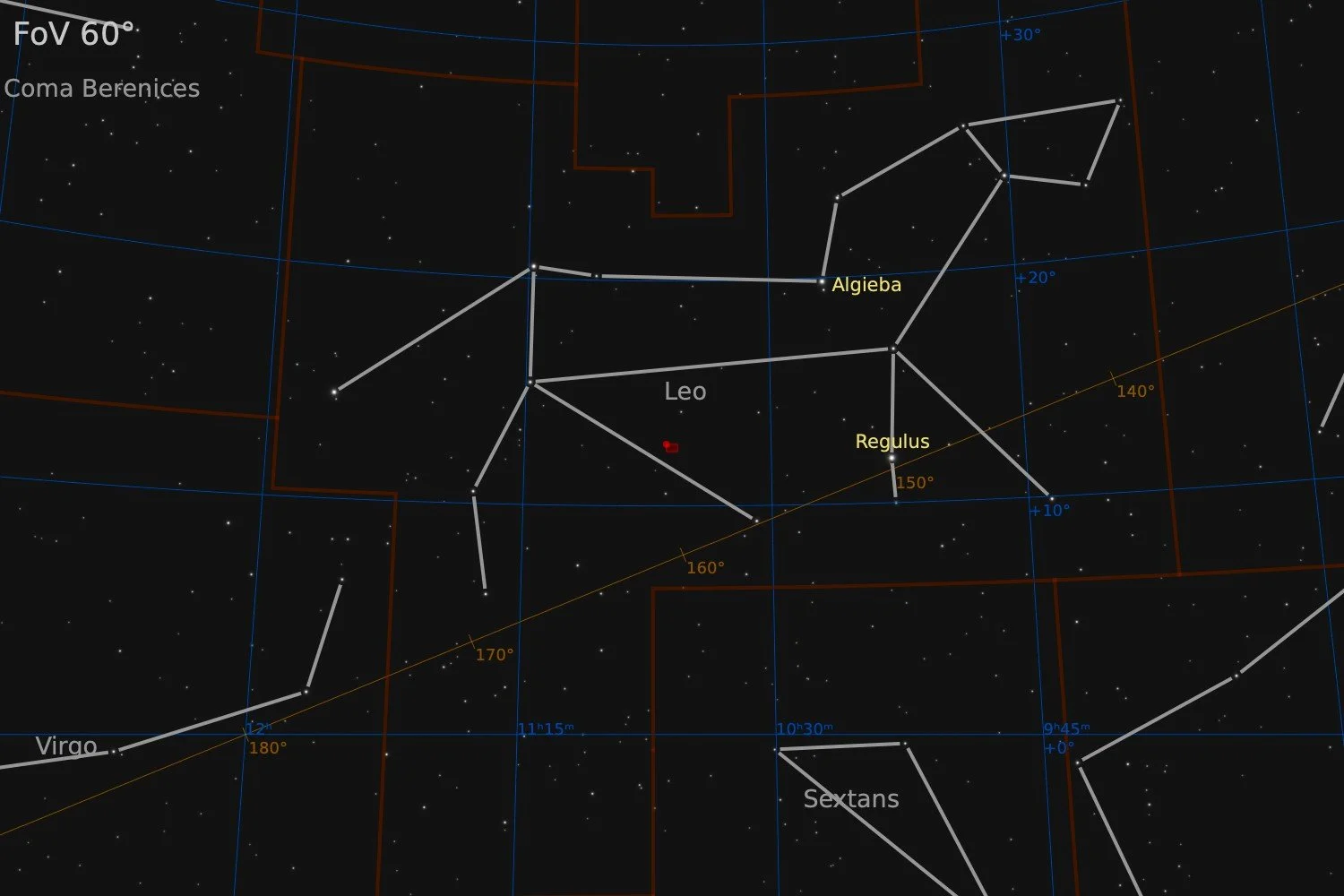
Leo
RA 10h 48m 07s Dec +12° 35’ 07” | 0°
Messier 105, also known as NGC 3379, is an elliptical galaxy located in the constellation Leo. It was discovered by Pierre Méchain on March 24, 1781, just days before Messier finalised his famous catalogue, making it one of the last entries added. Despite this late inclusion, it was not actually published in Messier's original catalogue and was only formally added in the 20th century based on Méchain's notes. M105 lies at a distance of approximately 32 million light-years from Earth and is the brightest elliptical galaxy in the Leo I Group, a galaxy group that also includes M95 and M96. M105 spans roughly 55,000 light-years in diameter. As a typical elliptical galaxy, M105 consists primarily of older, redder stars with little ongoing star formation and no significant dust lanes or spiral structure. However, it is far from featureless scientifically. Studies have indicated the presence of a supermassive black hole at its centre with a mass estimated at around 140 million solar masses. There is also evidence of a small amount of residual star formation activity in the very centre of the galaxy, which is unusual for an elliptical of this type.
Source: Claude.ai
Data Acquisition
Data was collected during 4 nights in February and March 2026, using a 14” reflector telescope with full-frame camera at the remote observatory in Spain. Data was gathered using standard LRGB filters. A total of approximately 18 hours of data was finally combined to create the final image.
Location Remote hosting facility IC Astronomy in Oria, Spain (37°N 2°W)
Sessions
Frames
Equipment
Telescope
Mount
Camera
Filters
Guiding
Accessoires
Software
Planewave CDK14 (2563mm @ f/7.2), Optec Gemini Rotating focuser
10Micron GM2000HPS, custom pier
Moravian C3-61000 Pro (full frame), cooled to -10 ºC
Chroma 2” LRGB unmounted, Moravian filterwheel L, 7-position
Unguided
Compulab Tensor I-22, Dragonfly, Pegasus Ultimate Powerbox v2
Voyager Advanced, Viking, Mountwizzard4, Astroplanner, PixInsight 1.9.3
Processing
All processing was done in Pixsinsight unless stated otherwise. Default features were enhanced using scripts and tools from RC-Astro, SetiAstro, GraXpert, CosmicPhotons and others. Images were calibrated using 50 Darks, 50 Flats, and 50 Flat-Darks, registered and integrated using WeightedBatchPreProcessing (WBPP). The processing workflow diagram below outlines the steps taken to create the final image.
Stretching the stars-only image is always a bit tricky. As the background is by definition 0, star stretching tools can give some unexpected results if not careful. SetiAstro has developed a script developed specifically for stars-only images, called StarStretch. This is the tool that I used for a long time. But often I found that stars always came out a bit more dull than anticipated. Even when giving it a maximum boost, the stars were still very much contained, and diffraction spikes for example disappeared to a large extent. Large diffraction spikes can be very distracting, so keeping them small is fine, but often I felt they might be just a bit too small.
For this image I practised a bit with the new MultiscaleAdaptiveStretch (MAS) tool. It assumes a target background value, but when putting in ‘0’, the stretching does not work. So the smallest possible value was chosen (0.001), which worked well. Playing with the aggressiveness and dynamic range compression sliders gives a lot of control over the stretch and works particularly well for stars. The stars can be stretched quite a bit without clipping. And star shape does not distort as it can do with GHS. Both the RGB and Lum stars were stretched using MAS and put together. The combined LRGB stars image was then added to the starless image using the ImageBlend script. With a pretty heavily stretched star structure, ImageBlend allowed to tone down a bit the overall star field. With the preview it was easy to find a pleasing star field look.
When stretching the starless image, the nuclei of both M105 and NGC 3384 became very apparent. So much so that I wondered if this was real, or that it was an artefact of the hyperbolic stretching algorithm. An on-line image from the Hubble telescope showed the same apparent nucleus of the galaxy, which inspired confidence that this was indeed the proper structure of the galaxies.
To enhance local contrast, the tool LocalHistogramEqualization is often applied. However, when applying it to the whole image in this case, it did some weird things with the rather structure-less galaxies M105 and NGC 3384. So LHE was applied to NGC 3389 only, using a mask created with the GAME script.
Other than these changes to normal, the rest of the processing used a fairly standard approach, outlined below.
Processing workflow (click to enlarge)
This image has been published on Astrobin.