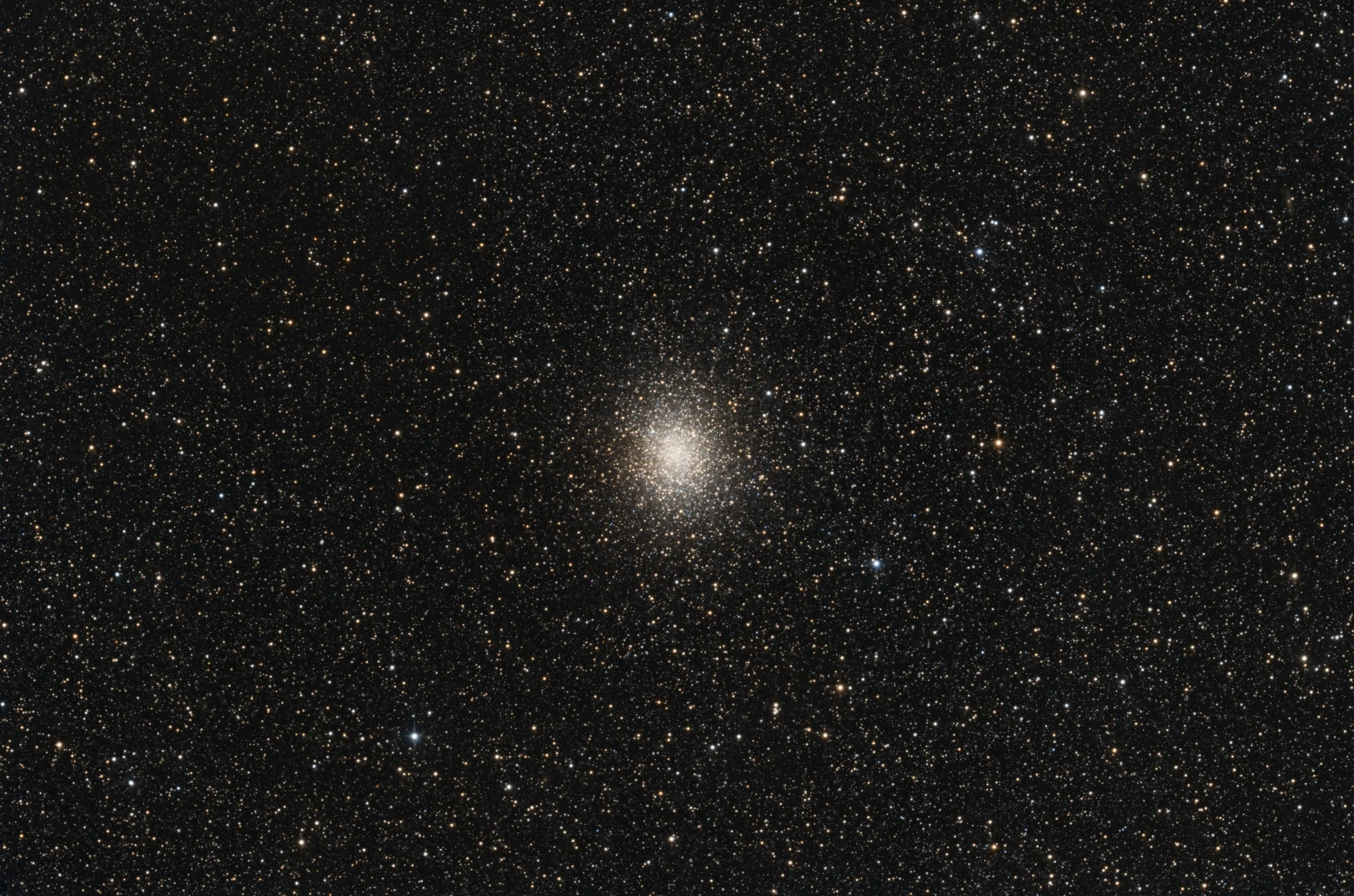
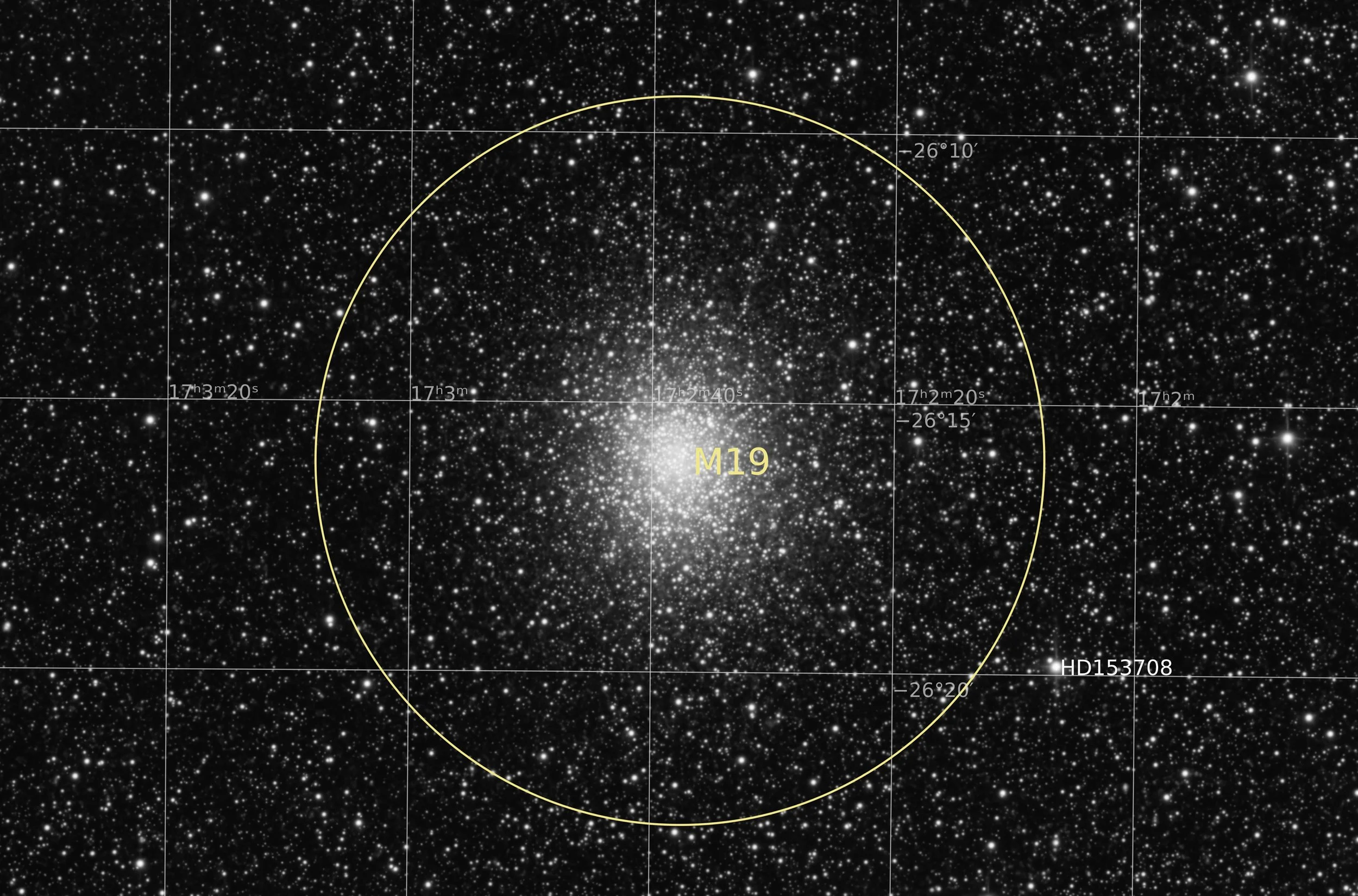
M19
NGC 6273
25’ x 16’ | 0.3”/px | 5000 × 3300 px | full resolution
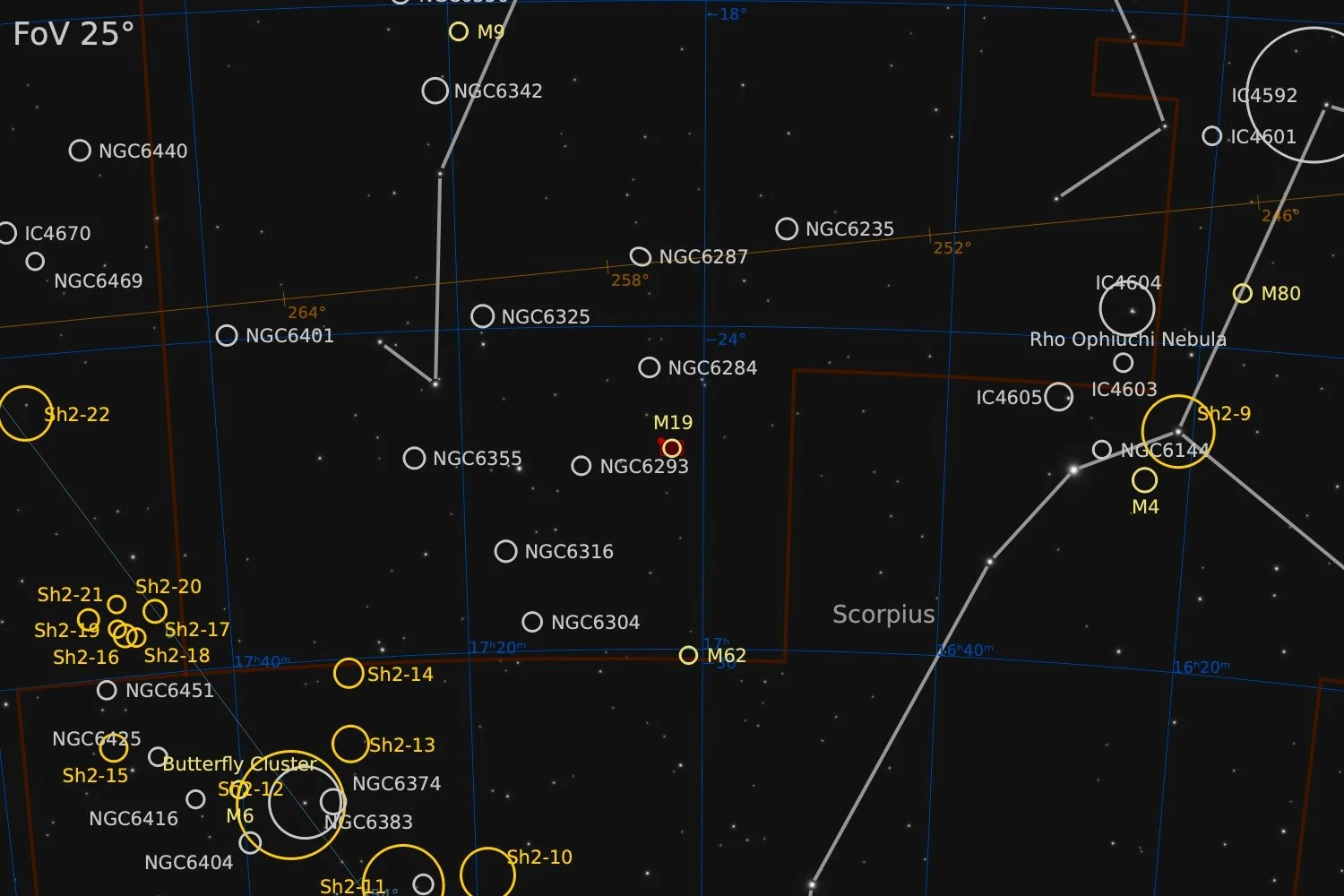
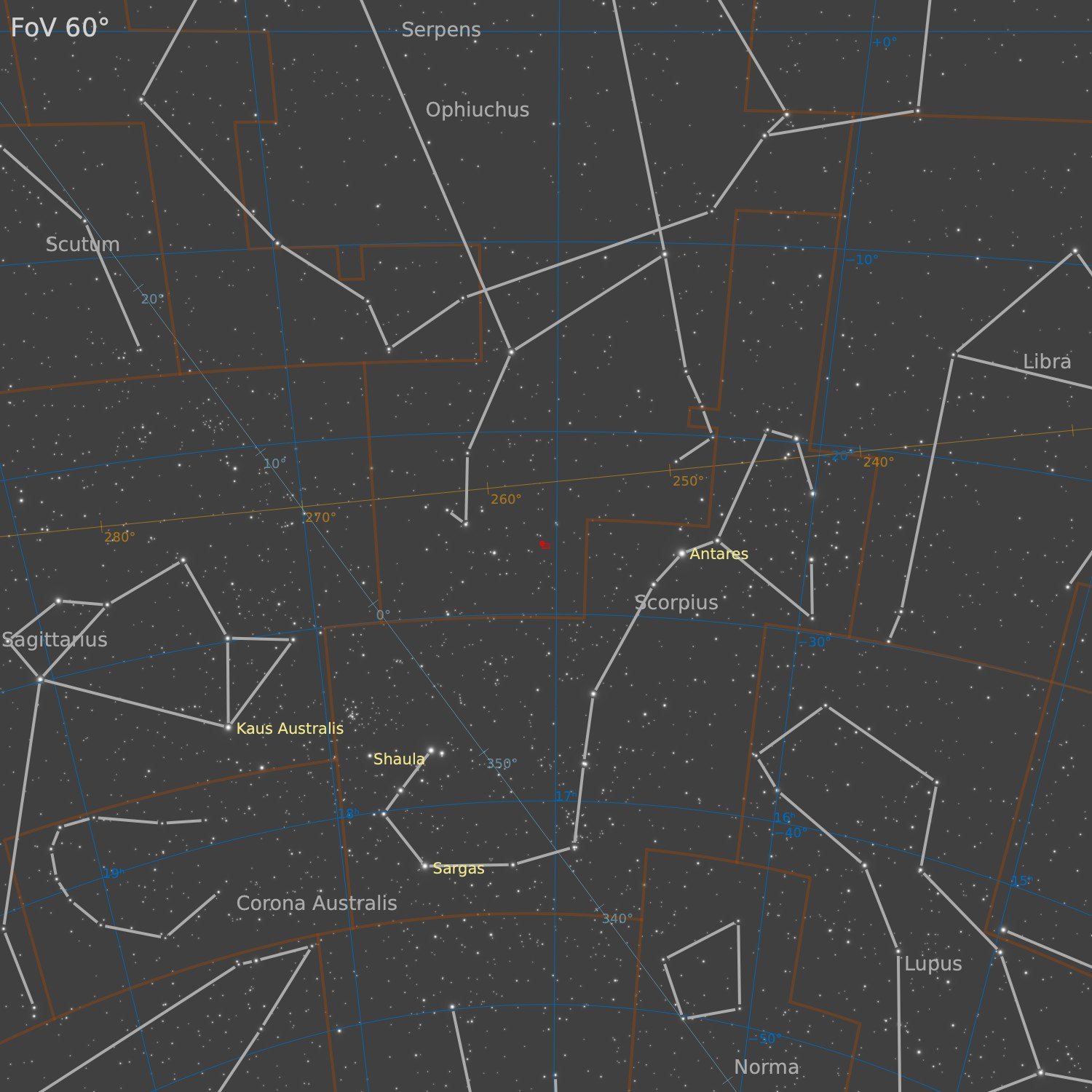
Ophiuchus
RA 17h 02m 38s Dec -26° 15’ 51” | 0°
Messier 19, also known as NGC 6273, is a globular cluster located in the constellation Ophiuchus, the Serpent Bearer. It was discovered by Charles Messier on June 5, 1764, making it one of his earlier catalogue entries. The cluster has no commonly used nickname. M19 lies at a distance of approximately 28,000 light-years from Earth, placing it in the inner regions of the Milky Way galaxy and relatively close to the galactic centre. This proximity to the galactic core is one of M19's most distinctive characteristics: it is one of the most oblate — or flattened — globular clusters known, a shape thought to result from the strong tidal forces exerted by the dense stellar environment near the galactic centre. Its diameter spans roughly 140 light-years. The cluster contains several hundred thousand stars and is home to a number of RR Lyrae variable stars. M19 also contains at least one known dwarf nova — a binary star system that undergoes periodic outbursts.
Source: Claude.ai
Data Acquisition
Data was collected during 7 nights in March and April 2026, using a 14” reflector telescope with full-frame camera at the remote observatory in Spain. Images collected after April 1 were taken with the same telescope but from a different remote observatory, Roboscopes in Fregenal de la Sierra, Spain. Data was gathered using standard RGB filters. A total of approximately 7 hours of data was finally combined to create the final image.
Location Remote hosting facility IC Astronomy in Oria, Spain (37°N 2°W) and Roboscopes in Fregenal de la Sierra, Spain (38°N 6°W)
Sessions
Frames
Equipment
Telescope
Mount
Camera
Filters
Guiding
Accessoires
Software
Planewave CDK14 (2563mm @ f/7.2), Optec Gemini Rotating focuser
10Micron GM2000HPS, custom pier
Moravian C3-61000 Pro (full frame), cooled to -10 ºC
Chroma 2” RGB unmounted, Moravian filterwheel L, 7-position
Unguided
Compulab Tensor I-22, Dragonfly, Pegasus Ultimate Powerbox v2
Voyager Advanced, Viking, Mountwizzard4, Astroplanner, PixInsight 1.9.3
Processing
All processing was done in Pixsinsight unless stated otherwise. Default features were enhanced using scripts and tools from RC-Astro, SetiAstro, GraXpert, CosmicPhotons and others. Images were calibrated using 50 Darks, 50 Flats, and 50 Flat-Darks, registered and integrated using WeightedBatchPreProcessing (WBPP). The processing workflow diagram below outlines the steps taken to create the final image.
Overall the images did not show much gradient, but as a standard approach, individual colour channels were background corrected, this time with the standard PixInsight tool GradientCorrection. After tweaking the default parameters, the correction seemed fine, mostly judged by the background model that was produced. When the colour channels were combined, there still seemed a bit of green/magenta gradient left in the background. Not sure if this was a shortcoming of GradientCorrection, or whether I should have background corrected after combining the channels. Either way, a quick run of GraXpert removed the small gradient completely.
Stretching of this globular cluster was done using MultiscaleAdaptiveStretch (MAS). In the processing of an earlier image of M100, I applied the same stretching method. For these star-only images I find this a very efficient and successful stretching method. GHS can have a tendency to pinch the star cores when too much local contrast is applied. And automated stretching algorithms can wash out the colours a bit. The MAS tool has just the right amount of flexibility to create a very pleasing star field, with sufficient contrast and colour.
Other than these changes to normal, the rest of the processing used a fairly standard approach, outlined below.
Processing workflow (click to enlarge)
This image has been published on Astrobin.