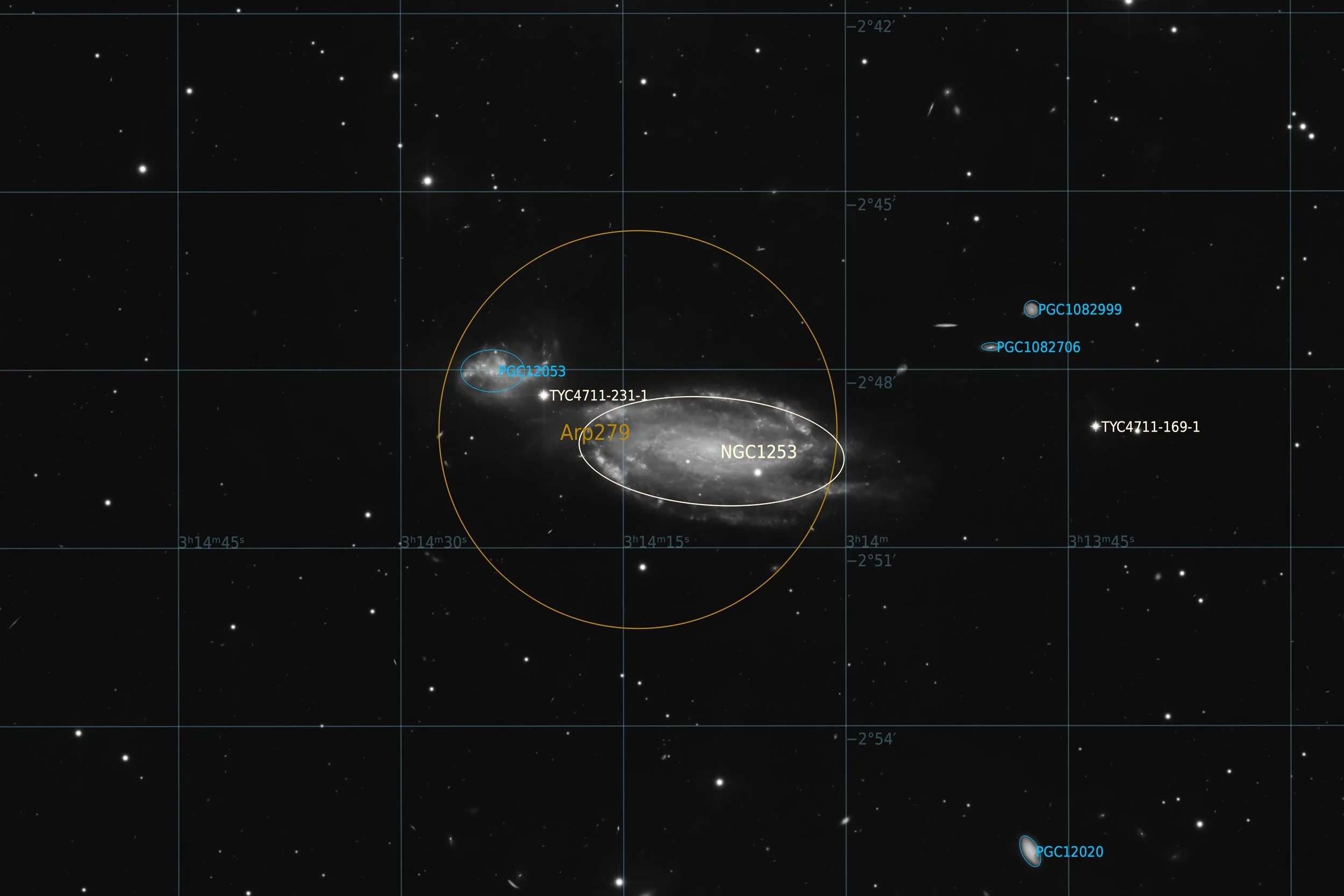
NGC 1253, NGC 1253A
22’ x 15’ | 0.3”/px | 4500 × 3000 px
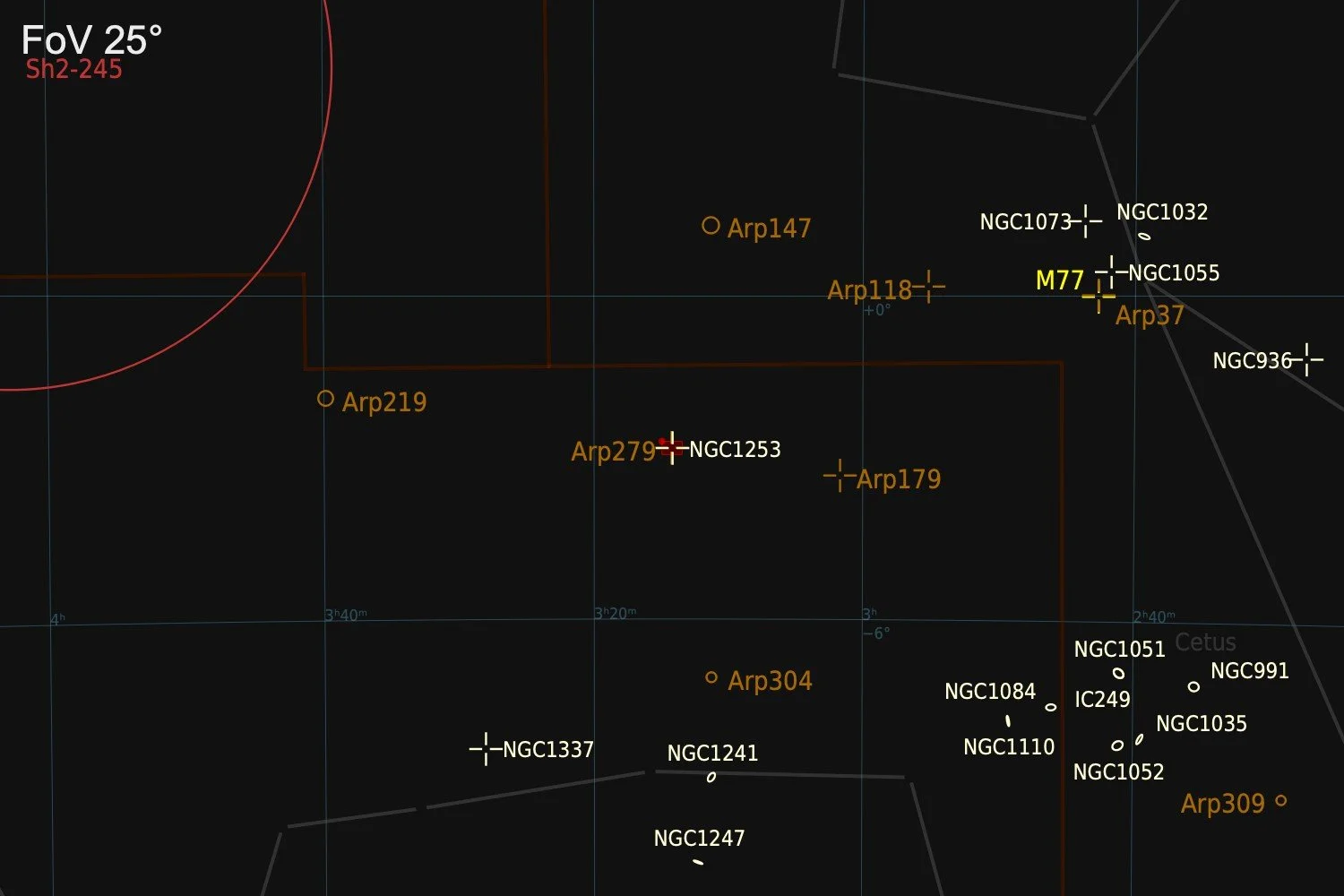
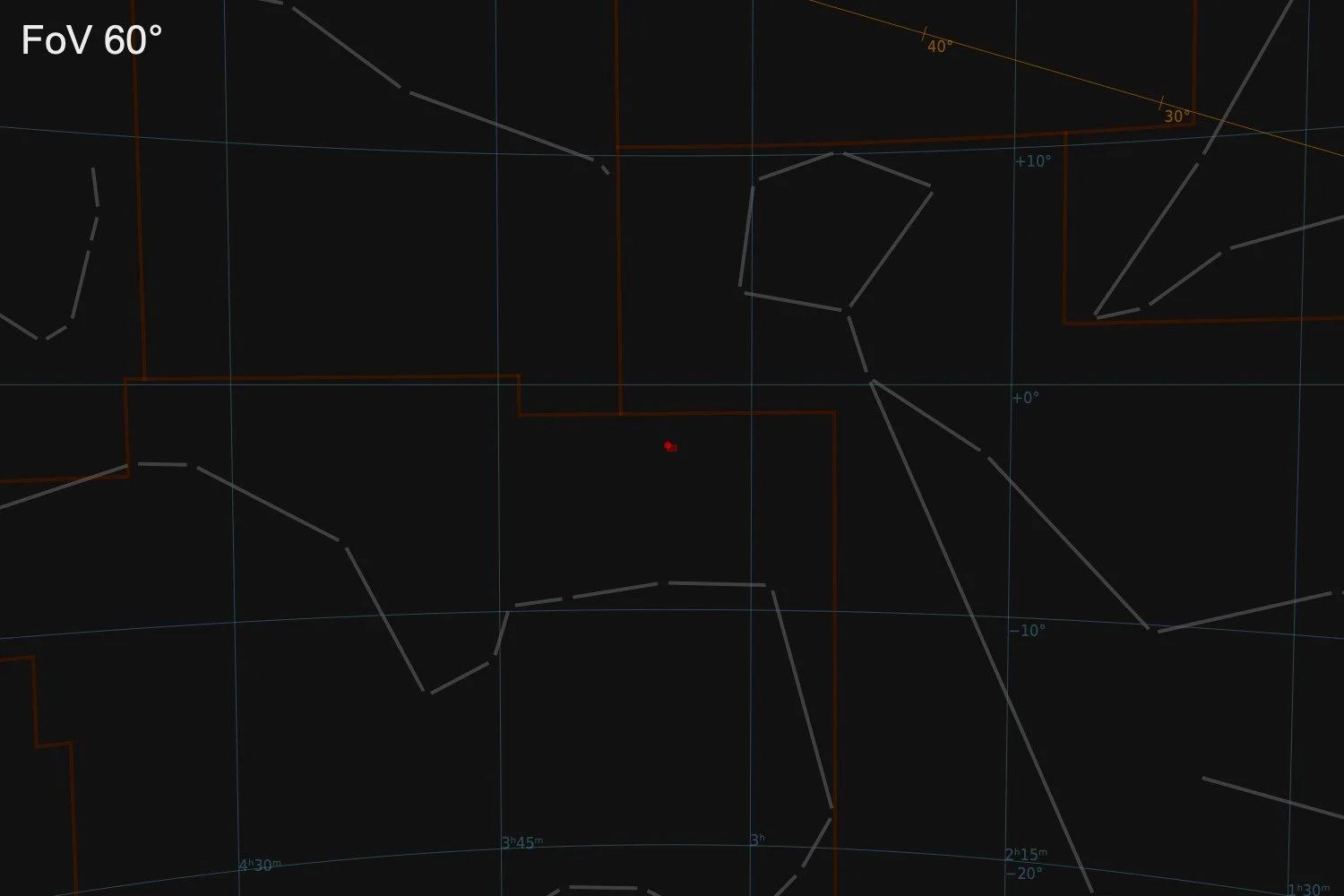
Eridanus
RA 3h 14m 12s Dec -2° 49’ 19” | 0°
Arp 279 is an interacting pair of galaxies in the constellation Eridanus, made up of the spiral galaxy NGC 1253 and its smaller companion NGC 1253A. NGC 1253 was discovered by William Herschel on 20 September 1784. The companion was not catalogued in the NGC, though it is often given the designation NGC 1253A. The system lies approximately 70 million light-years from Earth. NGC 1253 is a mixed spiral classified SAB(rs)cd, with an apparent size of about 5.2 by 2.3 arcminutes and a magnitude of around 11.7. This corresponds to a diameter of roughly 110,000 light-years, similar to the Milky Way. The companion is a much fainter Magellanic-type spiral of around magnitude 14, lying 3.7 arcminutes away, a projected distance of about 80,000 light-years. The interaction is the main point of interest. NGC 1253 has two prominent spiral arms, probably shaped by the encounter, which end in what looks like a ring of hydrogen gas. The largest HII regions in the galaxy lie along this ring. Radio observations show that the two galaxies share a common hydrogen envelope. A supermassive black hole of roughly 3 to 33 million solar masses is estimated to sit at the centre of NGC 1253.
The pair was included in Halton Arp’s 1966 Atlas of Peculiar Galaxies in the class “Double Galaxies: Interacting”.
Source: Claude.ai
Data Acquisition
Data was collected during 6 nights in September and October 2026, using a 14” reflector telescope with full-frame camera at the remote observatory in Spain. Data was gathered using standard LRGB filters. A total of approximately 18 hours of data was finally combined to create the final image.
Location Remote hosting facility Roboscopes in Fregenal de la Sierra, Spain (38°N 6°W)
Sessions
Frames
Equipment
Telescope
Mount
Camera
Filters
Guiding
Accessoires
Software
Planewave CDK14 (2563mm @ f/7.2), Optec Gemini Rotating focuser
10Micron GM2000HPS, custom pier
Moravian C3-61000 Pro (full frame), cooled to -10 ºC
Chroma 2” LRGB unmounted, Moravian filterwheel L, 7-position
Unguided
Compulab Tensor I-22, Dragonfly, Pegasus Ultimate Powerbox v2
Voyager Advanced, Viking, Mountwizzard4, Astroplanner, PixInsight 1.9.5
Processing
All processing was done in Pixsinsight unless stated otherwise. Default features were enhanced using scripts and tools from RC-Astro, SetiAstro, GraXpert, CosmicPhotons and others. Images were calibrated using 50 Darks, 50 Flats, and 50 Flat-Darks, registered and integrated using WeightedBatchPreProcessing (WBPP). The processing workflow diagram below outlines the steps taken to create the final image.
This was the first image processed on my new Mac Studio with M5 Ultra chip. As was already clear from extensive testing, this computer was a big step up from my Mac Pro from 2019. And indeed, it was an absolute joy to use, without any significant waiting time, or need to go and grab some coffee. The WBPP process took just over 12 minutes, 2.5 of which were due to me making decisions on which frames to include and which not.
Processing followed a very standard approach The outline below shows a detailed breakdown of the processing steps applied to the image.
Processing workflow (click to enlarge)
This image has been published on Astrobin.