Comet C/2025 R3 (PANSTARRS)
C/2025 R3 (panstarrs)
4° 22’ x 5° 41’ | 2.8”/px | 5563 × 7244 px | full resolution
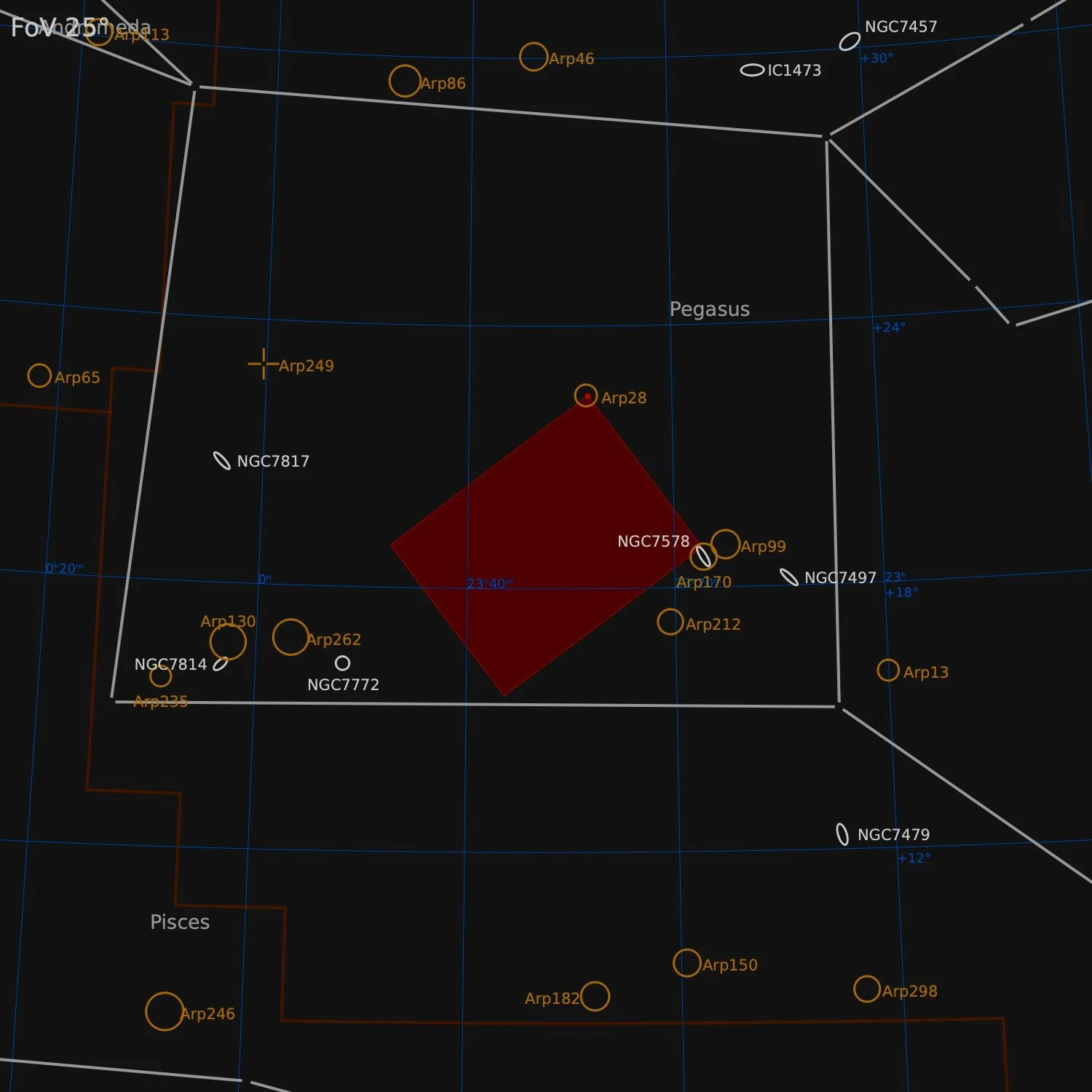
Pegasus
RA 23h 32m 25s Dec +18° 58’ 54” | -53°
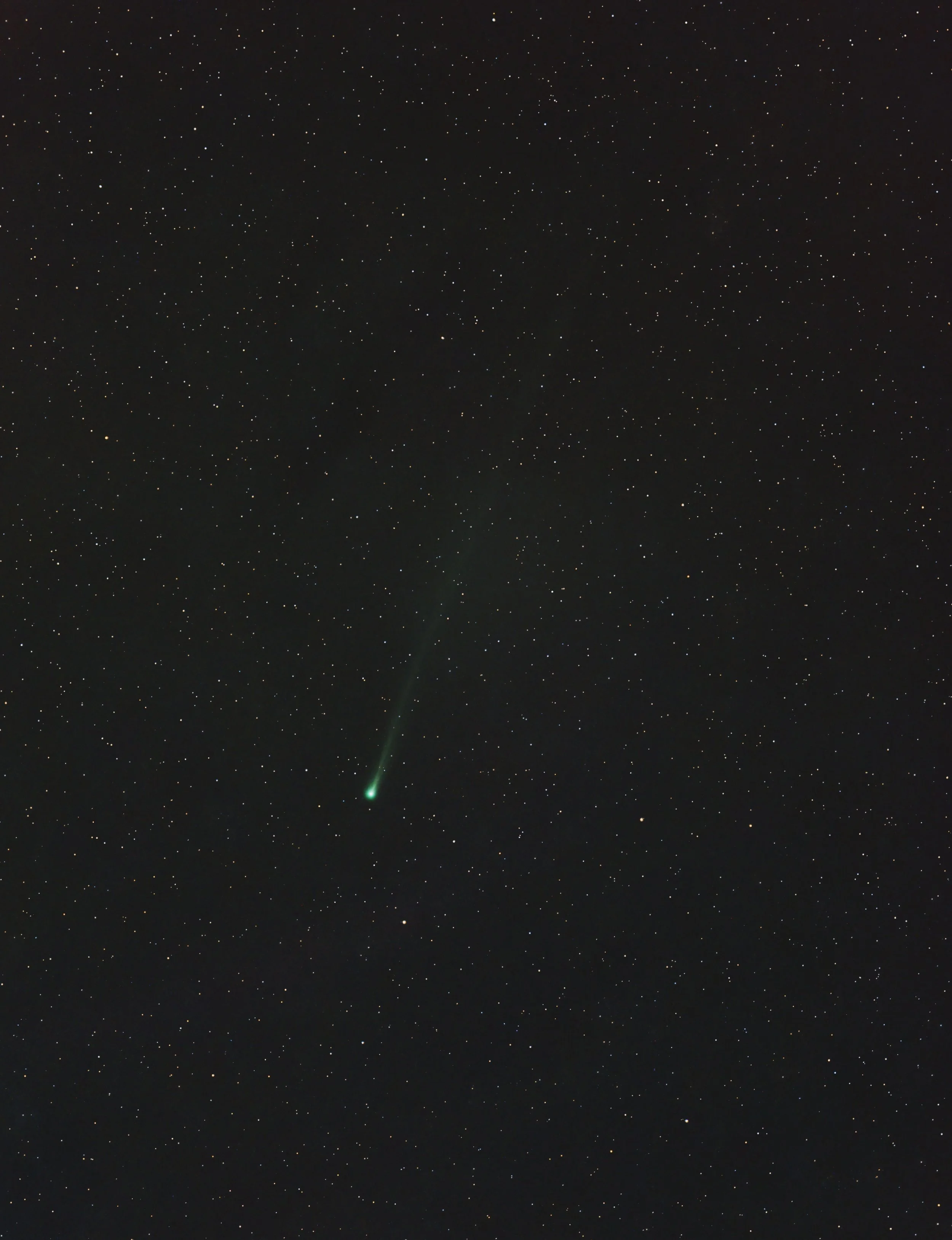
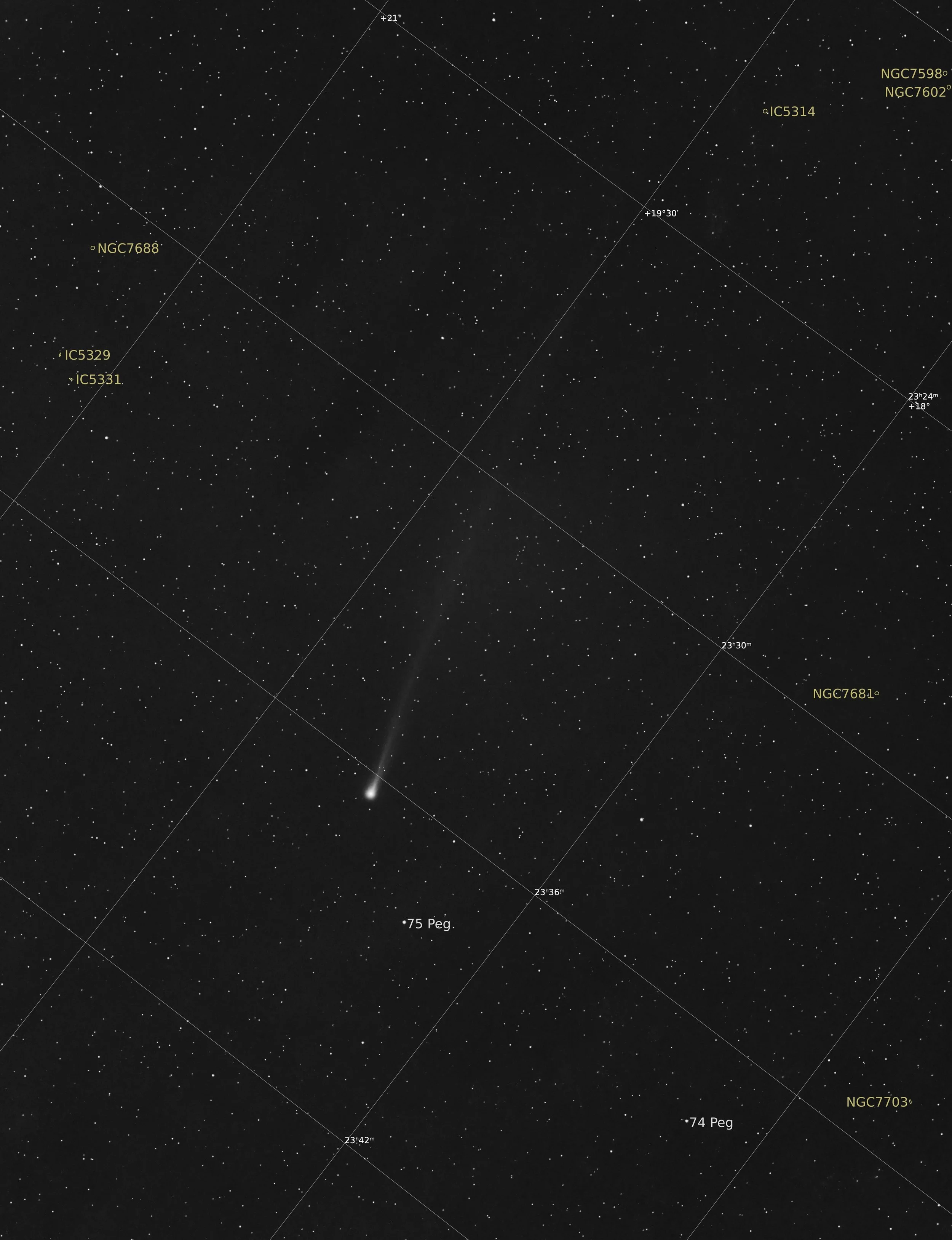
C/2025 R3 (PanSTARRS) is a hyperbolic comet originating from the Oort Cloud, discovered on 8 September 2025 in images taken by the 1.8-metre Ritchey-Chrétien telescope at Haleakala, Hawaii, as part of the Panoramic Survey Telescope and Rapid Response System (PanSTARRS) survey. At the time of discovery the comet was at a distance of 3.60 AU from the Sun and showed only a diffuse, 2.5-arcsecond coma with no visible tail, with an apparent magnitude of around 20. The comet reached perihelion on 19 April 2026, passing approximately 0.499 AU (74.6 million kilometres) from the Sun. Around perihelion it brightened to an estimated magnitude of 3.5 to 5, placing it within naked-eye reach from dark sky locations, though its low elevation above the horizon limited practical observing from northern latitudes. Its ion tail was measured at least 7 degrees in length in photographs taken in early April. Closest approach to Earth occurs on 26 April 2026, at a distance of 0.489 AU (73.2 million kilometres).
The comet is classified as hyperbolic, meaning its trajectory is not gravitationally bound to the Solar System. Its future outbound path will result in ejection from the Solar System entirely. Astronomers estimate it was likely formed near Saturn or Uranus in the early Solar System before being scattered into the Oort Cloud, where it remained for billions of years before beginning its inward journey approximately 160,000 years ago. The nucleus is estimated to be less than one kilometre in diameter.
Currently located in the constellation Pegasus near the Great Square asterism, the comet is best positioned for northern hemisphere observers in the pre-dawn sky through mid-April, after which southern hemisphere observers gain the better viewing window into early May.
Source: Claude.ai
Just as I was completing a series of comet images, I noticed that the moon was just rising as well. A waning crescent moon with only about 5% illumination, just above the sea where several boats were sailing, shown by the bright dots on the horizon line. The Earthshine is very nicely visible, while the small crescent is over-exposed.
Data Acquisition
Data was collected in the morning of 15 April 2026, using a regular mirrorless camera with tele-zoom objective mounted on a fixed tripod, from the roof of an apartment building in Spain. Data was gathered without any filters. A total of approximately 1 minute of data was finally combined to create the final image. Imaging started just after the comet appeared in the East, at around 05:15 and finished by about 06:30 when the sun started to illuminate the eastern horizon too much. Finding the comet was quite the challenge. While the view to the eastern horizon was unobstructed, there was a fully illuminated pier just underneath the place where the comet rose above the horizon. So the comet was not visible with the naked eye, and finding it in the camera took some time. Further testing the best exposure and ISO settings as well as precise focusing all took some time. When all was done, several series of images were shot, typically of 60-80 images each, in both landscape and portrait mode. The serie in which the comet was best visible was then used for processing and is presented here. Besides the light images, also a serie of 15 dark frames were shot. No flat frames were shot for this session.
Location Rooftop of an apartment building in Torrevieja, Spain (38°N 1°W)
Sessions
Frames
Equipment
Nothing of this shoot was planned beforehand. During a short holiday in Spain, following the move of my remote rig from one hosting site to another, it became apparent that this comet would be visible in the early morning hours. I had no tracker with me, only a longish telephoto lens, a regular mirrorless camera and a tripod. At the focal length of 280mm, exposures are limited to 1s. Anything longer and star elongation would become pretty visible.
Telescope
Mount
Camera
Filters
Guiding
Accessoires
Software
Leica APO-Vario-Elmarit-SL 90-280mm f/2.8-4 @ 280mm f/4.0
Gitzo Traveller tripod GK2545T-82QD
Leica SL3
n.a.
Unguided
n.a.
Capture One 16, PixInsight 1.9.3
Processing
All photos were loaded into CaptureOne, but not processed in any way. The series of shots were judged based on best visibility of the comet. The best serie was then loaded into PixInsight for processing. Images were calibrated (15 darks), debayered, registered and integrated using the WeightedBatchPreProcessing (WBPP). No specific precautions were taken for the movement of the comet itself. With 80 exposures of 1s each, the total time bracket of the series was just a few minutes. It was assumed that the movement of the comet during that time was too small to affect the image. Because of the low resolution of 2.8"/px also a 2x drizzle integration was performed. Follow up processing was done on the drizzled image and at the end downsized to the original resolution again.
The processing of the 2x drizzled image used a fairly standard approach and is outlined below. A few special aspects of the processing included the following.
At first I could not get a good plate-solve, so color calibration was done the old-fashioned way using the ColorCalibration tool. During star removal, the nucleus of the comet was also removed as if it were a star. Therefore a little mask was created to protect the comet from being extracted, using the method as described here.
Processing workflow (click to enlarge)
Overall there is nothing really special about this image. It is not a great recording by any means. Much better results would have been obtained by longer exposures on a tracking mount of some sort, as well as a longer focal length lens/telescope. But this was what I had available at the time, and any picture is still better than no picture.
This image has not been published on Astrobin.