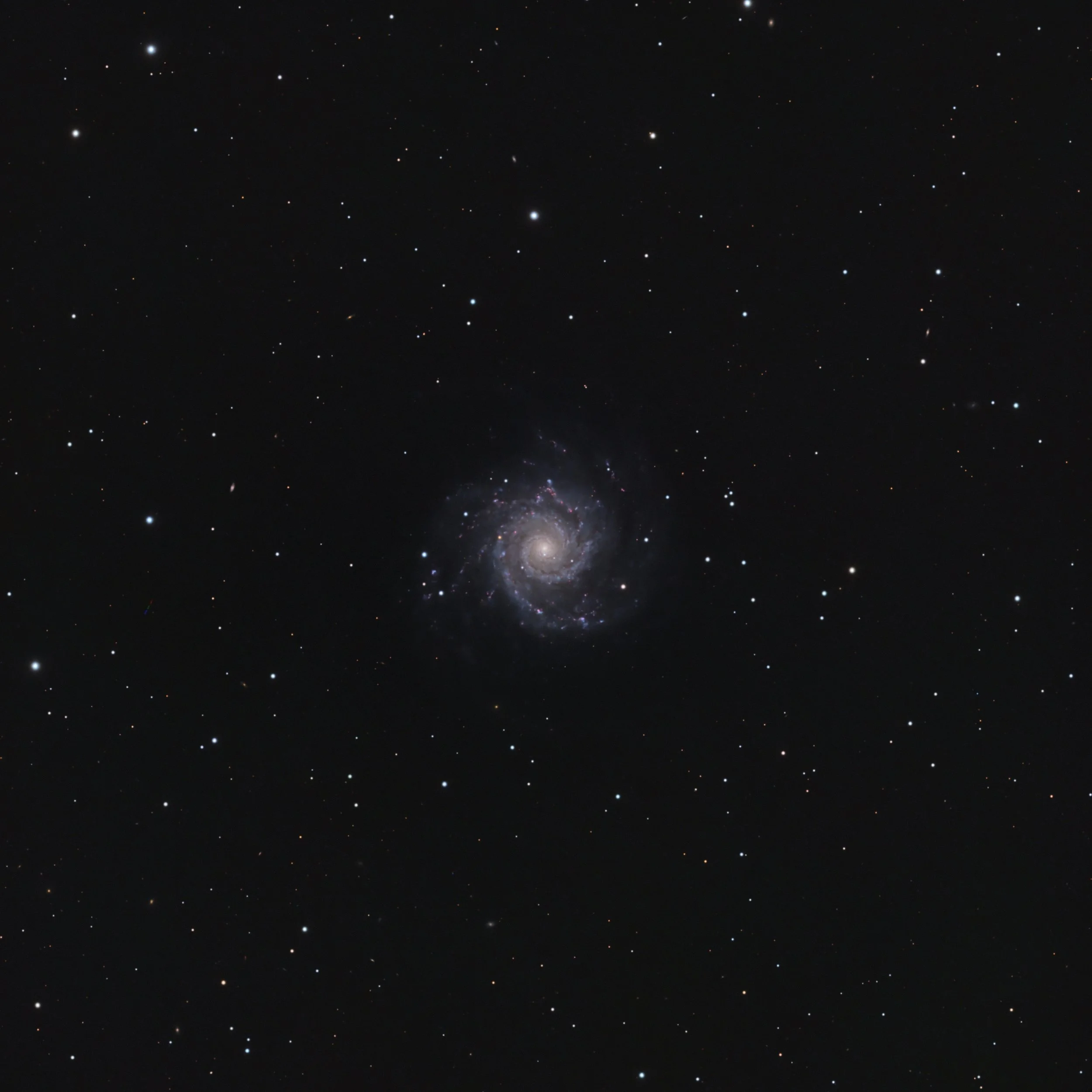
NGC 628, Phantom Galaxy
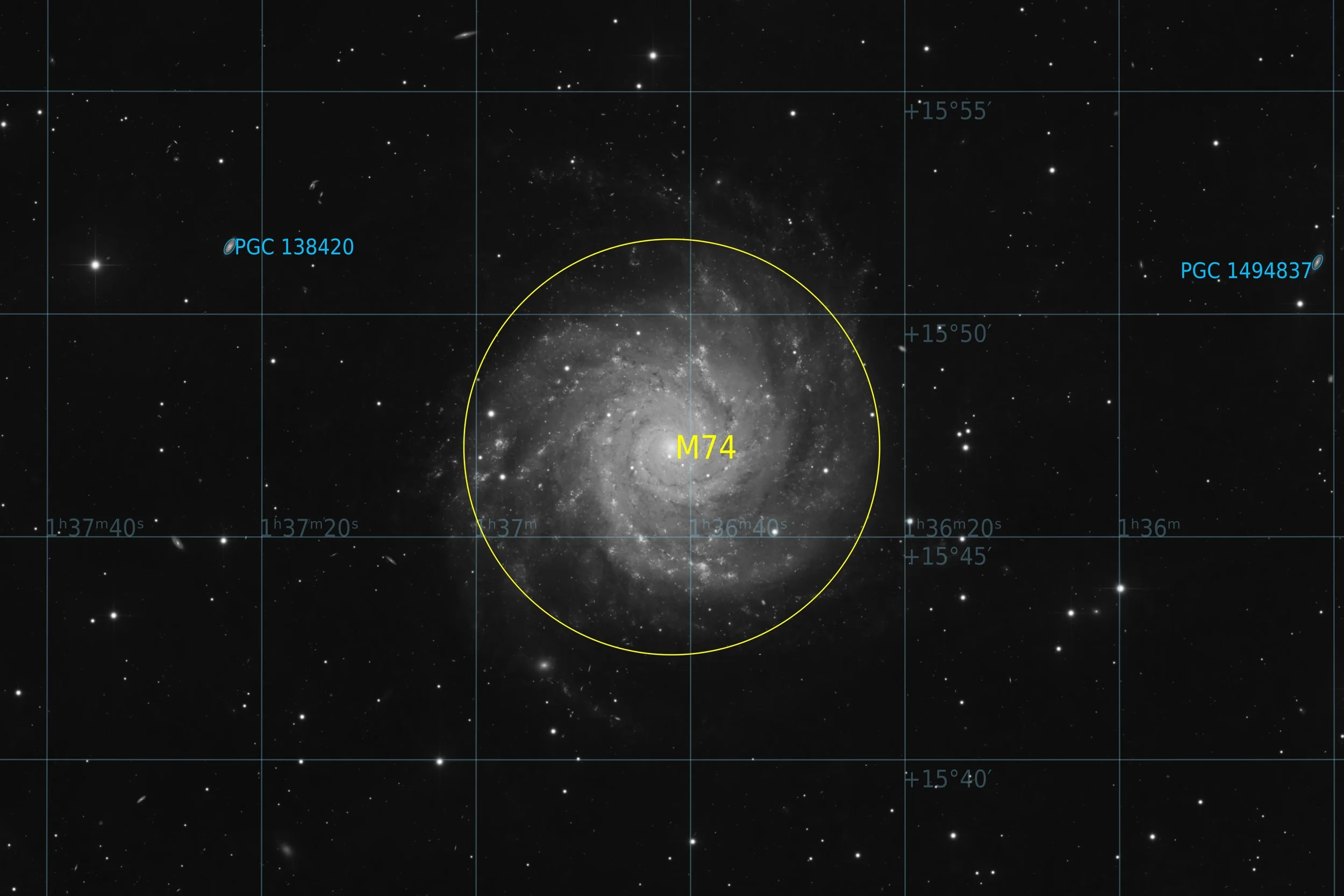
30’ x 20’ | 0.3”/px | 6000 × 4000 px
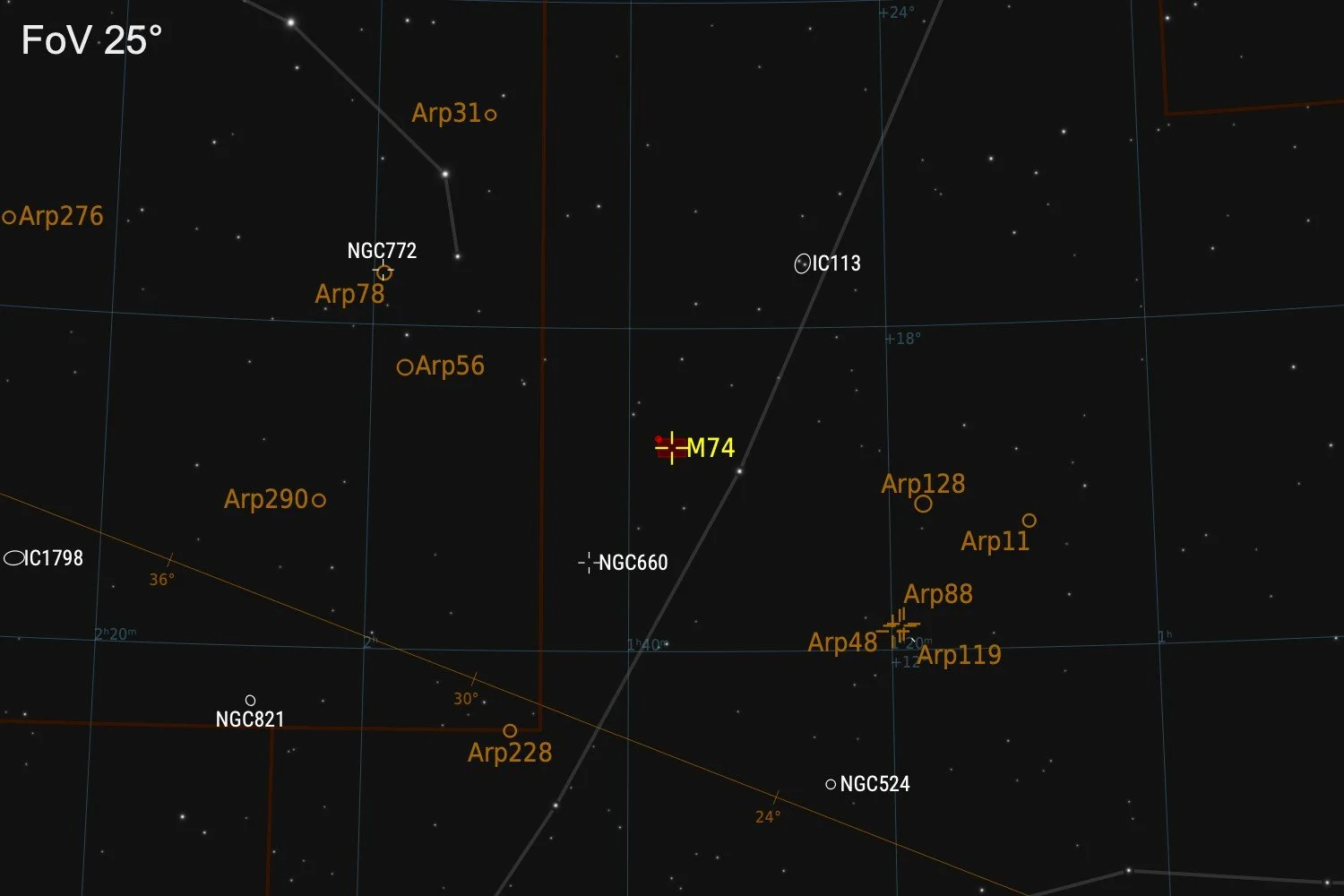
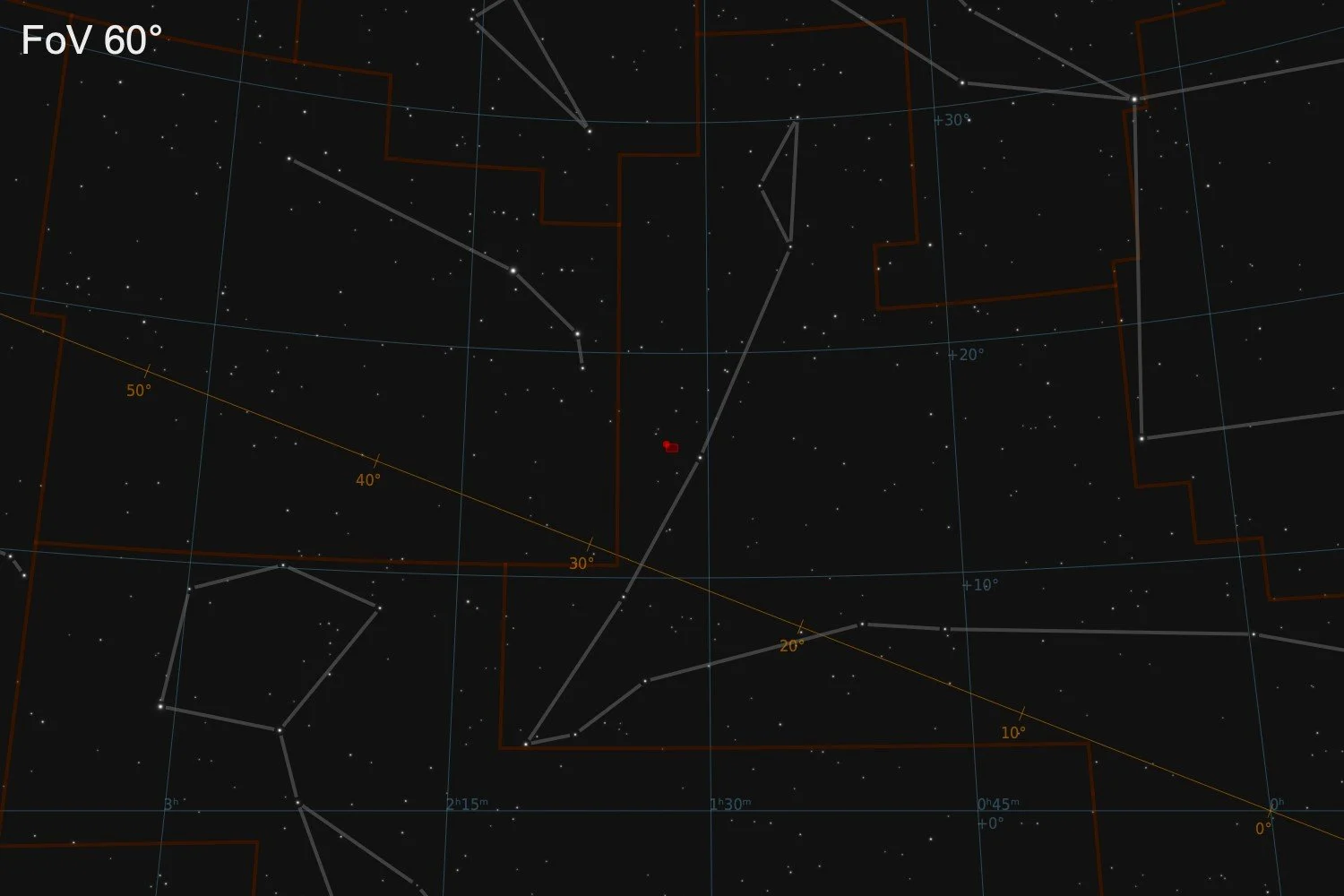
Pisces
RA 1h 36m 42s Dec +15° 47’ 00” | 0°
Messier 74, also known as NGC 628, is a face-on spiral galaxy in the constellation Pisces. It is popularly known as the Phantom Galaxy. Pierre Méchain discovered it in September 1780 and passed the find to Charles Messier, who catalogued it as number 74 that October. M74 lies about 32 million light-years from Earth and spans roughly 95,000 light-years, making it a little smaller than the Milky Way. It contains an estimated 100 billion stars and has an apparent size of about 10.5 by 9.5 arcminutes. Its total magnitude is around 9.4, but the light is spread over such a wide area that it has one of the lowest surface brightnesses in the Messier catalogue. This explains the nickname, since it is notoriously hard to see through a telescope. It is the brightest member of the M74 Group, a small collection of galaxies that includes the peculiar spiral NGC 660. The galaxy is considered a textbook grand-design spiral, with two well-defined arms winding out from a small bright nucleus. Its face-on orientation makes it a favourite for studying spiral structure and star formation. Pink HII regions and young blue star clusters trace the arms, together with dust lanes that start close to the nucleus. M74 has hosted three supernovae. These include SN 2002ap, a rare Type Ic event, and SN 2003gd, a Type II whose progenitor red supergiant was identified in earlier images and which was used to measure the galaxy’s distance. In 2005 the Chandra X-ray Observatory also found an ultraluminous X-ray source, which may point to an intermediate-mass black hole.
Source: Claude.ai
Data Acquisition
Data was collected during 9 nights in September and October 2026, using a 14” reflector telescope with full-frame camera at the remote observatory in Spain. Data was gathered using standard LRGB filters. To bring out the distinct areas of star formation, an additional set of images was taken using a Ha-filter. A total of approximately 27 hours of data was finally combined to create the final image. This target was photographed before in 2022. But as I am working towards completing the whole Messier catalogue, the old recording was of fairly low quality, and I decided that such a beautiful target would deserve a better version in my final list. So I photographed it again with a better imaging setup and using better processing skills.
Location Remote hosting facility Roboscopes in Fregenal de la Sierra, Spain (38°N 6°W)
Sessions
| Object | Session | Moon% | Moon ° | SQM | Hum % | Temp °C | Frames | Exposure |
|---|---|---|---|---|---|---|---|---|
| M74 | 2026-09-11 | 0 | 148 | 21.5 | 39 | 20 | 30 | 1h 30m |
| 2026-09-12 | 3 | 162 | 21.5 | 40 | 22 | 29 | 1h 45m | |
| 2026-09-13 | 14 | 175 | 21.5 | 41 | 22 | 71 | 5h 48m | |
| 2026-09-14 | 14 | 173 | 21.5 | 40 | 23 | 38 | 3h 46m | |
| 2026-09-17 | 49 | 136 | 21.3 | 42 | 18 | 45 | 2h 43m | |
| 2026-09-18 | 59 | 124 | 21.3 | 38 | 19 | 55 | 5h 30m | |
| 2026-09-19 | 58 | 112 | 21.3 | 54 | 19 | 63 | 3h 39m | |
| 2026-09-21 | 76 | 88 | 20.0 | 47 | 21 | 23 | 2h 40m | |
| 2026-10-04 | 37 | 89 | 21.1 | 66 | 20 | 2 | 0h 20m | |
| Grand Total | 356 | 27h 41m | ||||||
Frames
| Object | Filter | Sensor °C | Bin | Gain | Exp (s) | Frames | Exposure |
|---|---|---|---|---|---|---|---|
| M74 | Chroma Luminance | -10 | 1 | 0 | 180 | 192 | 9h 36m |
| Chroma Red | -10 | 1 | 0 | 300 | 38 | 3h 10m | |
| Chroma Blue | -10 | 1 | 0 | 300 | 37 | 3h 5m | |
| Chroma Green | -10 | 1 | 0 | 300 | 36 | 3h 0m | |
| Chroma Ha - 3nm | -10 | 1 | 2750 | 600 | 53 | 8h 50m | |
| Grand Total | 356 | 27h 41m | |||||
Equipment
Telescope
Mount
Camera
Filters
Guiding
Accessoires
Software
Planewave CDK14 (2563mm @ f/7.2), Optec Gemini Rotating focuser
10Micron GM2000HPS, custom pier
Moravian C3-61000 Pro (full frame), cooled to -10 ºC
Chroma 2” LRGB and Ha (3nm) unmounted, Moravian filterwheel L, 7-position
Unguided
Compulab Tensor I-22, Dragonfly, Pegasus Ultimate Powerbox v2
Voyager Advanced, Viking, Mountwizzard4, Astroplanner, PixInsight 1.9.6
Processing
All processing was done in Pixsinsight unless stated otherwise. Default features were enhanced using scripts and tools from RC-Astro, SetiAstro, GraXpert, CosmicPhotons and others. Images were calibrated using 50 Darks, 50 Flats, and 50 Flat-Darks, registered and integrated using WeightedBatchPreProcessing (WBPP). The processing workflow diagram below outlines the steps taken to create the final image.
When applying StarXTerminator (SXT) for star removal, it took out a lot of small structures from the galaxy, that were not stars. This can happen more often, and the typical method to prevent this from happening is to run SXT, see which areas are removed incorrectly, make a mask covering those areas, and then re-do SXT but now with that mask in place. Making that mask was typically done using a method originally developed by Adam Block and described in detail here. But the Dodge & Burn tool from the Lighthouse suite also has a mask creation tool in it. And the process is a lot easier. It starts with the same stars-only image that includes the artefacts. Using a white paint tool, all incorrectly removed areas are painted white. The paintbrush gives a semi-transparent white, so it is easy to see what is included and what is not. When pressing the button ‘Create Mask’, a new image is created where the paint is 100% white, including feathering on the edges. While it still a painstakingly detailed process, the Dodge & Burn tool makes it as easy as it gets.
To blend in the Ha data representing active star forming regions, the continuum subtraction technique was applied as described in detail here. It is amazing how simple this process works and how well the results are that come out. The combination of the dedicated Continuum Subtraction tool from SetiAstro and the ImageBlend tool from Cosmic Photons work very nicely together here for great results.
There are a lot of steps involved in the processing, but in the end it is a fairly straightforward workflow, with many fairly standard steps. The outline below shows a detailed breakdown of all the processing steps applied to the image.
Processing workflow (click to enlarge)
This image has been published on Astrobin.