Sh2-157
Lobster Claw Nebula
1d 55’ x 1d 14’ | 0.78”/px | 8890 × 5702 px | full resolution
Cassiopeia
RA 23h 15m 35s Dec +60° 06’ 46” | -85°
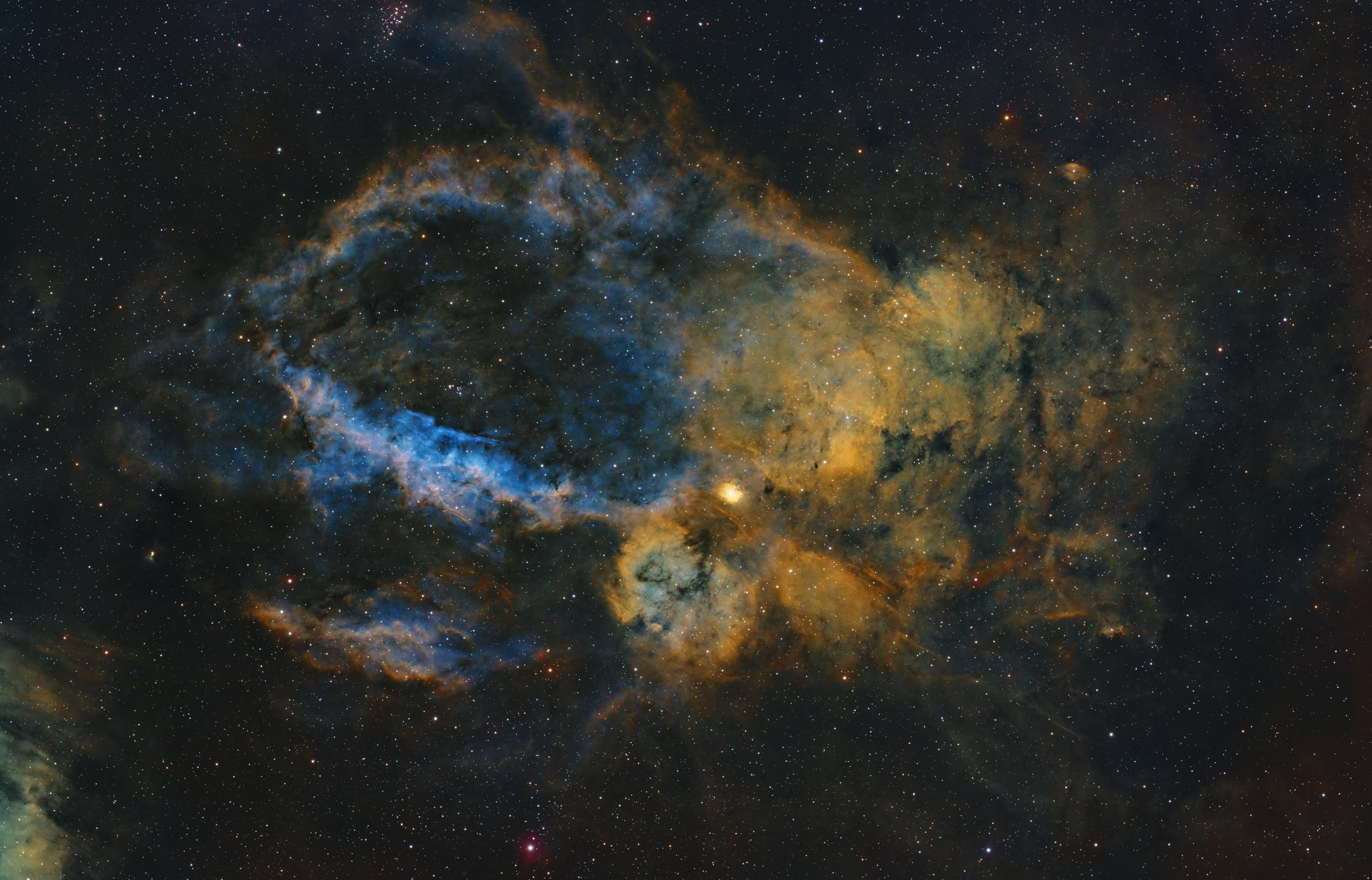
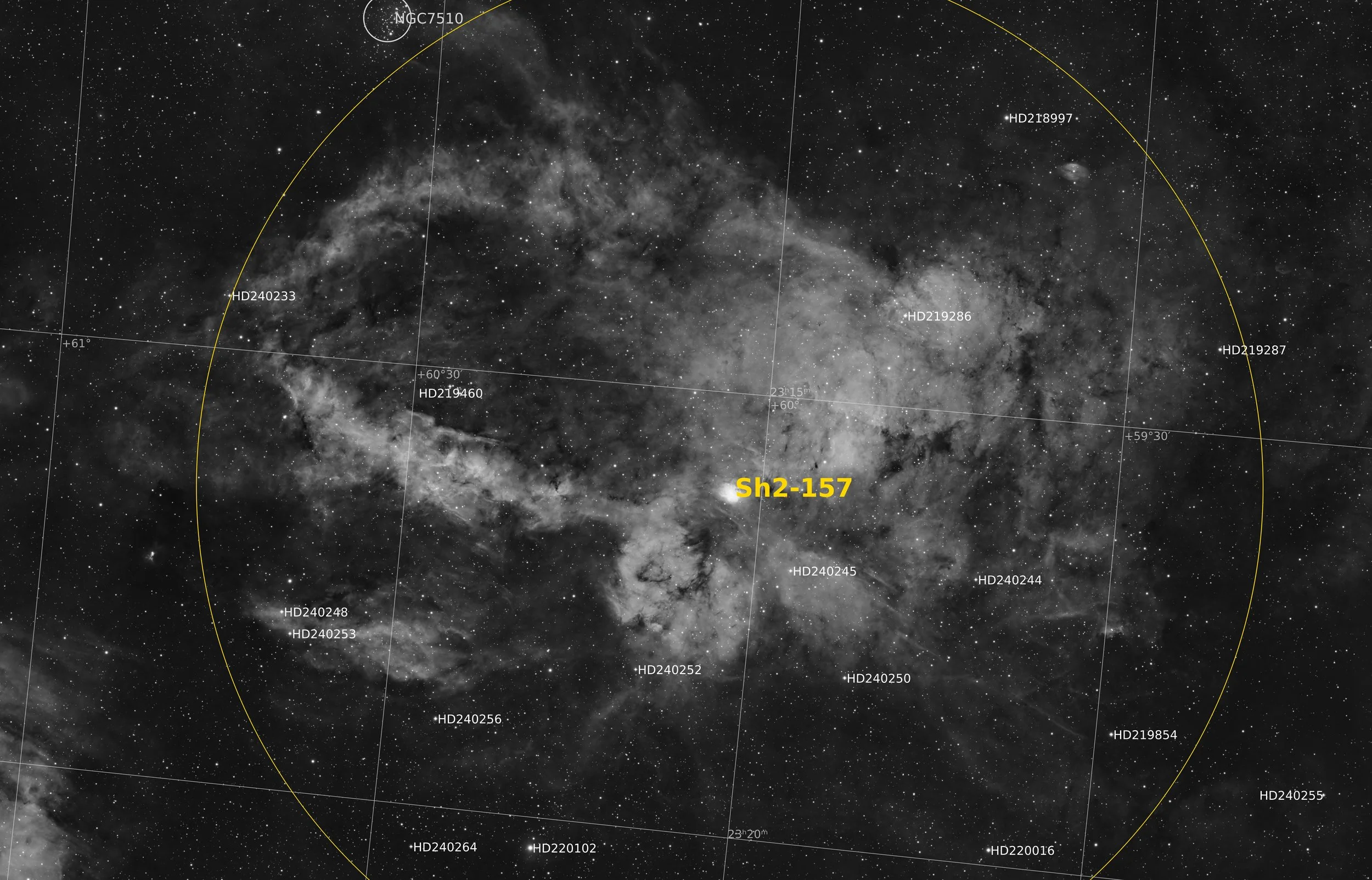
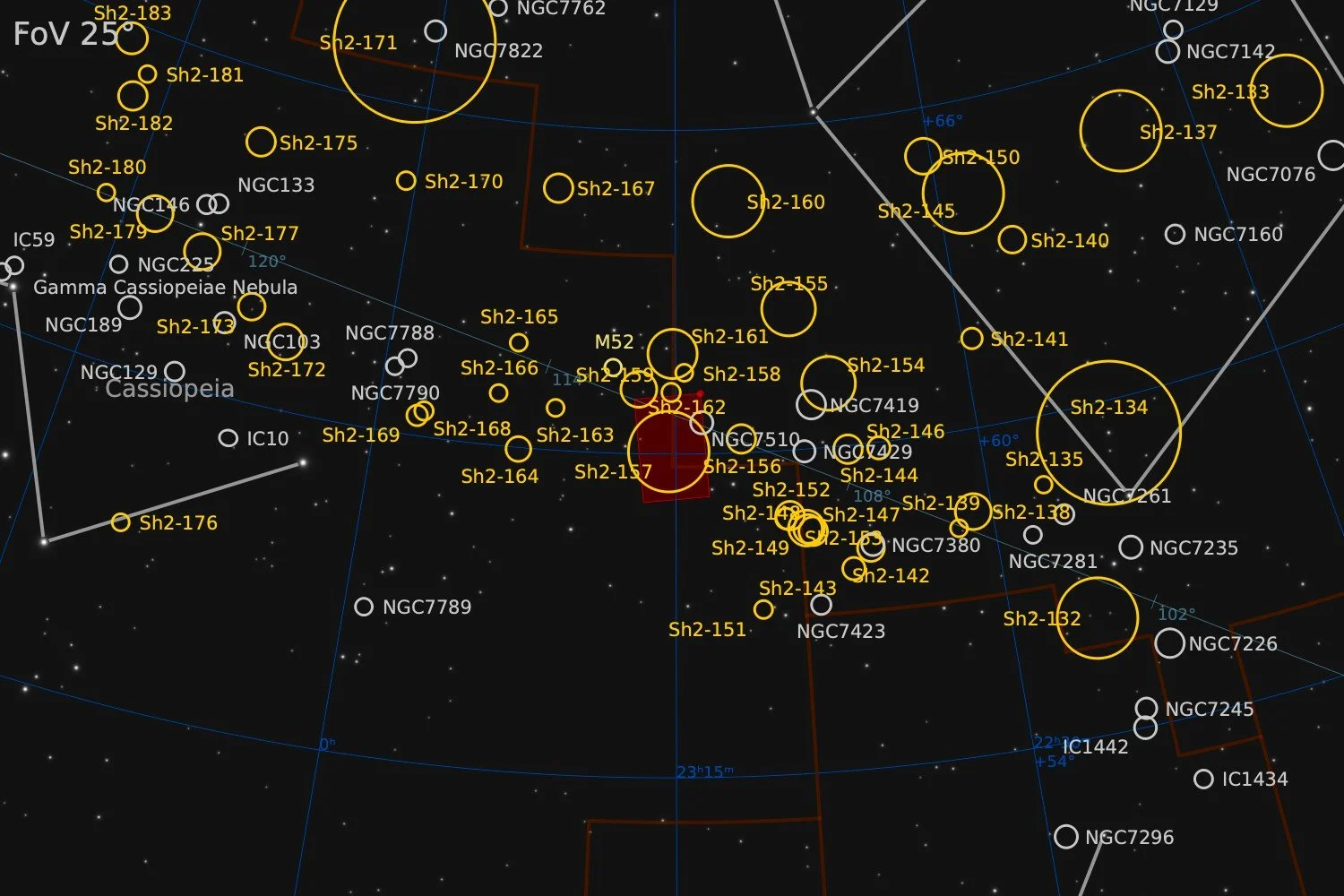
Sharpless 157 (Sh2-157) is a large but faint emission nebula located on the border of the constellations Cassiopeia and Cepheus, approximately 8,000 to 11,000 light-years from Earth. It is also popularly known as the Lobster Claw Nebula due to its distinctive shape, which features a northern ring formed by stellar winds and a southern sector excited by the radiation of massive O-type stars. Located in the Perseus Arm of our galaxy, Sh2-157 is directly associated with the large Cassiopeia OB2 association, a group of hot, massive stars . The nebula is a vibrant star-forming region and contains within it the very young star cluster Markarian 50 (Mrk 50). This cluster includes the notable Wolf-Rayet star WR 157 (also known as HD 219460), an extremely hot and massive star in a late stage of evolution . The region is complex, with compact nebulous components catalogued as Sh2-157A and Sh2-157B, and is also home to protostars and starless cores, indicating active ongoing star formation .
source: Deepseek
Data Acquisition
Data was collected over 3 nights in early March2026 130mm refractor telescope with full-frame camera from the backyard in The Netherlands. Data were gathered in narrowband using Ha, OIII and SII filters with the intention to create a Hubble palette. No additional RGB data was collected for the stars. Several frames were lost due to some trees that were in the way around midnight. Autumn is a better time to photograph this object, but clear skies gaves an opportunity to photograph under unfavourable moonlight conditions, so a suitable narrowband object was chosen. A total of about 9 hours of data was combined to create the final image.
Location Backyard Observatory in Groningen, The Netherlands (53°N 6°E)
Sessions
Frames
Equipment
Already quite some time ago, Takahashi had updated the flattener used for the TOA series of telescopes. The former 67L flattener was designed with big sensor sizes in mind. The new TOA-645 flattener was designed primarily with ultimate performance in mind, while still able to generously cover a full-frame sensor. During a recent visit to Japan, I was able to purchase the TOA-645 flattener for a reasonable price and this is the first image taken with this new piece of equipment. The results were very good, with tiny round stars far into the corners. It would be interesting to do a head-to-head comparison one day.
Telescope
Mount
Camera
Filters
Guiding
Accessoires
Software
Takahashi TOA-130 (1000mm @ f/7.7), Pegasus Astro Motor Focus kit v2
10Micron GM1000HPS, EuroEMC S130 pier
ZWO ASI6200MM Pro, cooled to -15 ºC
Antlia 2” SII,Ha,OIII (3nm) unmounted, ZWO EFW 7-position
Unguided
Fitlet3, Pegasus Ultimate Powerbox v2, DeepSkyDad Flat panel, MBox
Linux Mint, KStars/Ekos, INDI Library, Mountwizzard4, PixInsight 1.9.3
Processing
All processing was done in Pixsinsight unless stated otherwise. Default features were enhanced using scripts and tools from RC-Astro, SetiAstro, GraXpert and others. Images were calibrated using 50 Darks, 50 Flats, and 50 Flat-Darks, registered, integrated and drizzled (2x) using WeightedBatchPreProcessing (WBPP). The processing workflow diagram below outlines the steps taken to create the final image.
For stretching the individual stacks, the Statistical Stretch tool from SetiAstro was used. Historically my experience was that it was a bit of a hit or miss with this tool. This time I took the effort to play a bit more with the various controls. Especially lowering the black point sigma and increasing the curves boost, while at the same time keeping the target median background on the lower side, resulted in some pretty decent results. Some small touch-ups using the CurvesTransformation tool put the individual channels in sufficient state to be combined and further processed using NarrowbandNormalisation. GHS offers a lot more flexibility and fine-tuned control. But on the other hand the StatisticalStretch tool was straightforward to use and gave good results.
When the image was in its final form, there was a bit of a blue hue in the background of the top-left corner. This was removed by creating a very selective mask for that specific blue hue, clonestamping all areas that should not be effected and reduce the background blue in the masked image.
The rest of the processing followed a pretty standard pattern.
Processing workflow (click to enlarge)
This image has been published on Astrobin.