M108
NGC 3556, Surfboard Galaxy
42’ x 27’ | 0.3”/px | 8528 × 5467 px | full resolution
Ursa Major
RA 11h 11m 32s Dec +55° 40’ 38” | 0°
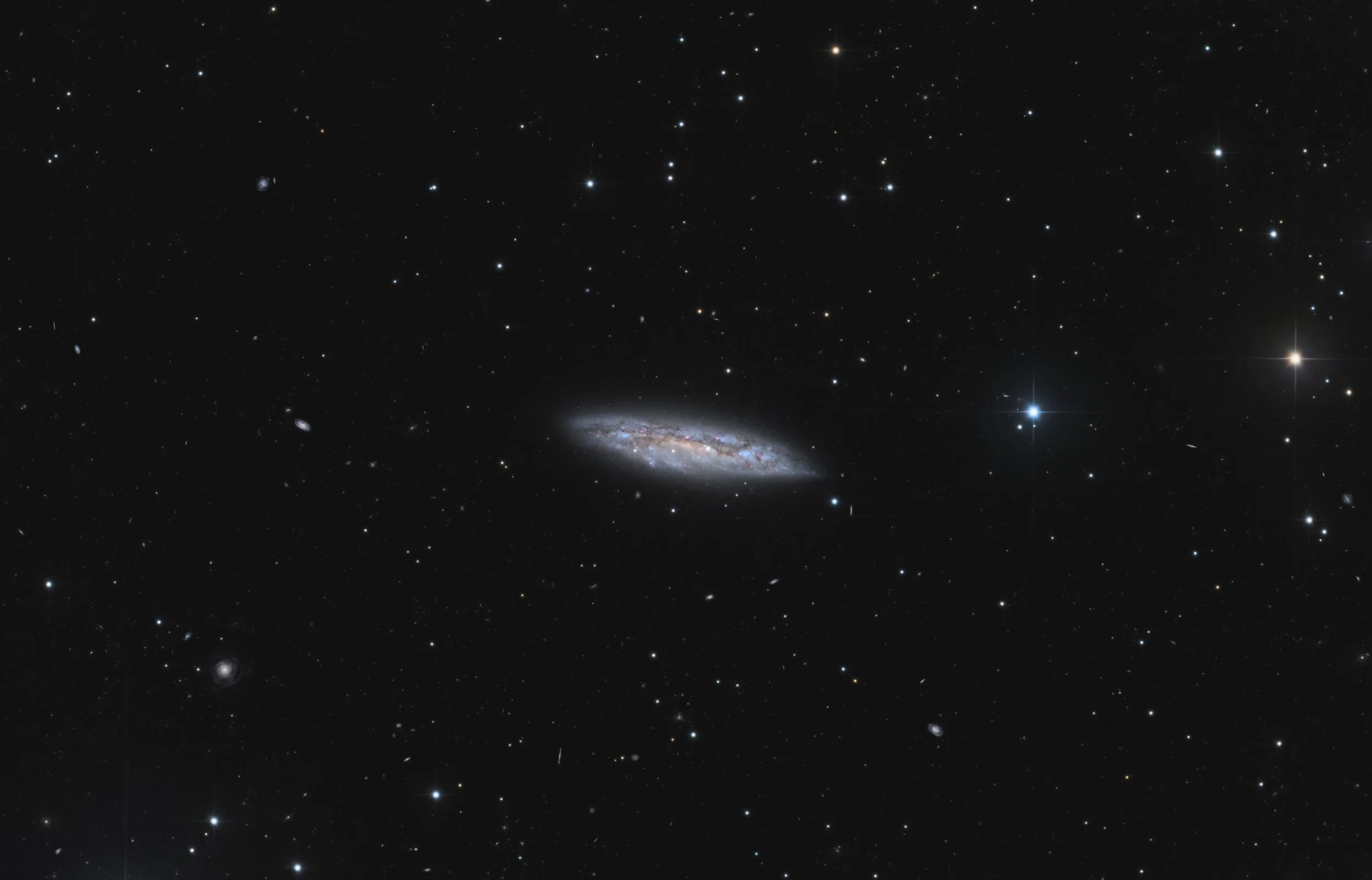
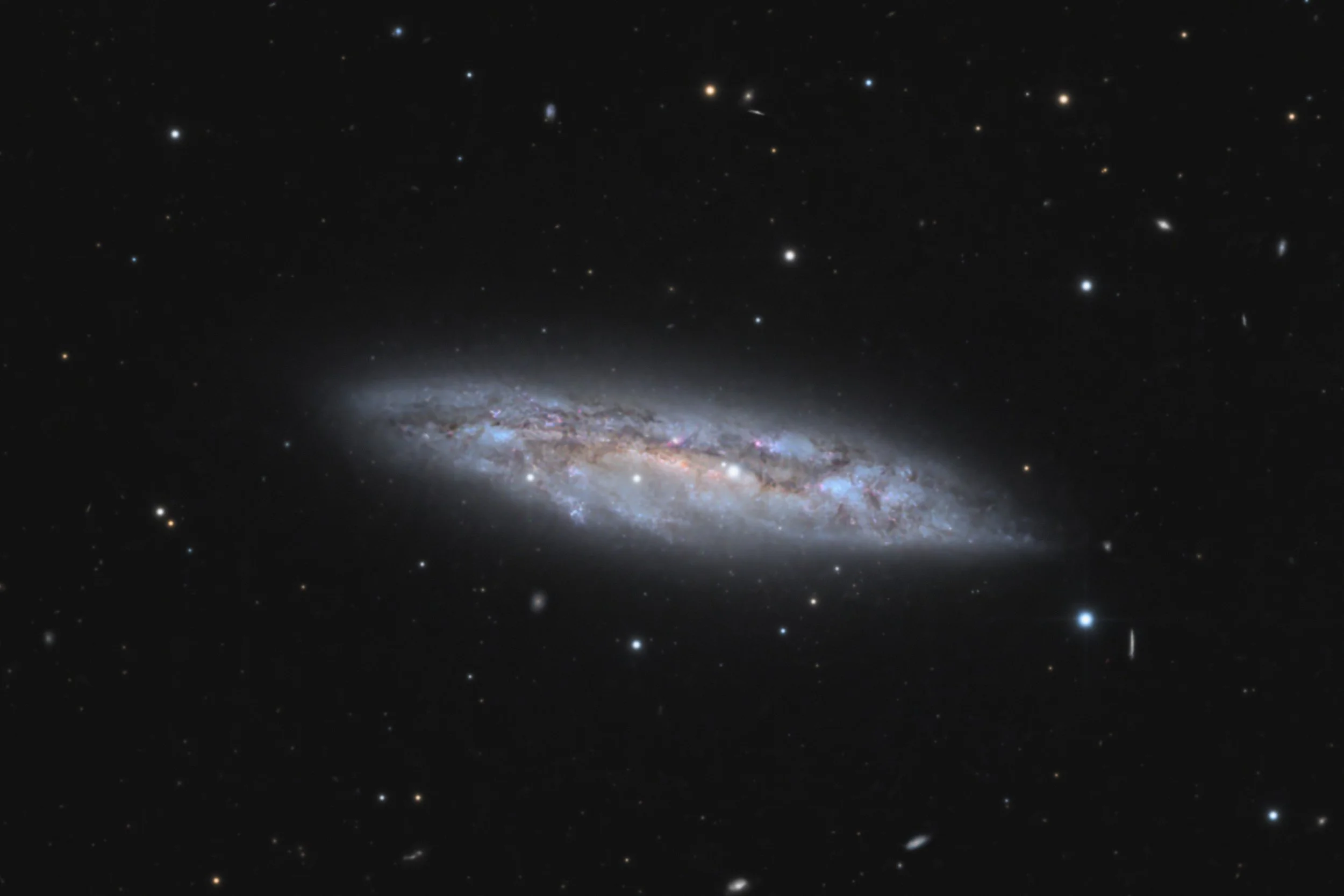
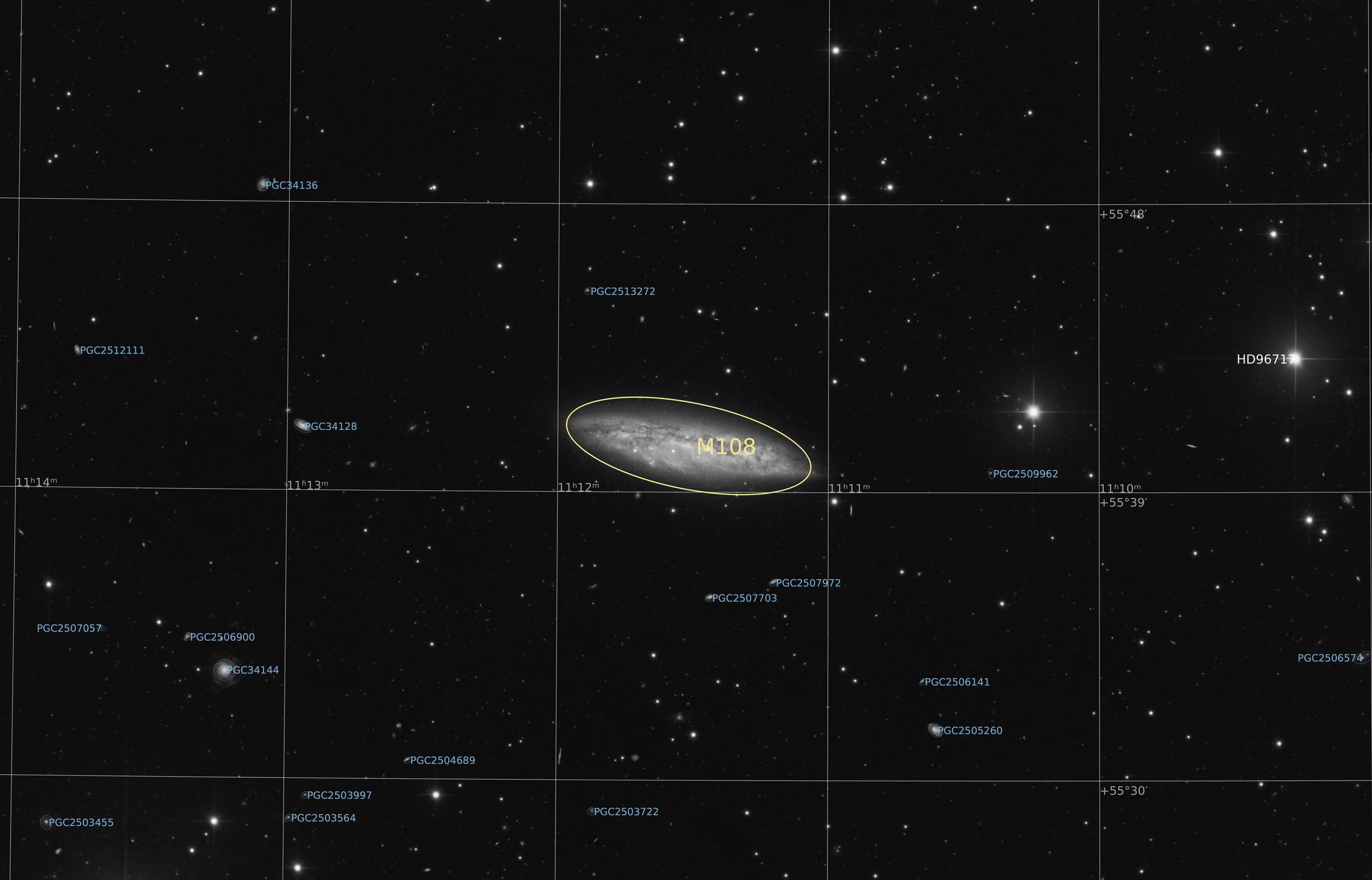
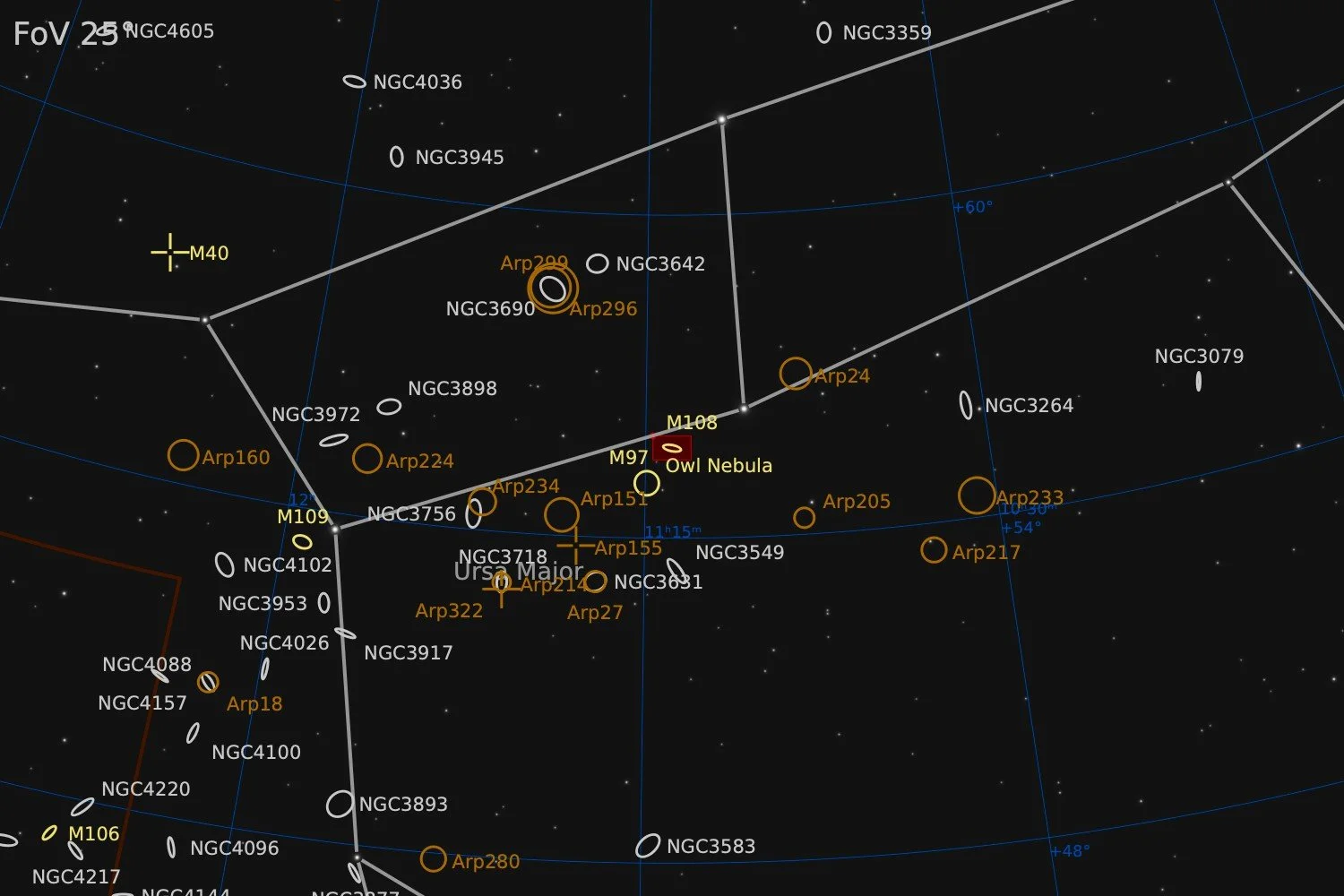
Messier 108, also known as NGC 3556 and nicknamed the Surfboard Galaxy, is a barred spiral galaxy about 46 million light-years away from Earth in the northern constellation Ursa Major. It was discovered by Pierre Méchain in 1781 or 1782. From the Earth, this galaxy is seen almost edge-on. This galaxy is an isolated member of the Ursa Major Cloud of galaxies in the local supercluster. It has a morphological classification of type SBbc in the ‘de Vaucouleurs’ system, which means it is a barred spiral galaxy with somewhat loosely wound arms. The maximum angular size of the galaxy in the optical band is 11′.1 × 4′.6, and it is inclined 75° to the line of sight.
This galaxy has an estimated mass of 125 billion solar masses and bears about 290 ± 80 globular clusters. Observations with the Chandra X-ray Observatory have identified 83 X-ray sources, including a source at the nucleus. The brightest of these is consistent with an intermediate-mass black hole accreting matter. The galaxy is also emitting a diffuse soft X-ray radiation within 2.6 arcminutes of the optical galaxy. The spectrum of the source at the core is consistent with an active galactic nucleus, but an examination with the Spitzer Space Telescope showed no indication of activity. The supermassive black hole at the core has an estimated mass of 24 million solar masses
Source: Wikipedia
Data Acquisition
Data was collected during 3 nights in February 2026, using a 14” reflector telescope with full-frame camera at the remote observatory in Spain. Data was gathered using standard LRGB filters. A total of approximately 13 hours of data was finally combined to create the final image.
Location Remote hosting facility IC Astronomy in Oria, Spain (37°N 2°W)
Sessions
Frames
Equipment
Telescope
Mount
Camera
Filters
Guiding
Accessoires
Software
Planewave CDK14 (2563mm @ f/7.2), Optec Gemini Rotating focuser
10Micron GM2000HPS, custom pier
Moravian C3-61000 Pro (full frame), cooled to -10 ºC
Chroma 2” LRGB unmounted, Moravian filterwheel L, 7-position
Unguided
Compulab Tensor I-22, Dragonfly, Pegasus Ultimate Powerbox v2
Voyager Advanced, Viking, Mountwizzard4, Astroplanner, PixInsight 1.9.3
Processing
All processing was done in Pixsinsight unless stated otherwise. Default features were enhanced using scripts and tools from RC-Astro, SetiAstro, GraXpert, CosmicPhotons and others. Images were calibrated using 50 Darks, 50 Flats, and 50 Flat-Darks, registered and integrated using WeightedBatchPreProcessing (WBPP). The processing workflow diagram below outlines the steps taken to create the final image.
When removing stars from the RGB image, some small parts in and around the core of the galaxy were taken out as if they were stars. A mask was created using the methodology described before. Now a pure star extraction could be done on the RGB image.
There were no further peculiarities and the rest of the processing used a fairly standard approach, outlined below.
Processing workflow (click to enlarge)
This image has been published on Astrobin.