Sh2-231 | Sh2-233 | Sh2-235
47’ x 31’ | 0.3”/px | 9415 × 6220 px | full resolution
Auriga
RA 05h 39m 55s Dec +35° 52’ 39” | -15°
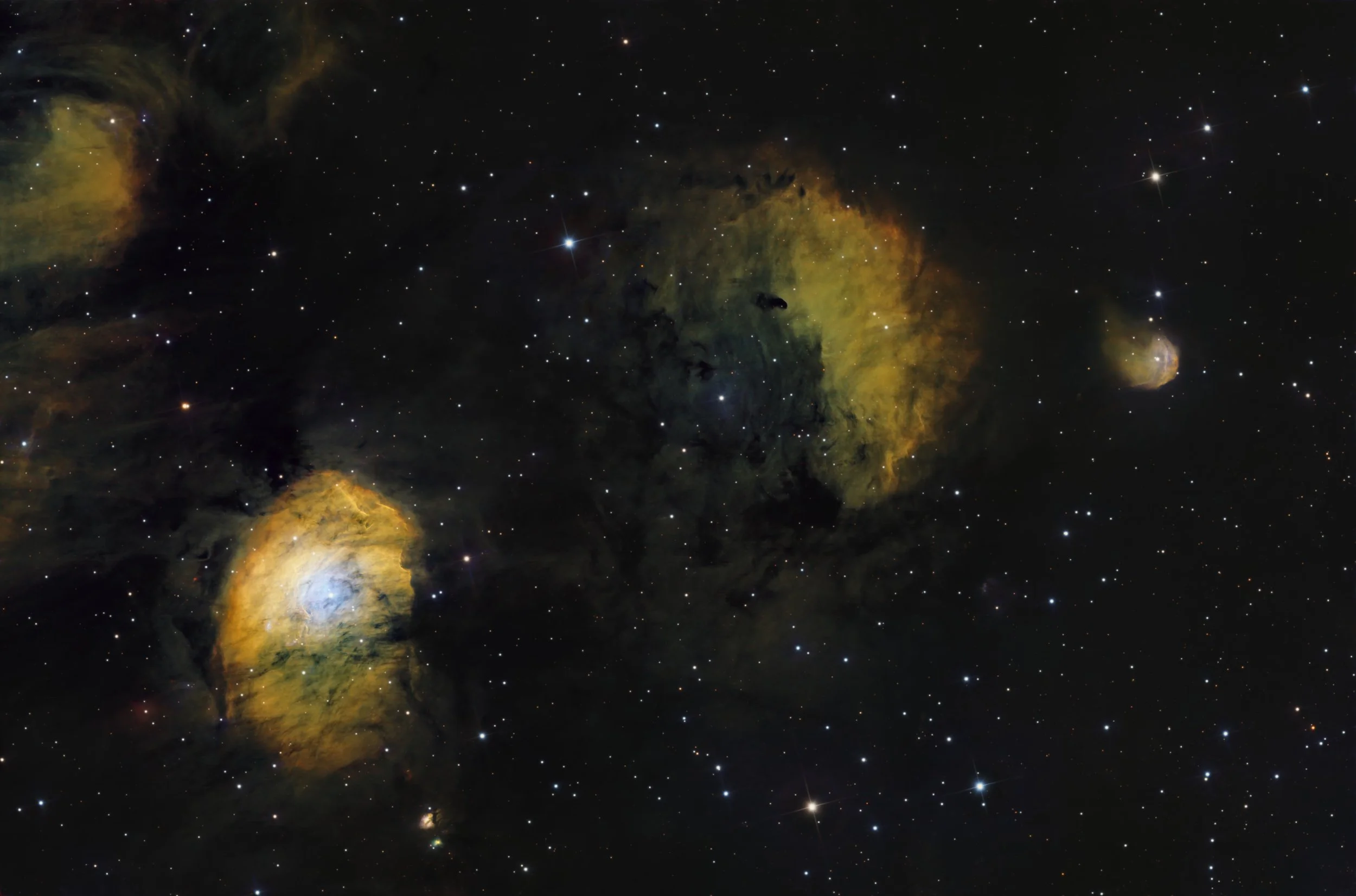
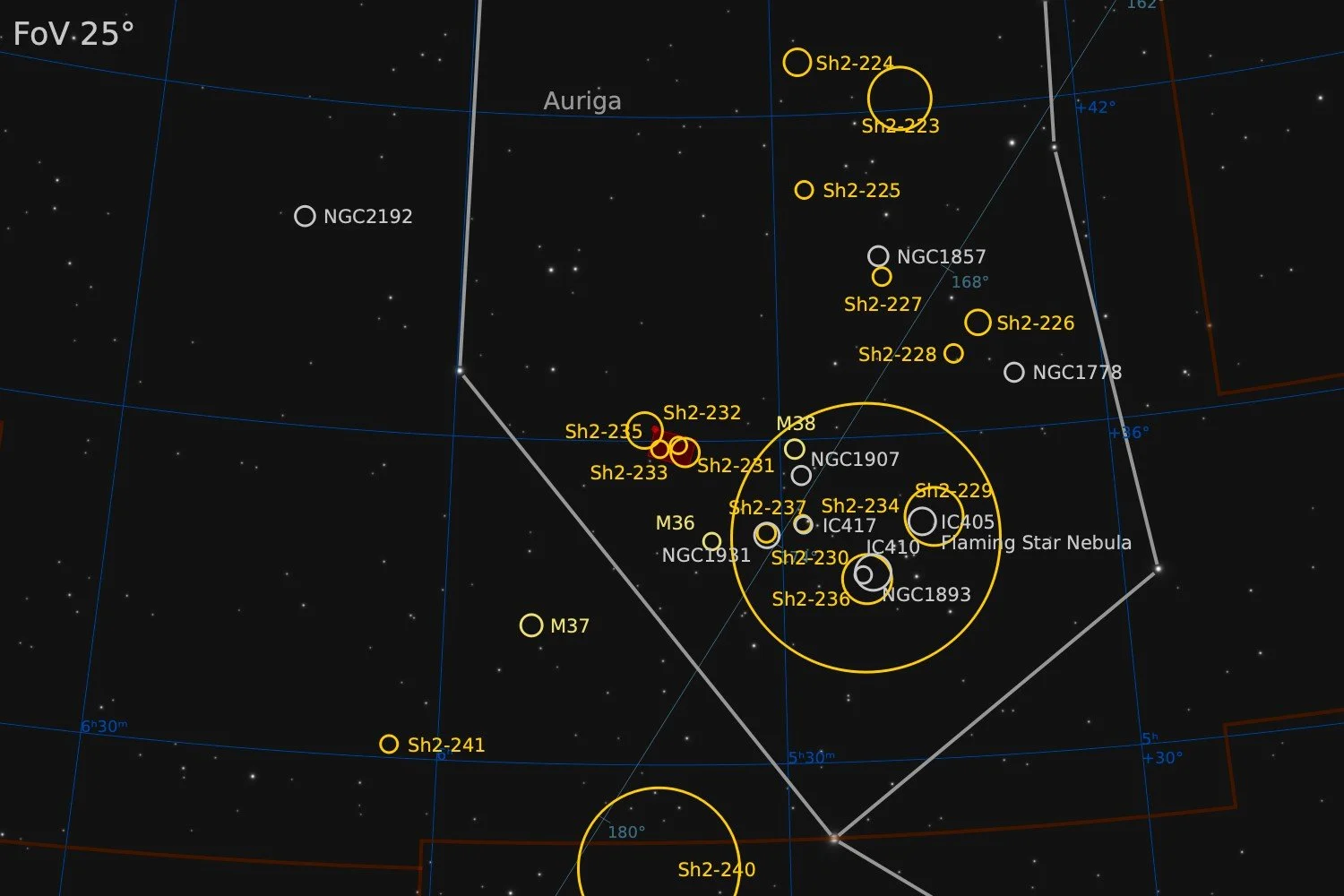
Sh2-235 is the most central and brightest nebula of a region H II known as G174+2.5; it is observed in the direction of the northern part of the OB association Aur OB1 and includes the nebulae cataloged as Sh2-231, Sh2-232, Sh2-233 and Sh2-235. They are identified as individual nebulae in the H II catalogue of Shapless, published in 1959. Although in optical images they appear as distinct nebulae, in reality they all belong to a single giant molecular cloud, parts of which appear illuminated by young and warm stars. This cloud is located in the Arm of Perseus.
While Sh2-235 is the brightest in the area, Sh2-232 is a much larger nebula. On this image, only a small part is visible in the top-left. Often the four nebulae are photographed together in a much wider field of view. But this image is a close-up, creating a bit different composition than typical.
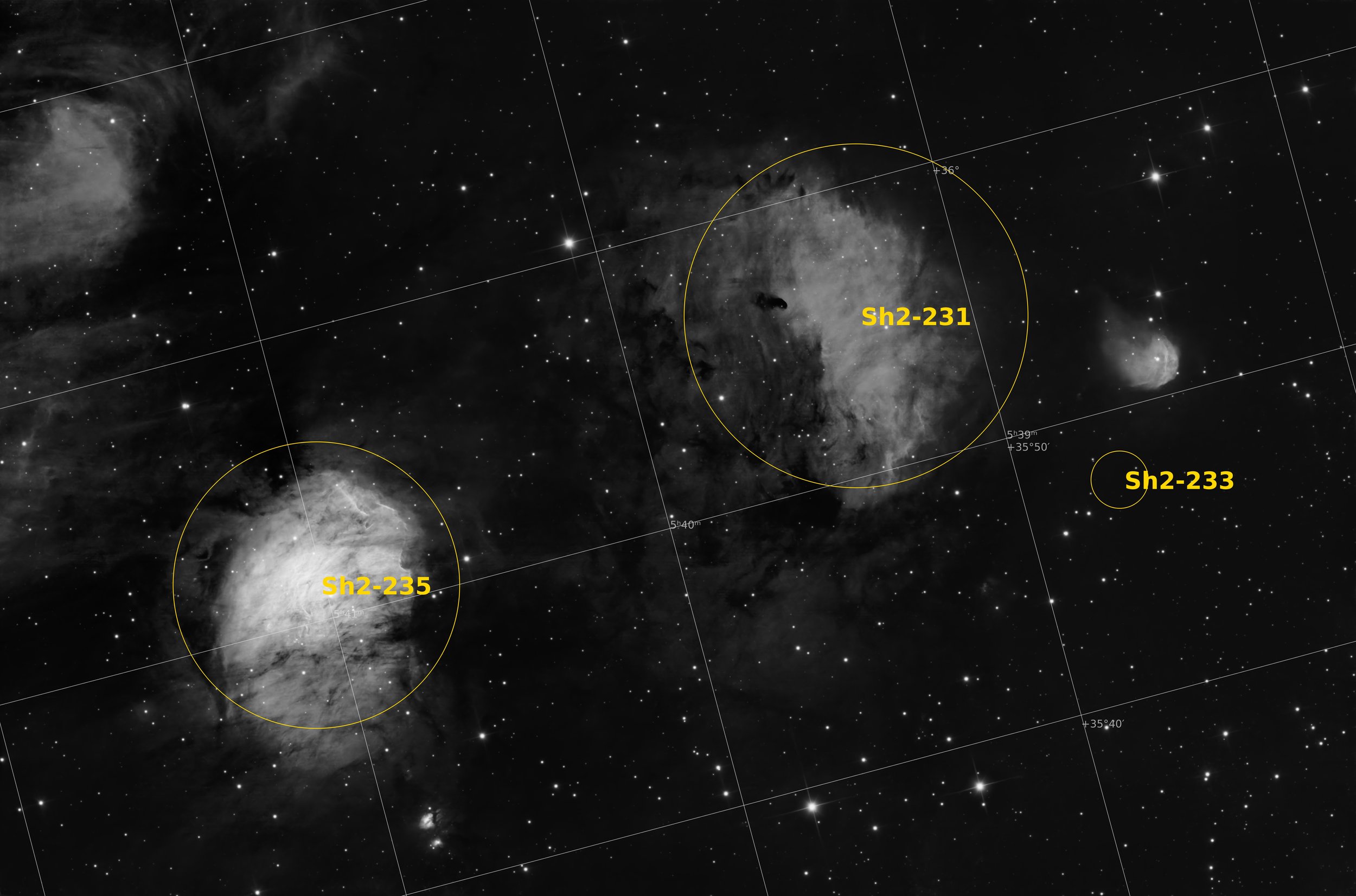
The annotated image shows a very different location for Sh2-233 than the actual nebula just above it. The coordinates in the annotation are the ones noted by Dr. Sharpless. But it is generally assumed that Sharpless made a mistake here. The publication that is usually referred to as the first paper that describes this error is the one from Israel and Felli, 1978, where they describe a survey of the area with the Westerbork Synthesis Radio Telescope in The Netherlands.
source: Wikipedia
Sh2-231
Sh2-233
Sh2-235
Data Acquisition
Data was collected over 11 nights In October and November 2025, using a 14” reflector telescope with full-frame camera at the remote observatory in Spain. Narrowband filters (Ha, OIII and SII, all 3nm) were used to gather the data. A total of approximately 24 hours of data was combined to create the final image.
Location Remote hosting facility IC Astronomy in Oria, Spain (37°N 2°W)
Sessions
Frames
Equipment
Telescope
Mount
Camera
Filters
Guiding
Accessoires
Software
Planewave CDK14 (2563mm @ f/7.2), Optec Gemini Rotating focuser
10Micron GM2000HPS, custom pier
Moravian C3-61000 Pro (full frame), cooled to -10 ºC
Chroma 2” Ha, OIII, SII (3nm) unmounted, Moravian filterwheel L, 7-position
Unguided
Compulab Tensor I-22, Dragonfly, Pegasus Ultimate Powerbox v2
Voyager Advanced, Viking, Mountwizzard4, Astroplanner, PixInsight 1.9.3
Processing
All processing was done in Pixsinsight unless stated otherwise. Default features were enhanced using scripts and tools from RC-Astro, SetiAstro, GraXpert, CosmicPhotons and others. Images were calibrated using 50 Darks, 50 Flats, and 50 Flat-Darks, registered and integrated using WeightedBatchPreProcessing (WBPP). The processing workflow diagram below outlines the steps taken to create the final image.
These are HII nebulae and overall exhibit very little OIII signal. Only Sh2-235 has a decent amount of OIII in its nucleus, and Sh2-233 has a very faint OIII signal. Sh2-231 does not exhibit any visibility in the OIII spectrum. SII, although much dimmer than Ha, is present in all three nebulae. One could argue that these nebulae are better imaged using a HaLRGB palette. They probably are and the Hubble palette is clearly not the most ideal one. But having the data, I wanted to bring out the OIII in Sh2-235 as much as possible, but as can be seen from the processing overview, pulling this blue channel out required quite a bit of pushing blue back in other parts of the image.
When doing gradient correction, my first choice tool GraXpert appeared to be a bit tricked by the small bit of nebulosity from Sh2-232 in the corner. So instead MGC was tried, and this gave a very good result with default settings. The overall image seemed to have a tad more contrast than with GraXpert.
Stretching required quite a bit of trial and error. First I tried each channel manually, but with so much difference in overall signal, it was hard to get them all in a state that they would blend well in the combination. So I tried the two automatic stretch algorithms PMGUI and Statistical Stretch. With automatic convergence on it gave just a bit nicer results. At least good enough to balance the channels to an attractive colour palette in NarrowbandNormalization.
Creating proper star colours from SHO signal can be a bit challenging. Applying SPCC does help a lot. But in this case, the blue stars remained a bit too teal-like to my taste. So the hue was shifted a tiny bit using the CurvesTransformation tool.
With three such distinctly different objects in the image, I created a GAME mask for each of them and made some nebula-specific edits. For Sh2-235 the blue was a bit enhanced. Sh2-231 was brightened up a bit, to make it pop just a bit more. Sh2-233 had a slight magenta hue (probably due to the pushing and pulling of the blue), which was corrected using the traditional Invert > SCNR > Invert mechanism.
Overall there was not much of a standard processing workflow, almost every step had some unique elements to it. Below is the full diagram of all processing steps.
Processing workflow (click to enlarge)
This image has been published on Astrobin.