Arp273
UGC 1810, UGC 1813
18’ x 14’ | 0.3”/px | 3768 × 2826 px | full resolution
Andromeda
RA 02h 21m 34s Dec +39° 22’ 15” | 0°
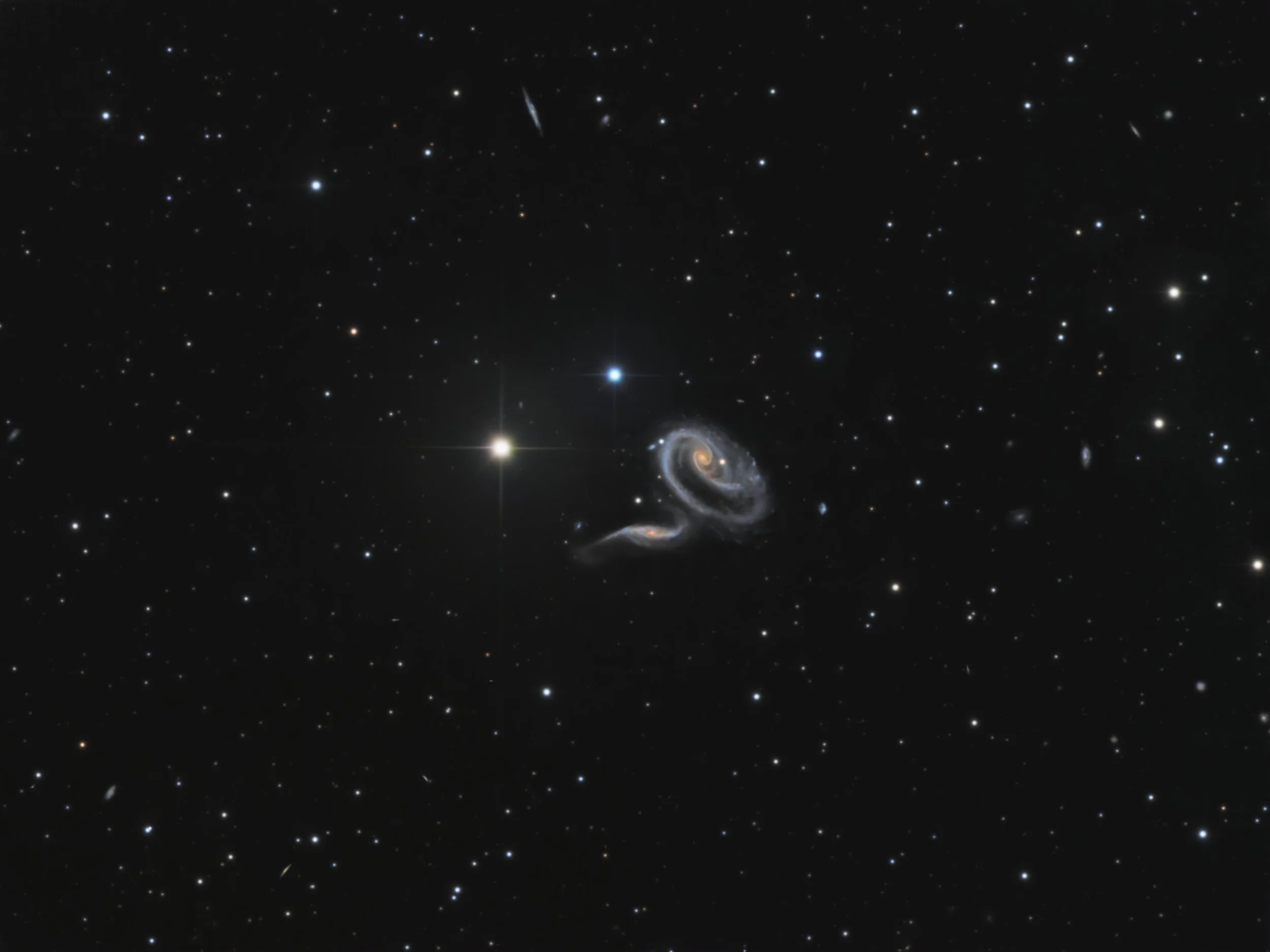
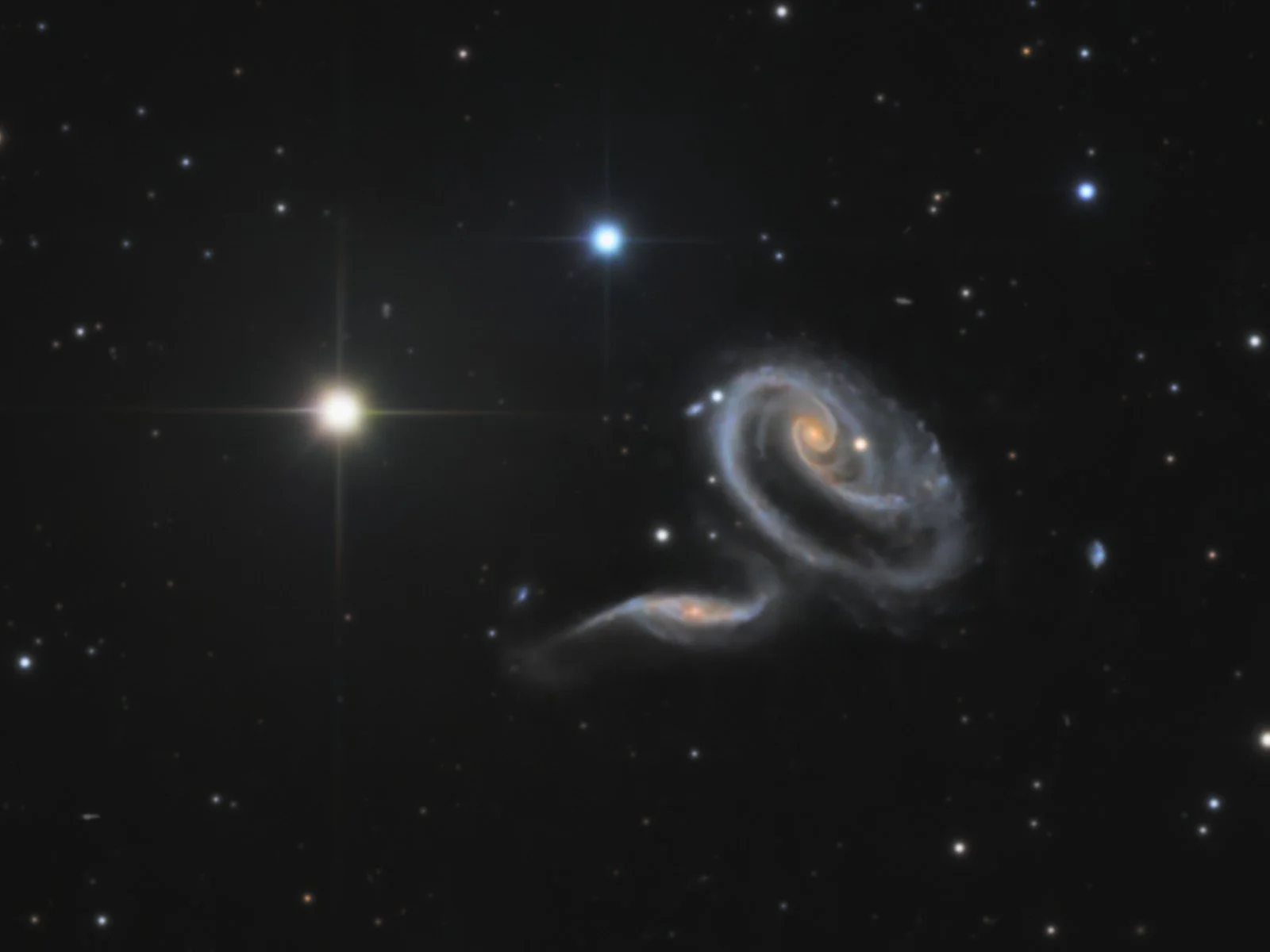
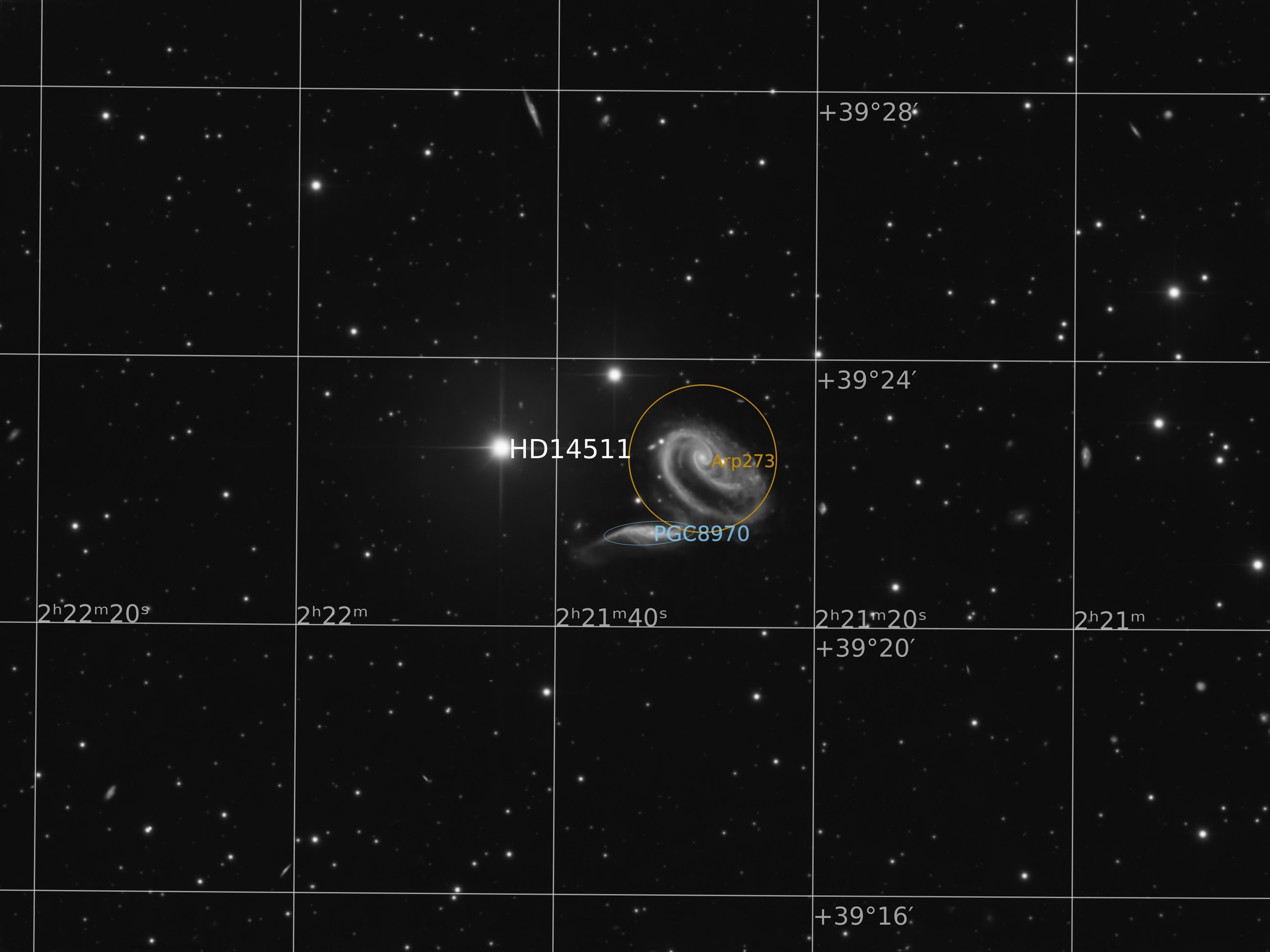
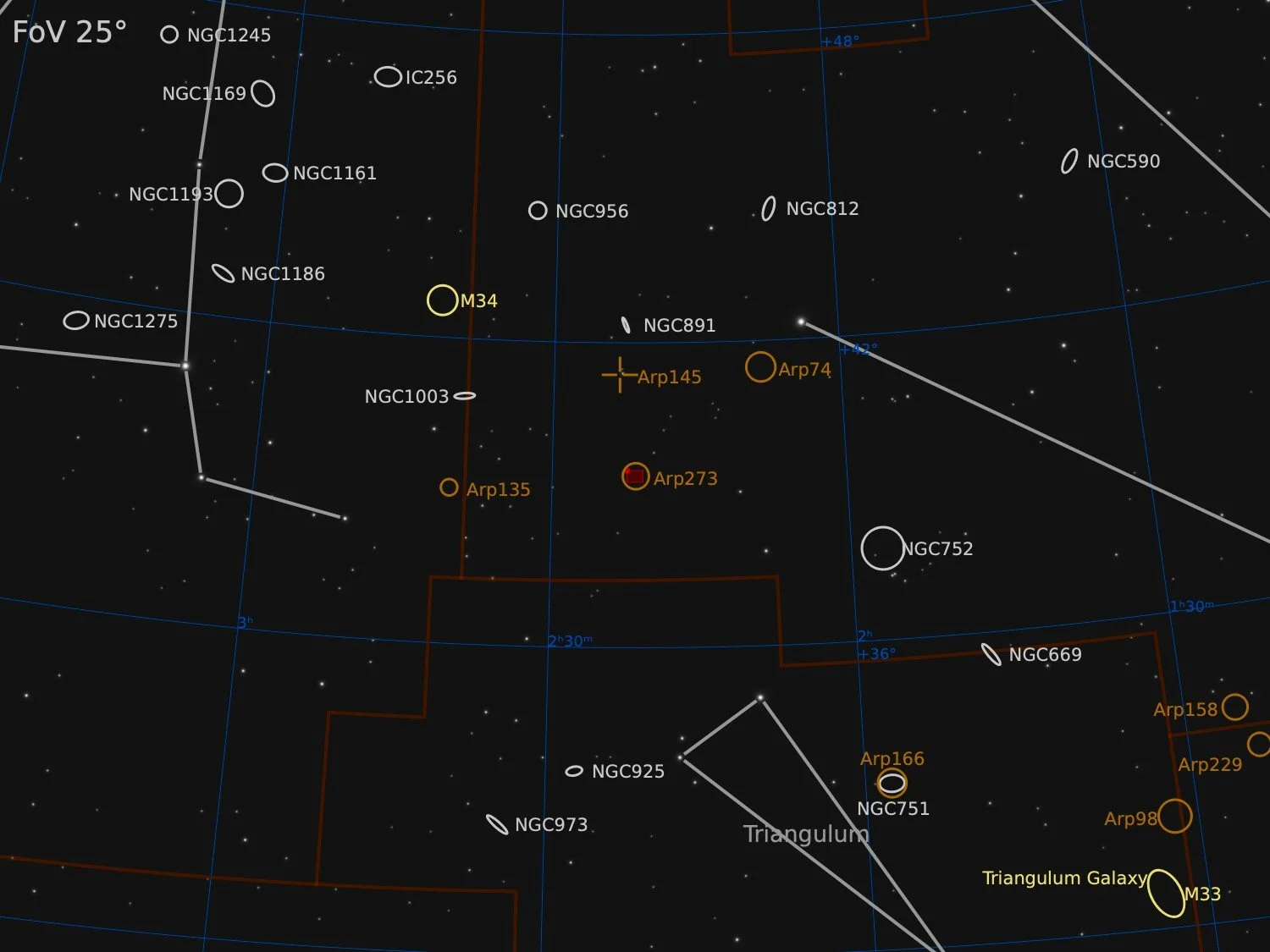
Arp 273 is a pair of interacting galaxies, 300 million light years away in the constellation Andromeda. It was first described in the Atlas of Peculiar Galaxies, compiled by Halton Arp in 1966 in the category ‘Double galaxies with connected arms’. The larger of the spiral galaxies, known as UGC 1810, is about five times more massive than the smaller galaxy. It has a disc that is tidally distorted into a rose-like shape by the gravitational pull of the companion galaxy below it, known as UGC 1813. The smaller galaxy shows distinct signs of active star formation at its nucleus, and "it is thought that the smaller galaxy has actually passed through the larger one. One supernova has been observed in UGC 1810: SN 1962R (type unknown, mag. 15.9) was discovered on plates taken at the Lick Observatory in December 1962, and presumed to be of type II.
UGC 1810 - mag 13.4 - size: 2.0’ x 1.3’ - SA(s)b pec.
UGC 1813 - mag 15.1 - size 1.5’ x 0.4’ - SB(s)a pec.
Arp’s notes: Bright long well defined arms, but smooth, not patchy.
source: Wikipedia and The Arp Atlas of Peculiar Galaxies.
Data Acquisition
Data was collected over 5 nights during November 2025, using a 14” reflector telescope with full-frame camera at the remote observatory in Spain. Data was gathered using standard LRGB filters. A total of approximately 20 hours of data was finally combined to create the final image.
Location Remote hosting facility IC Astronomy in Oria, Spain (37°N 2°W)
Sessions
Frames
Equipment
Telescope
Mount
Camera
Filters
Guiding
Accessoires
Software
Planewave CDK14 (2563mm @ f/7.2), Optec Gemini Rotating focuser
10Micron GM2000HPS, custom pier
Moravian C3-61000 Pro (full frame), cooled to -10 ºC
Chroma 2” LRGB unmounted, Moravian filterwheel L, 7-position
Unguided
Compulab Tensor I-22, Dragonfly, Pegasus Ultimate Powerbox v2
Voyager Advanced, Viking, Mountwizzard4, Astroplanner, PixInsight 1.9.3
Processing
All processing was done in Pixsinsight unless stated otherwise. Default features were enhanced using scripts and tools from RC-Astro, SetiAstro, GraXpert, CosmicPhotons and others. Images were calibrated using 50 Darks, 50 Flats, and 50 Flat-Darks, registered and integrated using WeightedBatchPreProcessing (WBPP). The processing workflow diagram below outlines the steps taken to create the final image.
The integration of the green and blue channel straight from the WBPP script still showed remainders of a satellite trail. Judging by the bright trail that was visible in the rejection frames, one would wonder if this was some kind of over-correction. Looking into the WBPP processes, it turned out that PixInsight had selected Generalised Extreme Studentized Deviate (ESD) as rejection algorithm. A re-integration using the Winsorized Sigma Clipping algorithm with strict rejection criteria (Sigma low: 3.0; Sigma high: 2.5) completely removed the satellite trail.
Other than this anomaly, processing this image followed pretty much a standard workflow, as shown in the diagram below.
Processing workflow (click to enlarge)
This image has been published on Astrobin and received Top Pick status.