Caldwell 22
NGC 7662, Blue Snowball
23’ x 15’ | 0.3”/px | 4756 × 3146 px | full resolution
Andromeda
RA 23h 25m 53s Dec +42° 31’ 59” | 0°
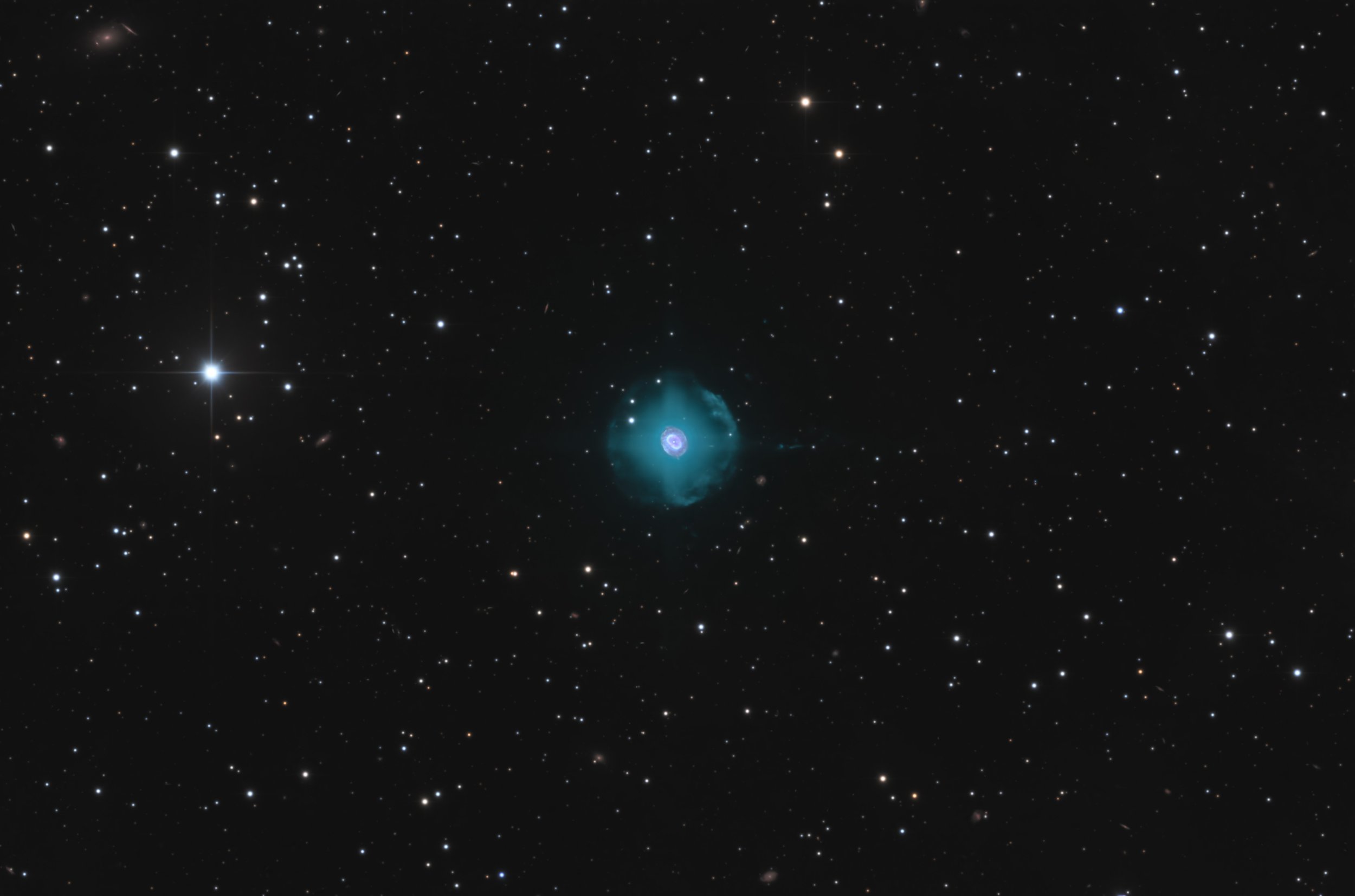
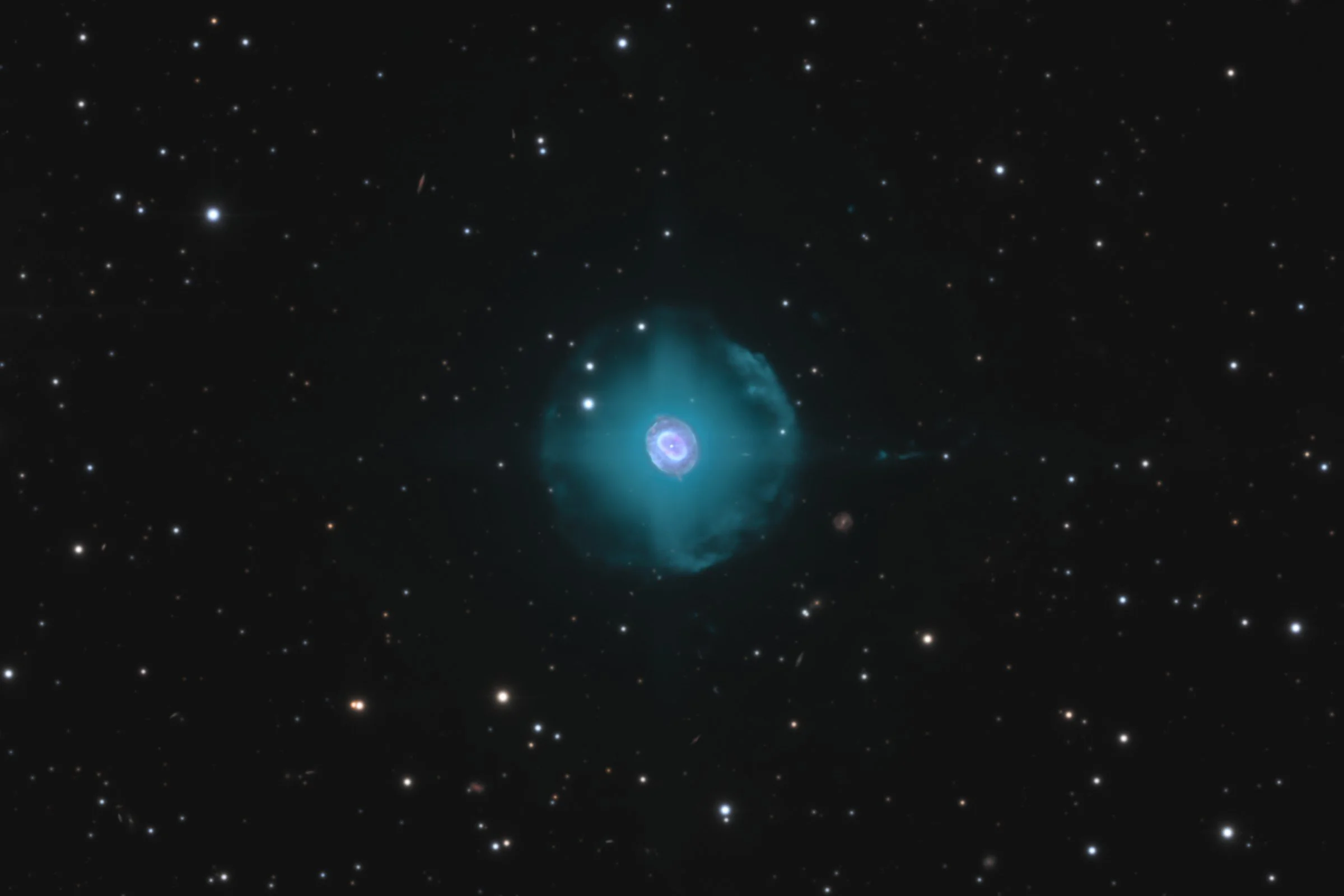
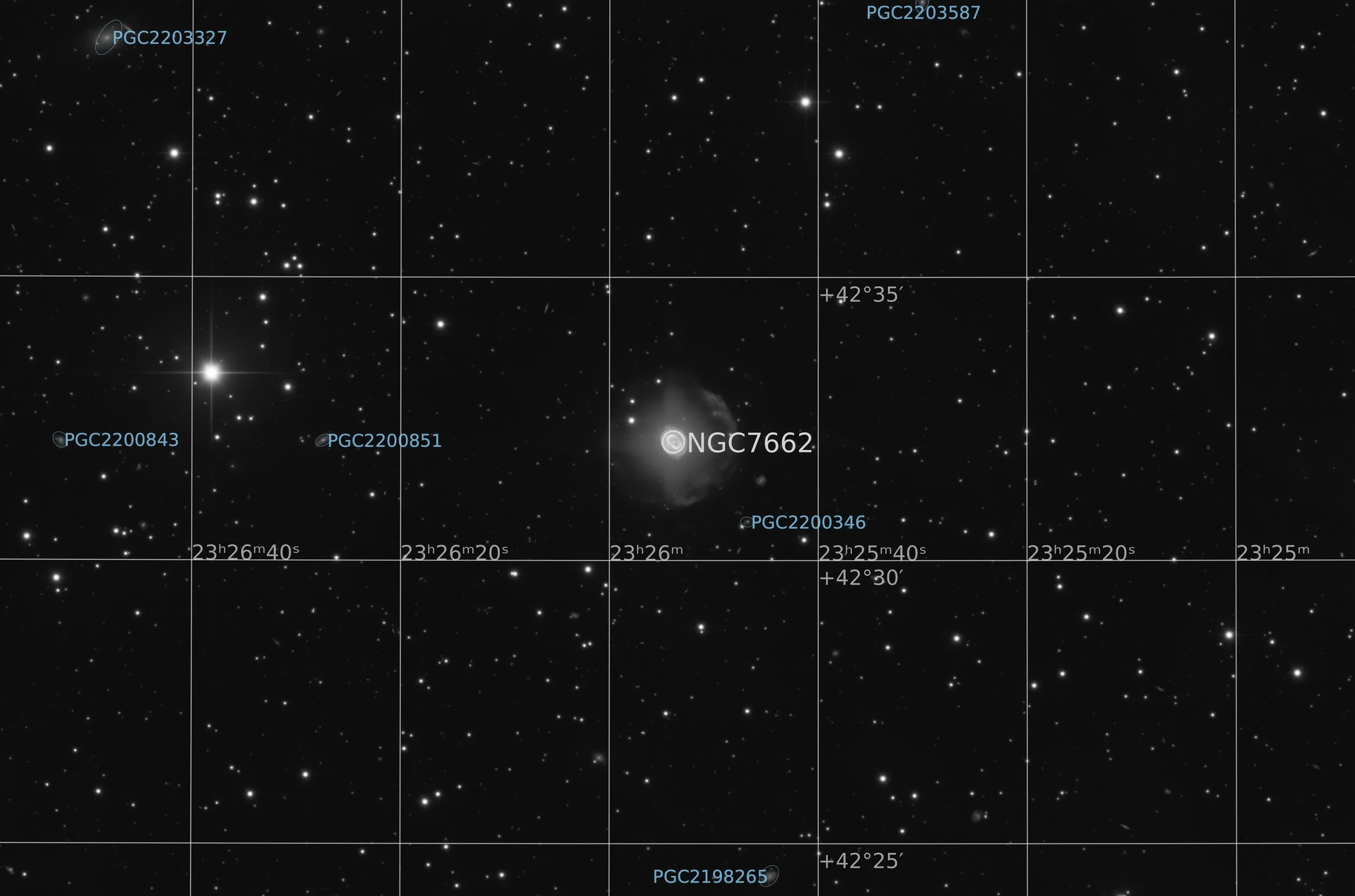
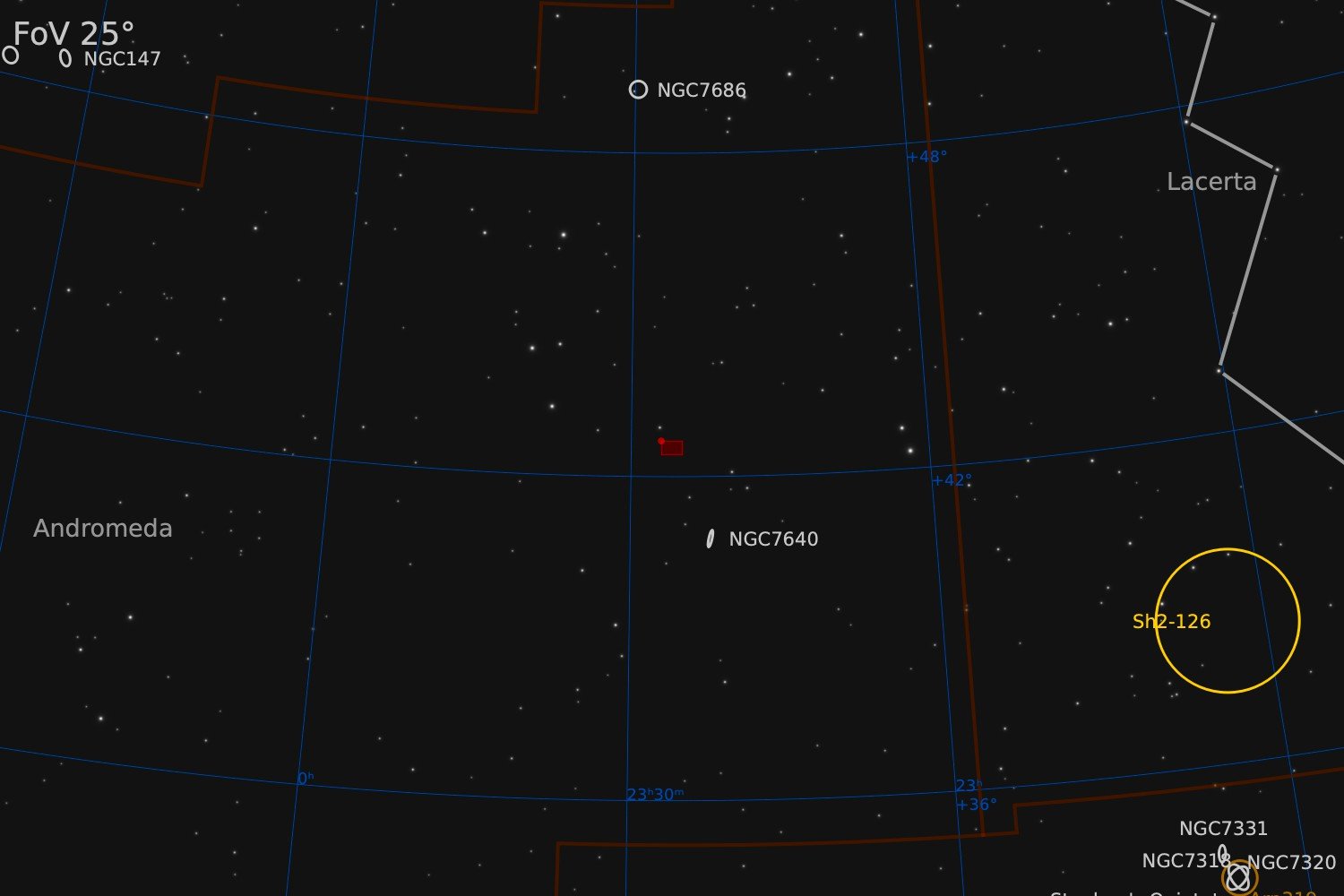
Caldwell 22, also known as NGC 7662, is a planetary nebula in the constellation Andromeda. It is known as the Blue Snowball Nebula or Snowball Nebula. This nebula was discovered October 6, 1784 by astronomer William Herschel. In the New General Catalogue it is described as a "magnificent planetary or annular nebula, very bright, pretty small in angular size, round, blue, variable nucleus". The object has an apparent visual magnitude of 8.3 and spans an angular size of 32″ × 28″. Parallax measurements give a distance estimate of 5,730 ± 340 lightyears. This nebula has an elliptical shape with a triple-shell structure. The brightest is the main shell, which spans 12″ × 18″. This is surrounded by a fainter outer shell, which has an elliptical form. Both shells are enclosed by a faint, circular halo, some 134″ in diameter. Several knots and a jet-like structure are visible, which display emission lines and low ionization. Based on the expansion rate, the estimated age of the nebula is 3,080 years. The central star of the planetary nebula is a sub-dwarf O star with a spectral type of sdO. The best fit model for this star gives an effective temperature of 100,000 K, with 5,250 times the luminosity of the Sun and 60.5% of the Sun's mass. X-ray emission from the nebula is being generated by the stellar wind from this star striking previously ejected matter.
source: Wikipedia
Data Acquisition
Originally the plan was to collect data with lots of frames of very short (e.g. 30s) duration, given the bright nucleus of this nebula. In September/October a series of short exposure images was shot. However when doing the first processing it became clear that there was just not enough light gathered. Weird structures in the background showed that details of the nebula were not standing out well enough. A quick test demonstrated that a regular exposure would give a maximum exposure in the nucleus of about 0.2. So there would be no risk of saturating any of the signal.
Many images of Caldwell 22 show the bright nucleus of the nebula. However, there is also an envelop of very faint OIII signal, extending far beyond the boundaries of the nebula itself. It is a bit of a challenge to capture both, but that is what was attempted in this image. The final set of data was collected over 4 nights during November 2025, using a 14” reflector telescope with full-frame camera at the remote observatory in Spain. Data was gathered using standrad LRGB filters and for the surrounding OIII nebula, data was gathered using a 3nm OIII narrowband filter. A total of approximately 22 hours of data was combined to create the final image.
Given the small size of the nebula, and based on the original plan of collecting many frames, only half of the sensor surface was used to collect the data.
Location Remote hosting facility IC Astronomy in Oria, Spain (37°N 2°W)
Sessions
Frames
Equipment
Telescope
Mount
Camera
Filters
Guiding
Accessoires
Software
Planewave CDK14 (2563mm @ f/7.2), Optec Gemini Rotating focuser
10Micron GM2000HPS, custom pier
Moravian C3-61000 Pro (full frame), cooled to -10 ºC
Chroma 2” LRGB, OIII (3nm) unmounted, Moravian filterwheel L, 7-position
Unguided
Compulab Tensor I-22, Dragonfly, Pegasus Ultimate Powerbox v2
Voyager Advanced, Viking, Mountwizzard4, Astroplanner, PixInsight 1.9.3
Processing
All processing was done in Pixsinsight unless stated otherwise. Default features were enhanced using scripts and tools from RC-Astro, SetiAstro, GraXpert, CosmicPhotons and others. Images were calibrated using 50 Darks, 50 Flats, and 50 Flat-Darks, registered and integrated using WeightedBatchPreProcessing (WBPP). The processing workflow diagram below outlines the steps taken to create the final image.
StarXTerminator was a bit tricky. It considered the whole core of the nebula as a star and eliminated it from the starless image. So SXT was applied on all channels with a GAME mask protecting the core of the nebula.
Stretching the nebula was extremely difficult. None of the linear data had any over-exposed areas. But the core of the nebula was very bright, so any regular stretching method would blow out the brightness in the core. Very careful steps were made with GHS, each of them with a high portion of highlight recovery. Small steps at a time led to stretches that showed both detail in the nucleus, as well as structure in the fainter areas (Lum and OIII). In the RGB image, stretching washed out some of the fainter red colours, so an extra red boost was given during stretching. This had to be corrected later on, using Background Neutralisation.
The plan was to add the OIII signal in its typical teal colour. The first step in that process was to combine OIII with RGB using the NBColourmapper. The teal colour of choice was a hue of 189. However, the nucleus of the OIII image was also very bright, so unless there would be some kind of masking of the nucleus, the OIII signal would just be way too dominant in the core. Unfortunately NBColourmapper does not allow for any masking, so this had to be done separately. The properly colour-mapped OIII image was blended into the LRGB image at a later stage using ImageBlend. In this step, a range-mask, carefully crafted not to leave too many edge artefacts, made it possible to add the teal-coloured OIII signal to the LRGB image, while leaving the blueish/purple core in tact. Reducing the transparency in the process gave control over the relative colour strengths of both the core and the wider nebula.
Throughout the process, some smaller colour/saturation adjustments were made to taste.
Overall the processing was much more complicated than for most of my images. A complete breakdown of each and every step, can be seen in the overview below.
Processing workflow (click to enlarge)
This image has been published on Astrobin and received Top Pick Nomination status.