Total Solar Eclipse 2026 - Wide-field images
Total Solar Eclipse Spain, 2026
Introduction
On 12 August 2026, a total solar eclipse was visible from Europe, with most ideal locations across the north of Spain. We travelled to the Spanish mountains in the north-west of Spain to photograph this event. You can find a full description of the preparation, tools, planning, travel, as well as a detailed account of events during the actual eclipse in the blog on this website entitled ‘Total Solar Eclipse 2026 - The Journey’. The current page shows details on photographing and processing the wide-angle shots. The close-up shots you can find here.
Location and conditions
One of the unique properties of this eclipse was the low altitude. Totality would happen only an hour before sunset. This provided an opportunity to plan for a wide-field image showing the full path of the eclipse on an interesting foreground of mountaIns. This was one of the main reasons we went to this area of Spain. As we did our recce mission the day before we found a beautiful spot just a bit up the hill with a beautiful view of the mountains towards the West, with a lovely lake in front of it. Visibility from this location was down to 3-4° altitude. This meant we would not be able to see the very last part of the partiality, but the trade-off with a beautiful backdrop was worth it. The terrain was not very easy to work from, but it turned out to be a fairly quiet place, so we could concentrate well on making sure that equipment was safe and well.
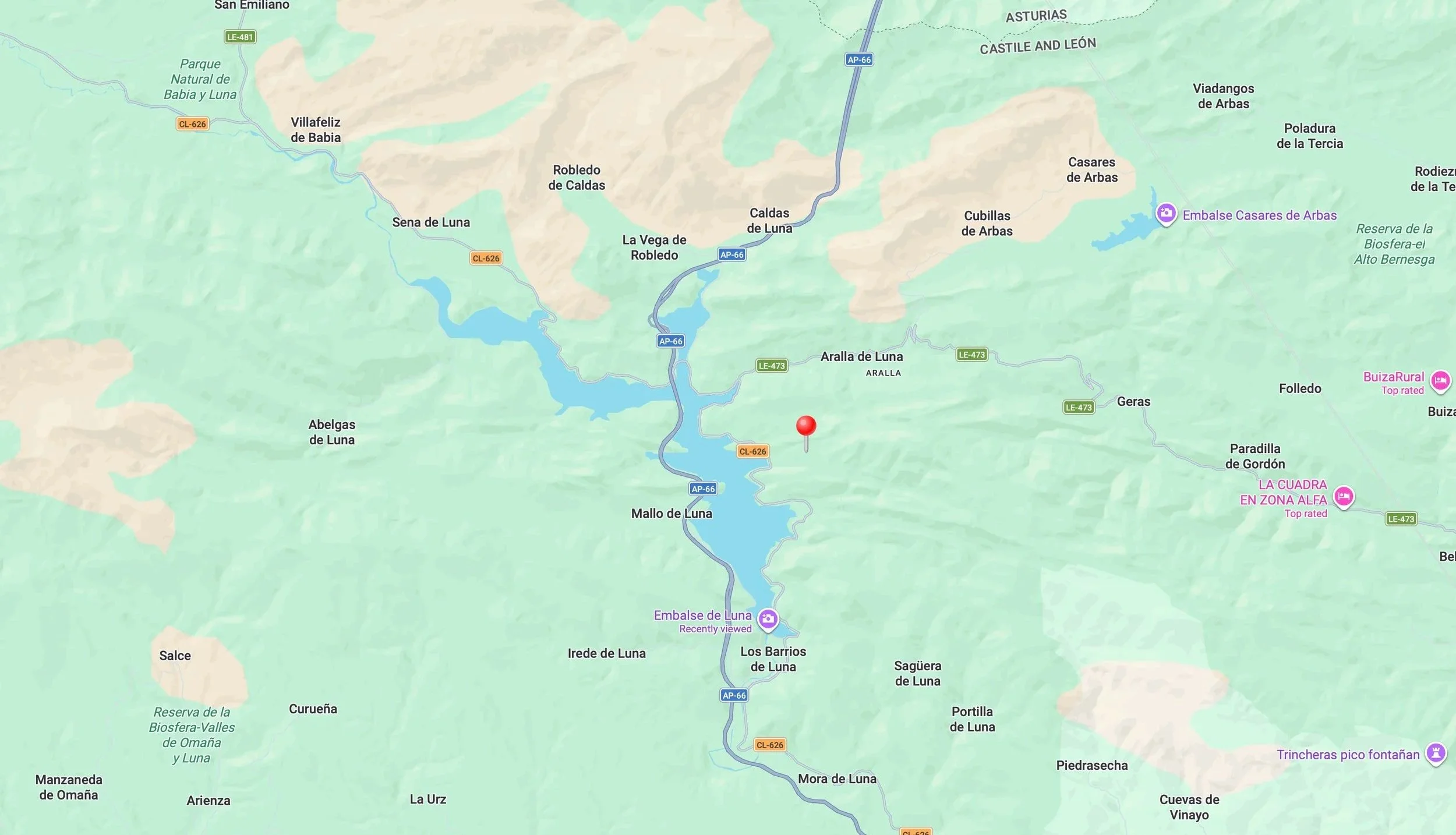
The location from where images were taken was at Los Barrios de Luna, a lake in the Cantabrian mountains, just a few hundred meters up on the hills near an abandoned mercury mine (42.88355°N 5.85951°W).
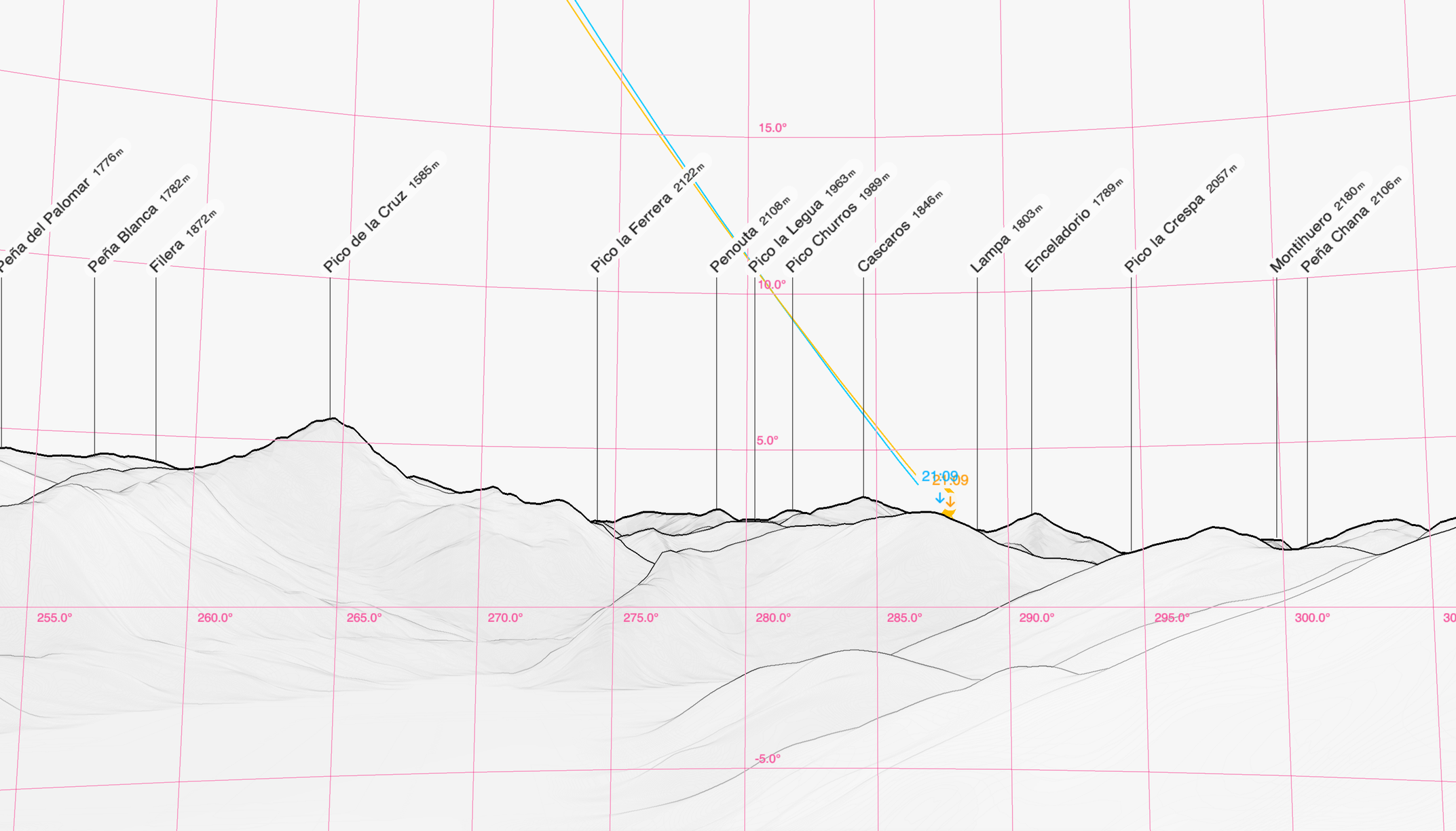
Peakfinder provided a pretty exact overview of the horizon for our location, showing where the sun would set on the day of the eclipse.
Equipment
The rig consisted of a Leica SL3-P camera with Leica Vario Elmarit-SL 28-70mm f/2.8 asph lens. The zoom lens offered some flexibility for the final field of view. The photos were taken at 43mm focal length. The zoom ring was fixed using tape to prevent it from shifting with taking the filter on and off. Solar filter used was the ASSF filter from Baader Planetarium, with has an optical density of OD5.1, leaving only 1/125,000th of the light through.
Telescope/Lens
Mount
Camera
Filters
Guiding
Accessoires
Software
Leica Vario Elmarit-SL 28-70mm f/2.8 asph
Gitzo 2-series traveller tripod with ballhead
Leica SL3-P
Baader AstroSolar® Spektiv Filter OD 5.1 – ClearWhite (65mm)
Stationary
Leica remote cable release and Anker 95Wh Powerbank
Capture One Pro 16.8.5.30, Photoshop 27.9.1
Imaging
During the partiality phases, images were taken every 30s, using the built-in intervalometer. Longer intervals cause the camera to shut off between exposures. This can get annoying during totality, where every second counts. During totality, after removal of the solar filter, bracketed shots were taken of 5 shots each with 2 stops intervals. Much longer 1/15s exposures were planned to get a proper background shot, but I forgot to adjust exposure. So for background I had to use images shot after sunset. During the final phase exposure times were step-wise increased to finally 1/60s.
8144 × 5424 px (44 MP)
43 mm @ f/8
45°' x 31°'
1/500s, f/8, ISO100
Bracketed (5x2 stops), 1/8000s-1/30s)
Resolution
Focal length
Field of View
Exposure partiality
Exposure totality
Processing
The first step in the processing was the color correction of the images in Capture One Pro. The Baader solar filters are great, but the images come out as almost black and white. For this purpose, white balance was set to 12,000 and tint was slightly reduced. The Color Editor was used to specifically target the somewhat pale-yellow colours to a more vibrant yellow-orange colour. Color correction was applied for all images in the same way. Therefore images later during the eclipse show up much more orange/red, due to the low altitude of the sun. The background image was processed to taste in Capture One Pro, brightening up the foreground and darkening the sky a little and adding some clarity and saturation.
Images were exported as 16 bit TIFFs from Capture One Pro. During the partial phase, one image was selected from every four minutes. During this time the sun had moved enough to separate the images in the stack and it gave a nice string of partially eclipsed suns, showing the course of events well. The exported TIFFs were loaded into Photoshop as a stack with blend mode ‘lighten’. Since I used a background image after sunset, the eclipsed solar disk had to be masked off in the background image. The ‘lighten’ blend mode shows the brightest pixels from the blended layers. Especially for the last images before sunset this required a careful control over the brightness of the background layer relative to the foreground solar disk images.
Another image created was a blend of the background in the wide-field shot, with the corona images from the close-up shot. Location and size were adjusted based on the associated wide-field shot. This allowed a tighter crop of the background and subsequently a more detailed eclipsed sun.
The totally eclipsed sun above the Cantabrian mountains in Spain.