Arp 135
NGC 1023, Perseus Lenticular Galaxy
45’ x 30’ | 0.3”/px | 9058 × 6066 px | full resolution
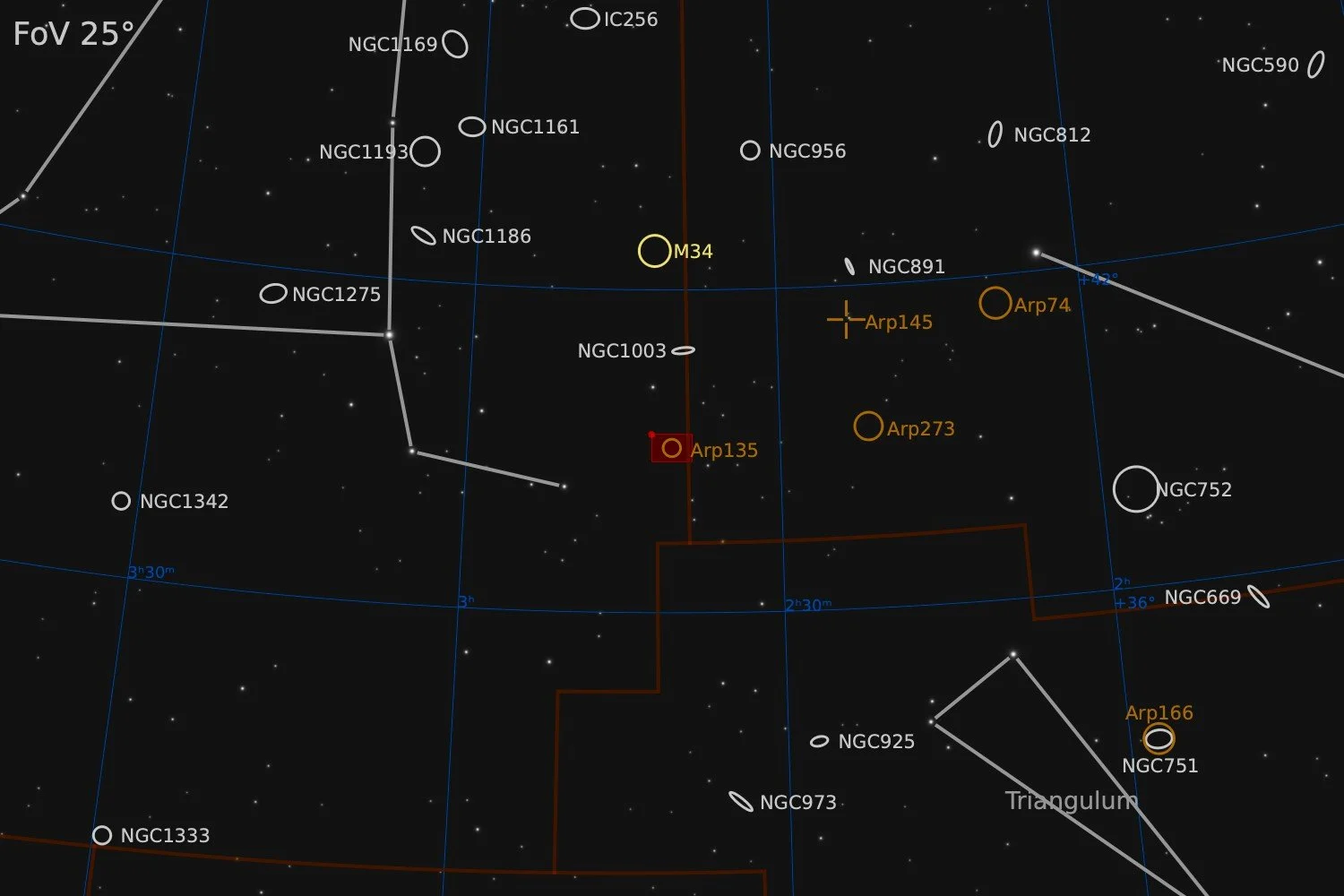
Perseus
RA 02h 40m 23s Dec +39° 03’ 44” | 0°
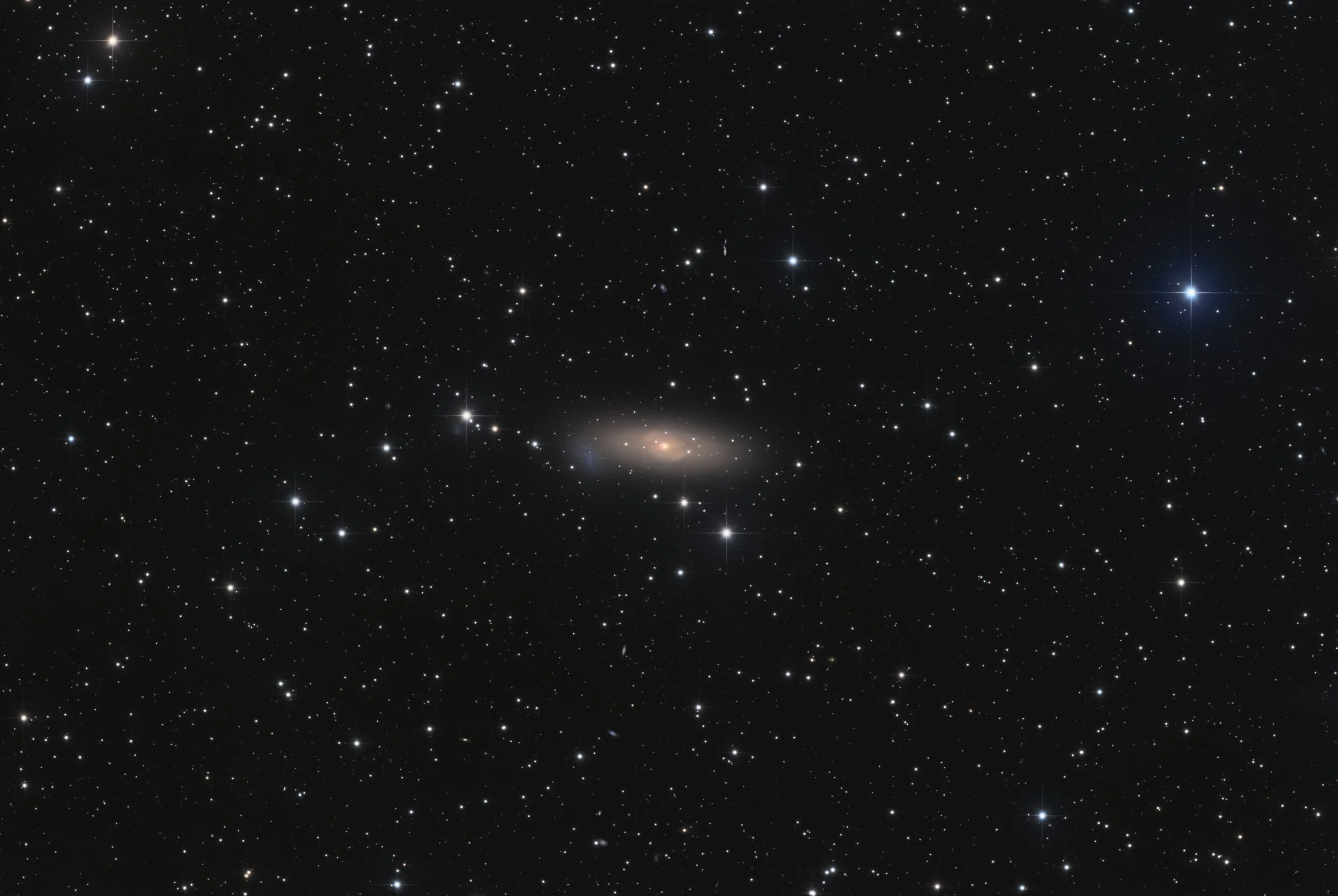
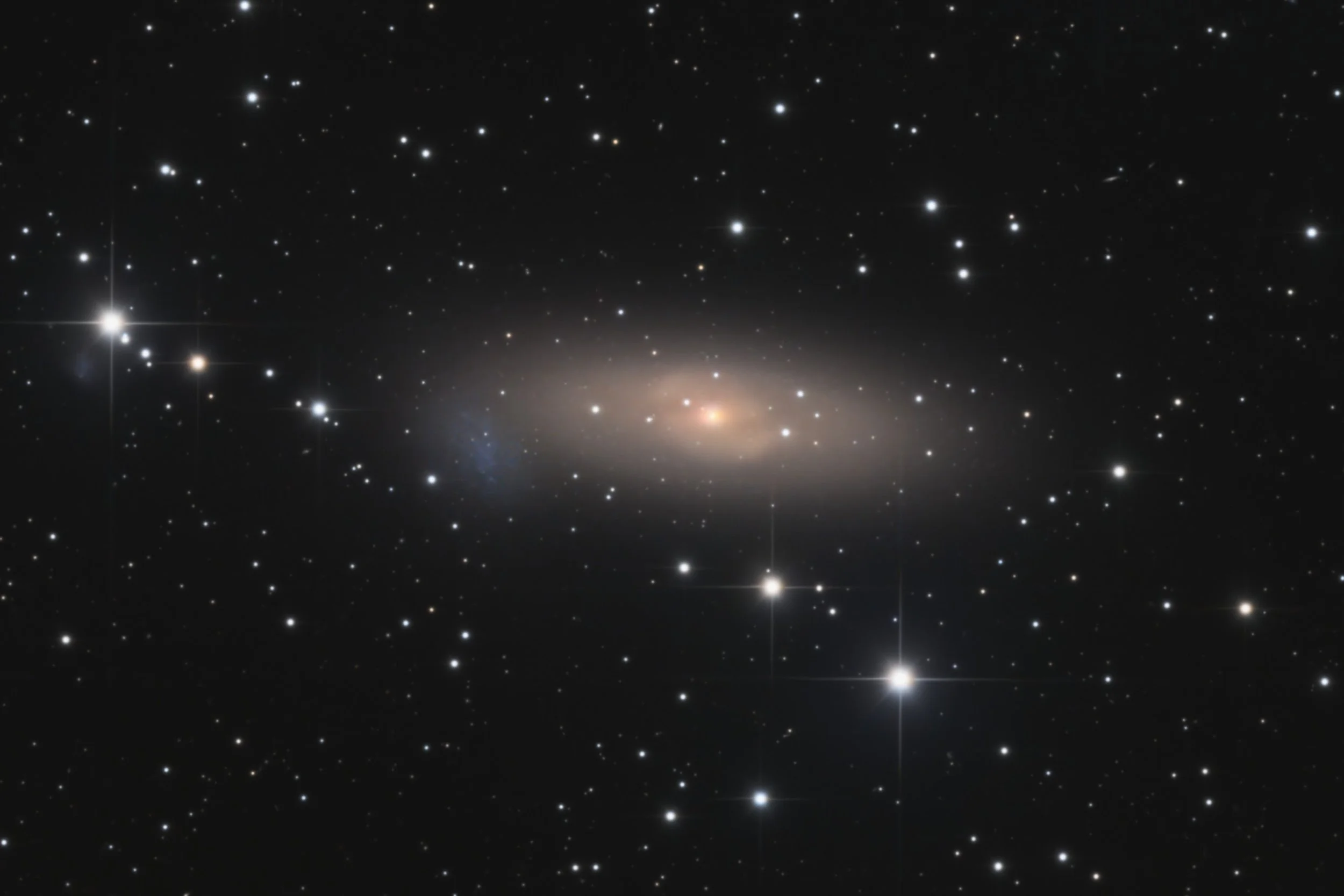
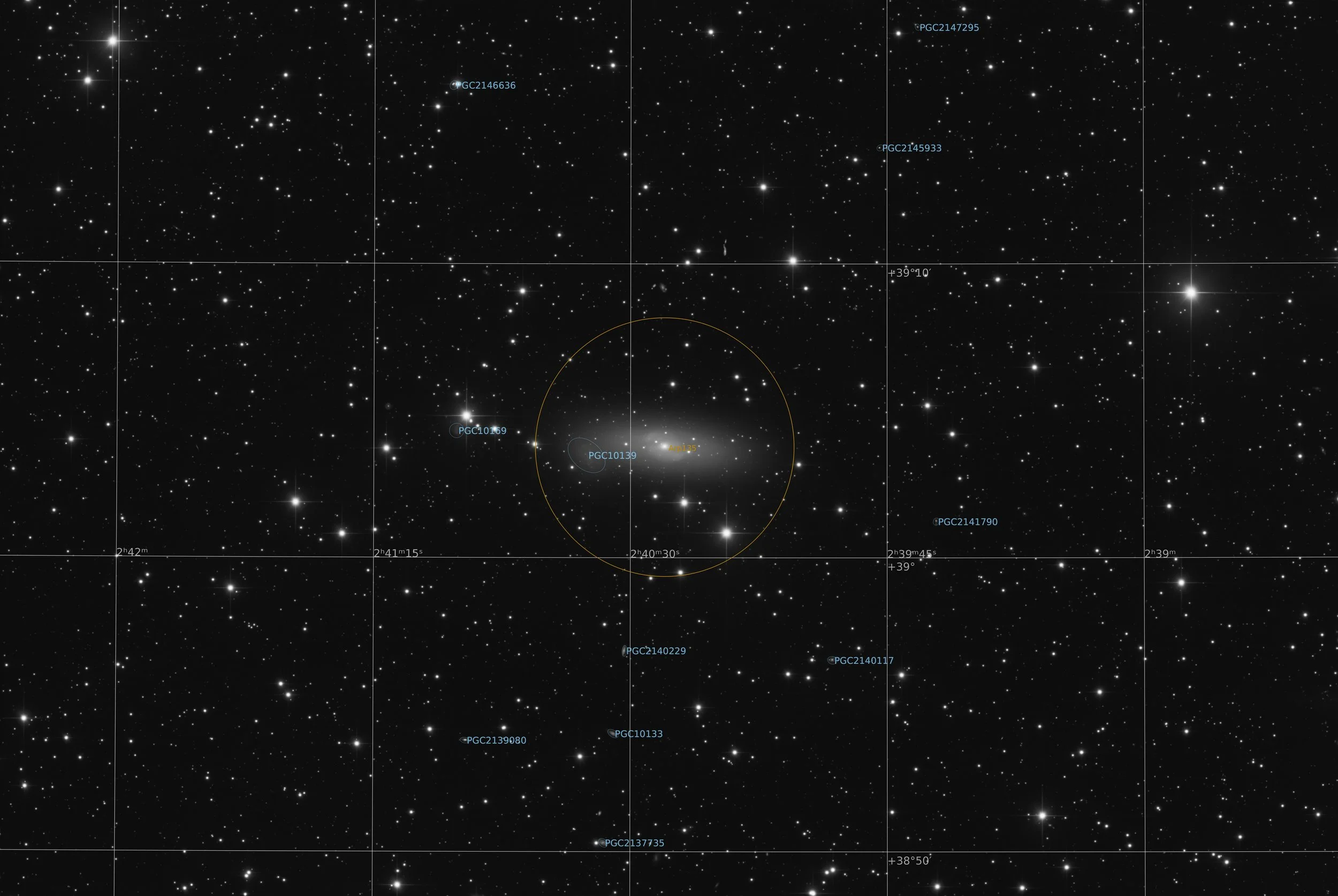
Arp 135, also known as NGC 1023 or the Perseus Lenticular Galaxy, is a member of the NGC 1023 group of galaxies in the Local Supercluster. Distance measurements vary from 30 to 64 million light-years. The supermassive black hole at the core has a mass of over 44 million sun masses. The black hole was discovered by analysing the dynamics of the galaxy. Arp 135 is included in Halton Arp's Atlas of Peculiar Galaxies under the category "Galaxies with Nearby Fragments". Arp 135 has been estimated to have about 490 globular clusters, consistent with similar early-type galaxies. A number of small galaxies have been found around NGC 1023, the collection of which is labelled the "NGC 1023 Group." It has a satellite galaxy named NGC 1023A (PGC10139), the small blue area to the left of the galaxy. This is a Magellanic spiral galaxy. Its globular cluster system is much smaller, estimated to be around six individuals.
Arp 135 is referred to as a barred lenticular galaxy. A lenticular galaxy (S0) has a structure in between a spiral galaxy and an elliptical galaxy. This is a transitionary state as the galaxy transitions from a spiral structure to an elliptical structure. In this case the core still shows the barred spiral origin.
Source: Wikipedia
Data Acquisition
Data was collected during 6 nights in December 2025 and January 2026, using a 14” reflector telescope with full-frame camera at the remote observatory in Spain. Data was gathered using standard LRGB filters. A total of approximately 21 hours of data was finally combined to create the final image.
Location Remote hosting facility IC Astronomy in Oria, Spain (37°N 2°W)
Sessions
Frames
Equipment
Telescope
Mount
Camera
Filters
Guiding
Accessoires
Software
Planewave CDK14 (2563mm @ f/7.2), Optec Gemini Rotating focuser
10Micron GM2000HPS, custom pier
Moravian C3-61000 Pro (full frame), cooled to -10 ºC
Chroma 2” LRGB unmounted, Moravian filterwheel L, 7-position
Unguided
Compulab Tensor I-22, Dragonfly, Pegasus Ultimate Powerbox v2
Voyager Advanced, Viking, Mountwizzard4, Astroplanner, PixInsight 1.9.3
Processing
All processing was done in Pixsinsight unless stated otherwise. Default features were enhanced using scripts and tools from RC-Astro, SetiAstro, GraXpert, CosmicPhotons and others. Images were calibrated using 50 Darks, 50 Flats, and 50 Flat-Darks, registered and integrated using WeightedBatchPreProcessing (WBPP). The processing workflow diagram below outlines the steps taken to create the final image.
Stretching was done manually using multiple steps in GHS. One of the benefits of doing this process manually is that you can see details along the way that may remain hidden when you apply an automated stretch. In this particular case, it appeared as if there was more detail in the core of the galaxy than a standard STF stretch showed. Therefore in final stretching the core was closely monitored not to blow out any part of this very bright area, but instead keep all brightness values well under 1.0. This then allowed a follow-up step using HDRMultiscaleTransform to get as much detail out of the core as possible. It was surprising how well this worked, and the barred spiral in the core came out remarkably well. Also the accompanying irregular galaxy NGC1023A showed up as a clear blue nebulous object. All in all there was more structure obtained from this object than was originally anticipated.
The rest of the processing used a fairly standard approach, outlined below.
Processing workflow (click to enlarge)
This image has been published on Astrobin.