M41
NGC 2287, Little Beehive Cluster
47’ x 31’ | 0.3”/px | 9478 × 6283 px | full resolution
Canis Major
RA 06h 46m 02s Dec -20° 43’ 09” | 0°
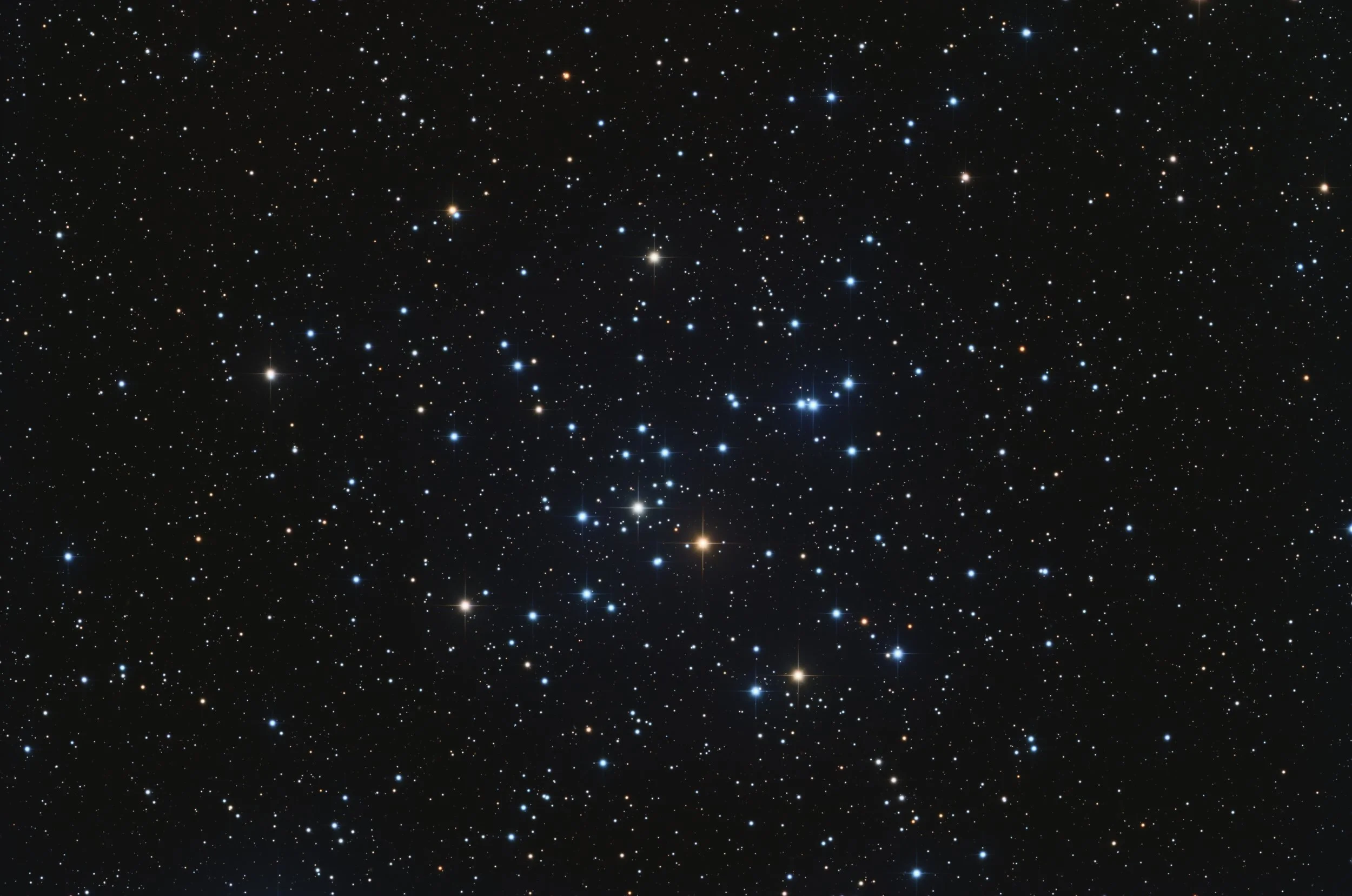
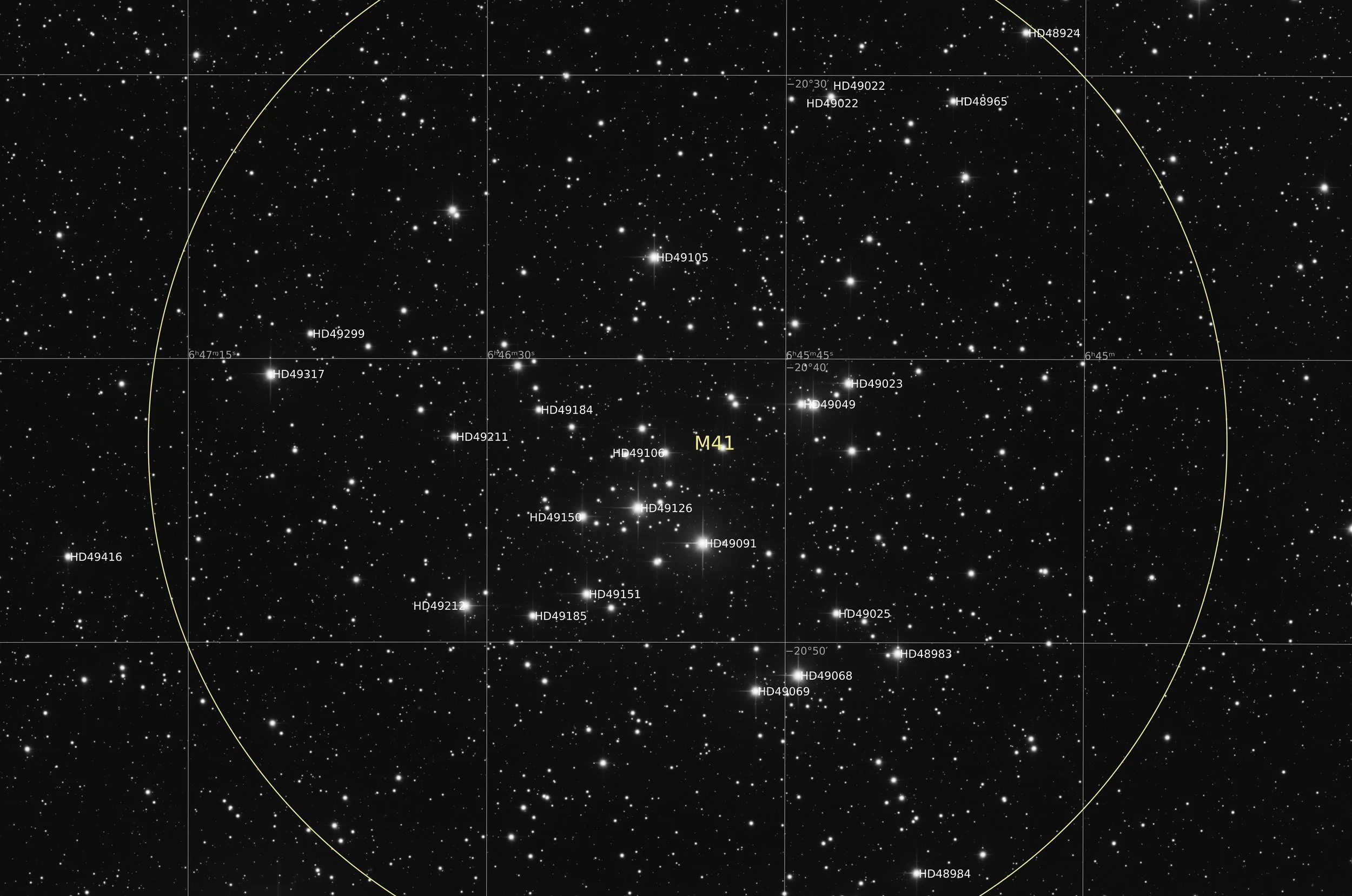
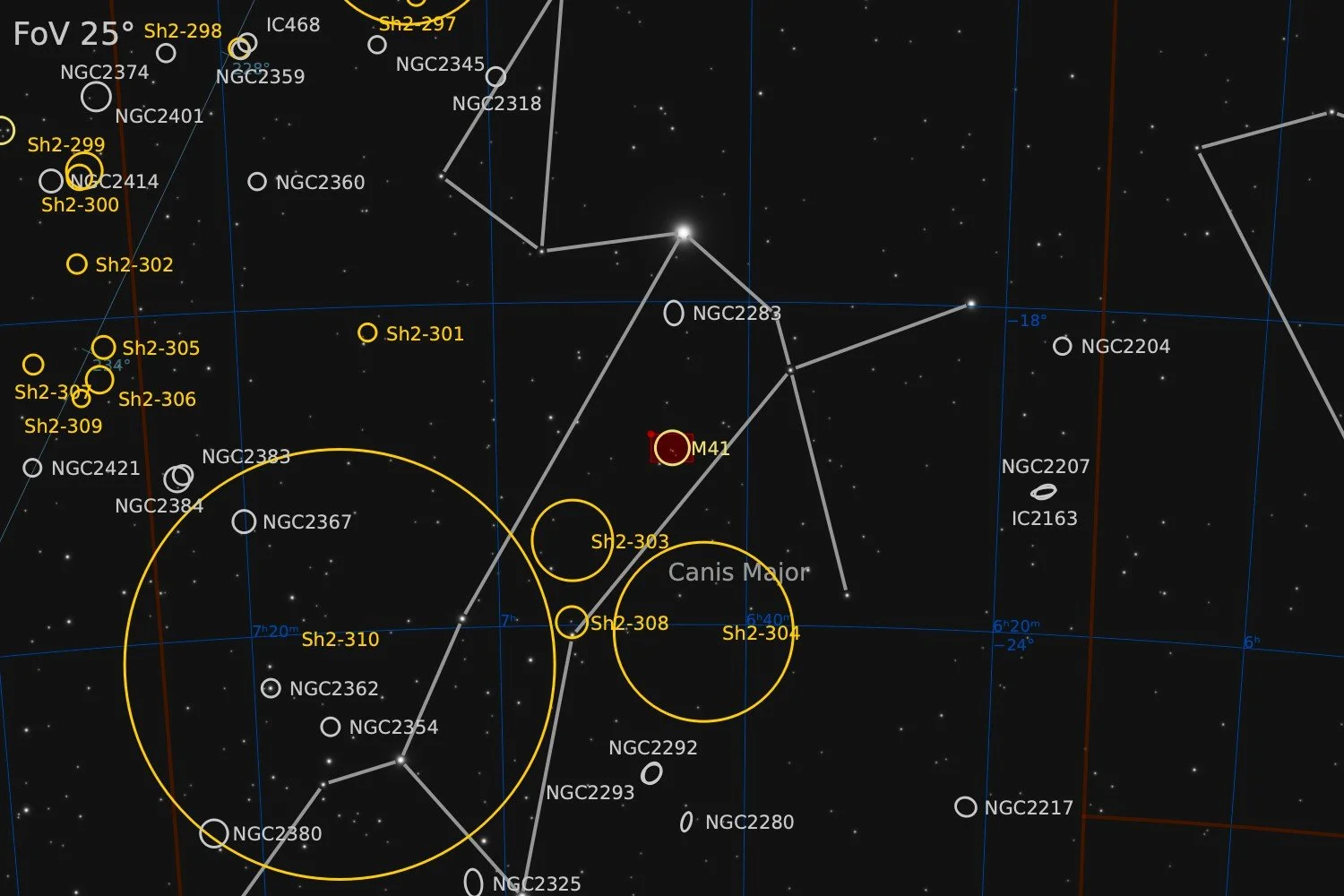
Messier 41, also known as NGC 2287, is an open cluster in the constellation Canis Major. Located approximately four degrees south of Sirius, it forms a roughly equilateral triangle with Sirius and Nu Canis Majoris, visible together in binoculars. The cluster spans an area comparable to the size of the full moon and contains about 100 stars, including several red giants and white dwarfs. Discovered by Giovanni Batista Hodierna before 1654, M41 may have been observed by Aristotle as early as 325 BC. It is sometimes called the Little Beehive Cluster due to its resemblance to the Beehive Cluster (M44). The brightest star in M41 is a red giant of spectral type K3 with an apparent magnitude of 6.3 near the cluster's center. The cluster has a diameter of 25–26 light-years and is receding from Earth at 23.3 km/s. Estimates suggest an age of 190 million years, with a predicted lifespan of 500 million years before disintegration.
Source: Wikipedia
Data Acquisition
Data was collected during 5 nights in December 2025 and January 2026, using a 14” reflector telescope with full-frame camera at the remote observatory in Spain. Data was gathered using standard RGB filters. A total of approximately 7 hours of data was finally combined to create the final image.
Location Remote hosting facility IC Astronomy in Oria, Spain (37°N 2°W)
Sessions
Frames
Equipment
Telescope
Mount
Camera
Filters
Guiding
Accessoires
Software
Planewave CDK14 (2563mm @ f/7.2), Optec Gemini Rotating focuser
10Micron GM2000HPS, custom pier
Moravian C3-61000 Pro (full frame), cooled to -10 ºC
Chroma 2” RGB unmounted, Moravian filterwheel L, 7-position
Unguided
Compulab Tensor I-22, Dragonfly, Pegasus Ultimate Powerbox v2
Voyager Advanced, Viking, Mountwizzard4, Astroplanner, PixInsight 1.9.3
Processing
All processing was done in Pixsinsight unless stated otherwise. Default features were enhanced using scripts and tools from RC-Astro, SetiAstro, GraXpert, CosmicPhotons and others. Images were calibrated using 50 Darks, 50 Flats, and 50 Flat-Darks, registered and integrated using WeightedBatchPreProcessing (WBPP). The processing workflow diagram below outlines the steps taken to create the final image.
Some of the very bright stars had a few tiny colour (mostly magenta) blotches in them. This was the result of the pixel rejection not smoothly applied throughout some of the very bright stars. This was caused by highly variable data going into the stacking. The weather conditions were not great during image capture, and while open clusters such as this are quite forgiving, sometimes these bad conditions do show up during processing.
By means of test, a synthetic luminance was created to add some extra sharpness to the image. The idea is to extract a luminance image from the RGB channels, which can then be stretched and sharpened just a bit further than a regular RGB image. Once finished, that luminance image is than added to the RGB image again. A synthetic luminance can be easily made using PixelMath, and is essentially the average of all three colour channels. The PixelMath expression looks as follows:
($T[0]+$T[1]+$T[2])/3 The result was a very subtle enhancement. Perhaps the same or at least a very similar result can be obtained by just carefully stretch and sharpen the RGB image. But the current method definitely worked and was rather easy to apply.
The rest of the processing used a fairly standard approach, outlined below.
Processing workflow (click to enlarge)
This image has been published on Astrobin.