M42 | M43
M42, NGC 1976, Orion Nebula | M43, NGC 1982, Mairan’s Nebula
48’ x 32’ | 0.3”/px | 9576 × 6388 px | full resolution
Orion
RA 05h 35m 07s Dec -05° 23’ 08” | 0°
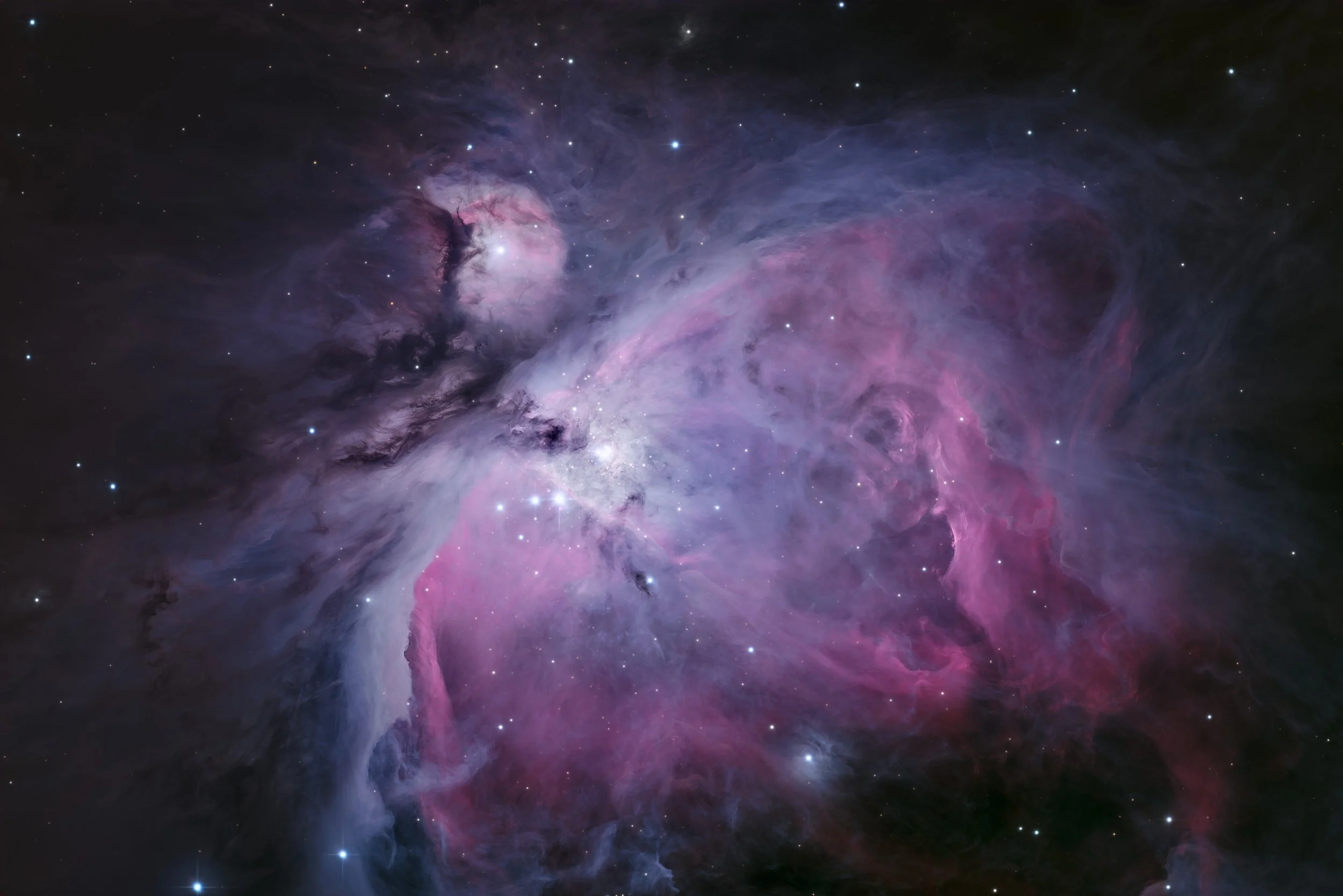
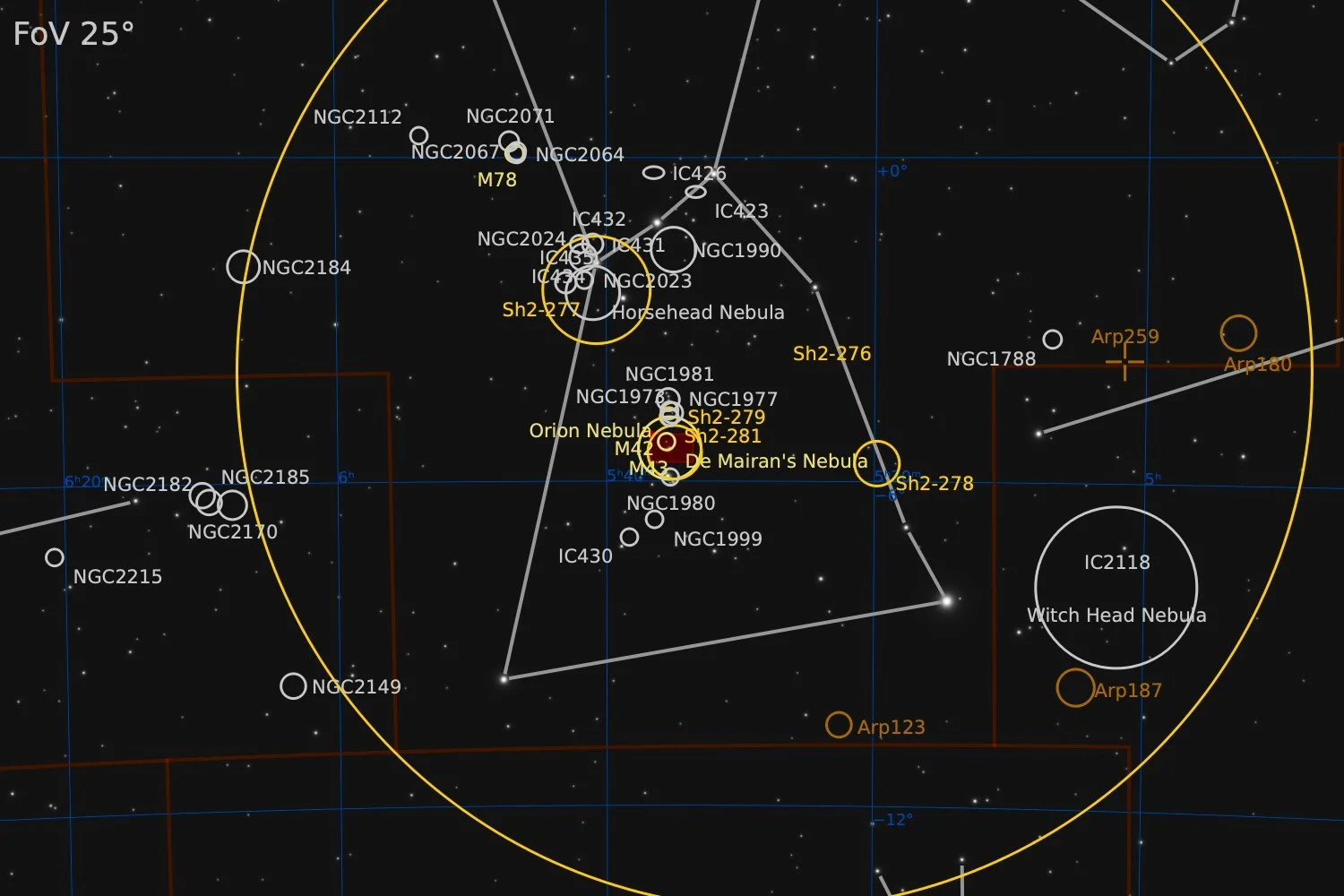
Messier M42, also known as the Orion Nebula or NGC 1976, is a diffuse nebula in the Milky Way situated south of Orion's Belt in the constellation of Orion. It is known as the middle "star" in the "sword" of Orion. It is one of the brightest nebulae and is visible to the naked eye in the night sky with an apparent magnitude of 4.0. It is situated 1,344 light-years away and is the closest region of massive star formation to Earth. M42 is estimated to be 25 light-years across (so its apparent size from Earth is approximately 1 degree). It has a mass of about 2,000 times that of the Sun. Older texts frequently refer to the Orion Nebula as the Great Nebula in Orion or the Great Orion Nebula. The Orion Nebula is one of the most scrutinized and photographed objects in the night sky and is among the most intensely studied celestial features. The nebula has revealed much about the process of how stars and planetary systems are formed from collapsing clouds of gas and dust. Astronomers have directly observed protoplanetary disks and brown dwarfs within the nebula, intense and turbulent motions of the gas, and the photo-ionizing effects of massive nearby stars in the nebula.
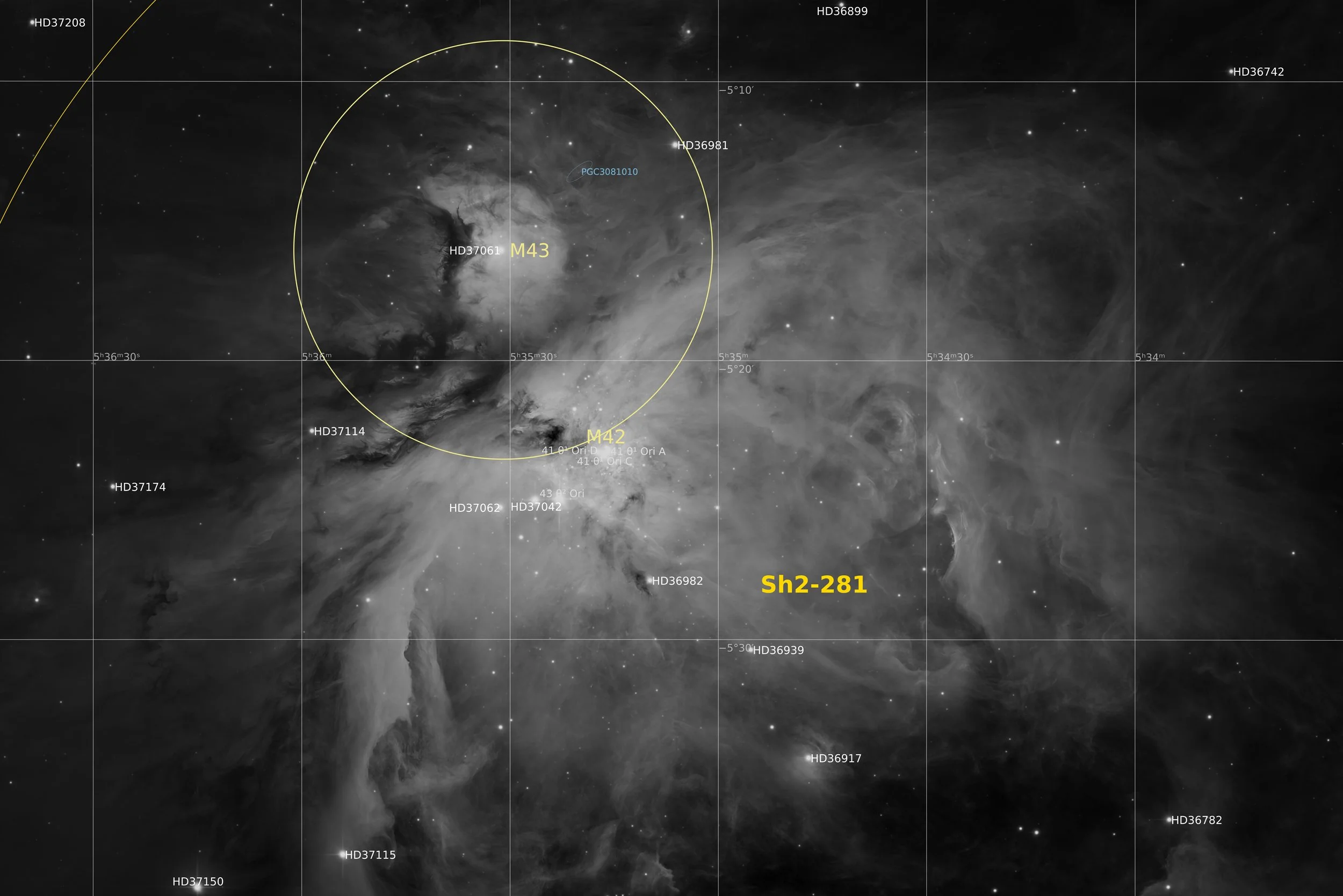
Messier 43, also known as De Mairan's Nebula or NGC 1982, is a star-forming nebula with a prominent H II region just next to M42. It was discovered by the French scientist Jean-Jacques d'Ortous de Mairan some time before 1731, then catalogued by Charles Messier in 1769. It is physically part of the Orion Nebula, separate from that main nebula by a dense lane of dust known as the northeast dark lane. The main ionizing star in this nebula is the quadruple star system NU Orionis (HD 37061), the focus of the H II region, 1,360 light-years away.
Source: Wikipedia (M42) and Wikipedia (M43)
M43, or the Mairan'‘s nebula is often seen as simply a part of M42, but it is a distinctly separate nebula, with the bright star Nu Orionis (HD 37061) as the central source of light that illuminates the gas around it.
In the super bright area of M42 is a small cluster of 4 very bright stars, often referred to as the trapezium. They can be clearly seen here as distinctly individual stars while highlighting how bright they are.
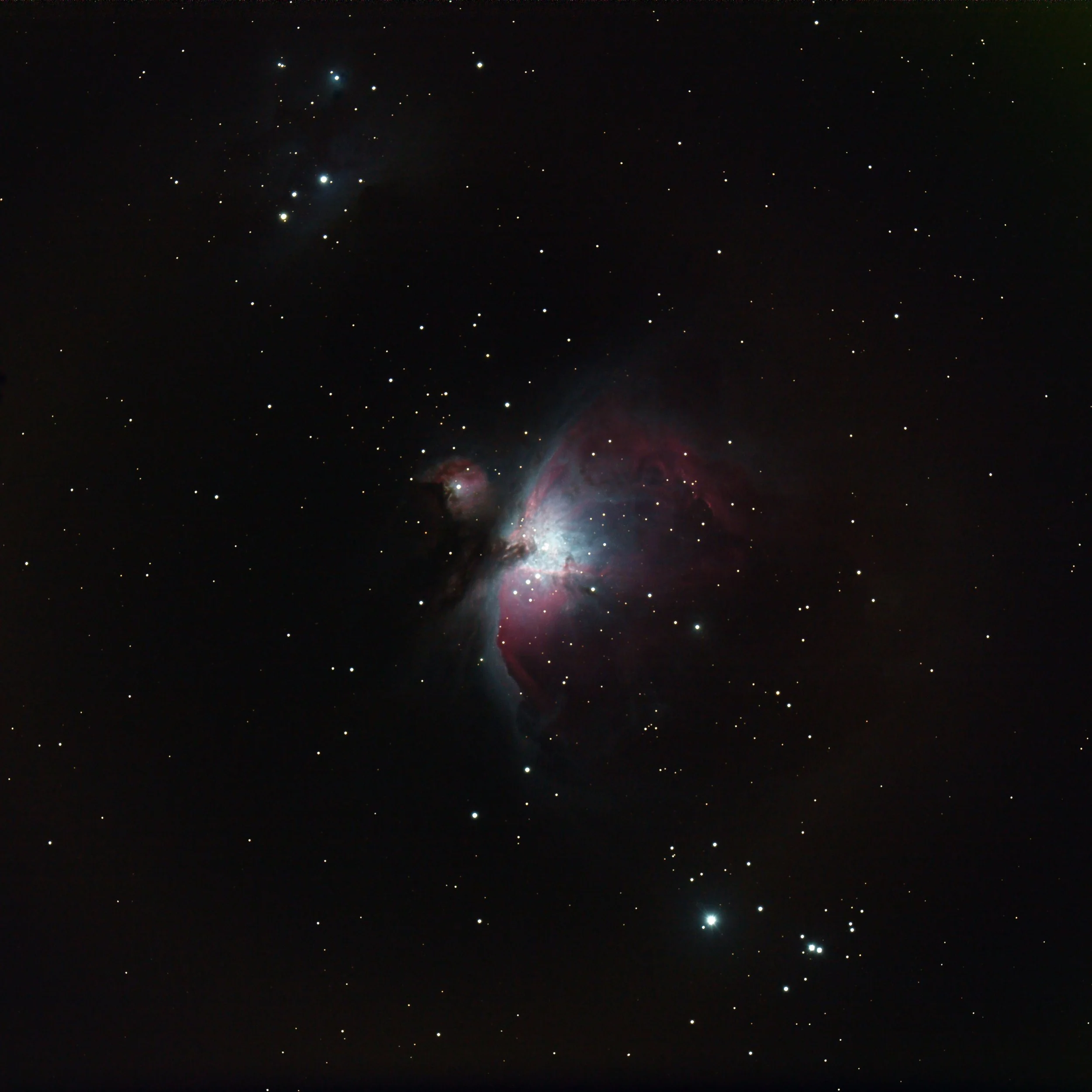
The Orion Nebula is maybe one the most photographed objects. No surprise that this is the first deep sky object I ever captured back in 2018. Now in 2026 it was time for a revisit.
Data Acquisition
The Orion Nebula was the first deep sky object that I ever photographed, back in 2018. Now, six years later a new series of images were taken. Data was collected during 7 nights in January 2026, using a 14” reflector telescope with full-frame camera at the remote observatory in Spain. Data was gathered using standard LRGB filters. To make sure also the detail in the very bright core of the nebula could be captured, a series of 10s luminance images were shot as well. A total of approximately 21 hours of data was finally combined to create the final image.
Location Remote hosting facility IC Astronomy in Oria, Spain (37°N 2°W)
Sessions
Frames
Equipment
Telescope
Mount
Camera
Filters
Guiding
Accessoires
Software
Planewave CDK14 (2563mm @ f/7.2), Optec Gemini Rotating focuser
10Micron GM2000HPS, custom pier
Moravian C3-61000 Pro (full frame), cooled to -10 ºC
Chroma 2” LRGB unmounted, Moravian filterwheel L, 7-position
Unguided
Compulab Tensor I-22, Dragonfly, Pegasus Ultimate Powerbox v2
Voyager Advanced, Viking, Mountwizzard4, Astroplanner, PixInsight 1.9.3
Processing
All processing was done in Pixsinsight unless stated otherwise. Default features were enhanced using scripts and tools from RC-Astro, SetiAstro, GraXpert, CosmicPhotons and others. Images were calibrated using 50 Darks, 50 Flats, and 50 Flat-Darks, registered and integrated using WeightedBatchPreProcessing (WBPP). The processing workflow diagram below outlines the steps taken to create the final image.
The biggest challenge when processing the Orion Nebula is the enormous dynamic range. The very faint layers of dust in the outer areas contrast significantly with the super bright core on the border between M42 and M43. And probably the biggest challenge is a small cluster of four stars, close together, located in that bright core. This cluster is known as the trapezium, and separation of individual stars in the trapezium is a unique challenge. Just to be prepared for this challenge, I had recorded 200 luminance images with an exposure of only 10s. That is much shorter than the 180s that I typically use.
But when processing the image, it appeared that not a single part of the starless nebula had any blown out highlights, not even in the brightest areas. In such a case, a careful stretching with highlight protection, in combination with some kind of HDR tool to compress the dynamic range will often suffice. And that was exactly the case here. Both in the RGB and the Lum channel, GHS in combination with HDRMultiscaleTransform worked well. The default settings in HDRMT were far too aggressive though, so I had to figure out the best parameters. I eventually settled on 9 layers to lightness for the Lum channel and 10 layers to intensity for the RGB channel. So the 10s exposures were not needed for the nebula part of the image.
This was different for the stars. Several of the bright stars and certainly all four stars of the trapezium had clipped in the core. This was even the case in the 10s exposures. It appeared impossible to stretch the Lum stars to a point where the trapezium stars would be separated, while the rest of the star field was properly visible. This was not helped by the fact that the trapezium stars did not survive the StarXTerminator process very well. Apparently SXT also had challenges with this bright core. The trapezium stars came out a bit blobby and showed a few spots around them as well. Many different approaches were tried, including HDRComposition, ImageBlending, HDRMT etc. But the stars-only images with their pure black background were not very malleable to any of these tools. So in the end I chose to stretch the 10s Lum and 180s Lum stars separately. The 10s image was stretched focusing on the trapezium and the 180s image was stretched for the whole star field. Next the trapezium stars from the 180s Lum were replaced by the ones from the 10s Lum. This was accomplished using a simple GAME mask. While this technique was simple to apply, it required a few tries before the two stretches and all brightness levels were such that the end result was a naturally looking image.
An alternative method might have been to process clones of the two starry Lum images, process them in a HDR way with focus on star visibility, and separate the stars after stretching.
One more thing to note on the stretching is that the Orion Nebula is extremely colourful and shows the typical magenta/purple hues all over the place. Often stretching in the ‘Colour’ mode with the blend set to 1 is required in GHS to maintain sufficient colour. But M42 has so much colour that the blend was set to somewhere between 0.1 and 0.2. Otherwise the whole image would be over-saturated.
The rest of the processing used a fairly standard approach, outlined below.
Processing workflow (click to enlarge)
This image has been published on Astrobin.