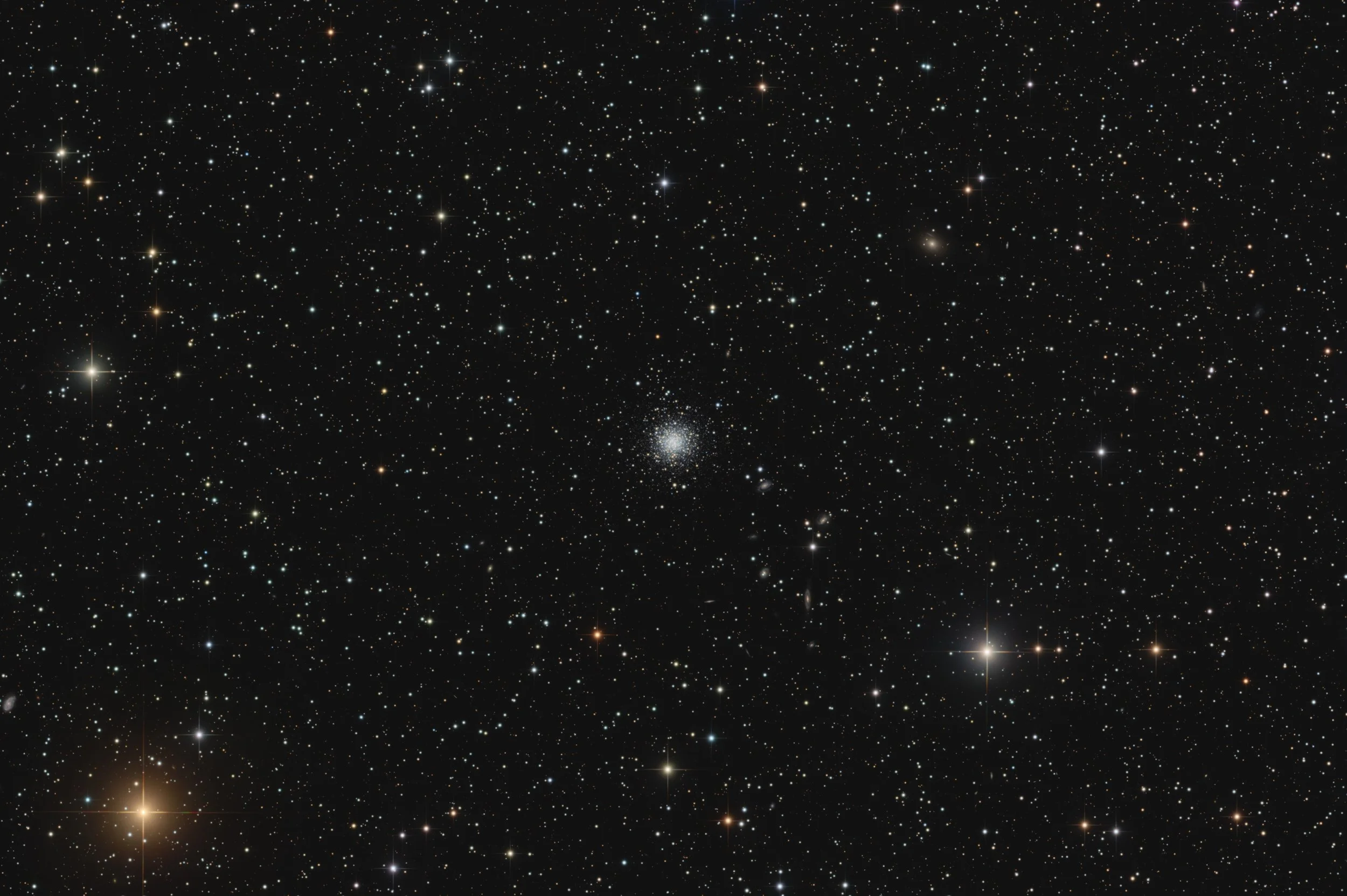
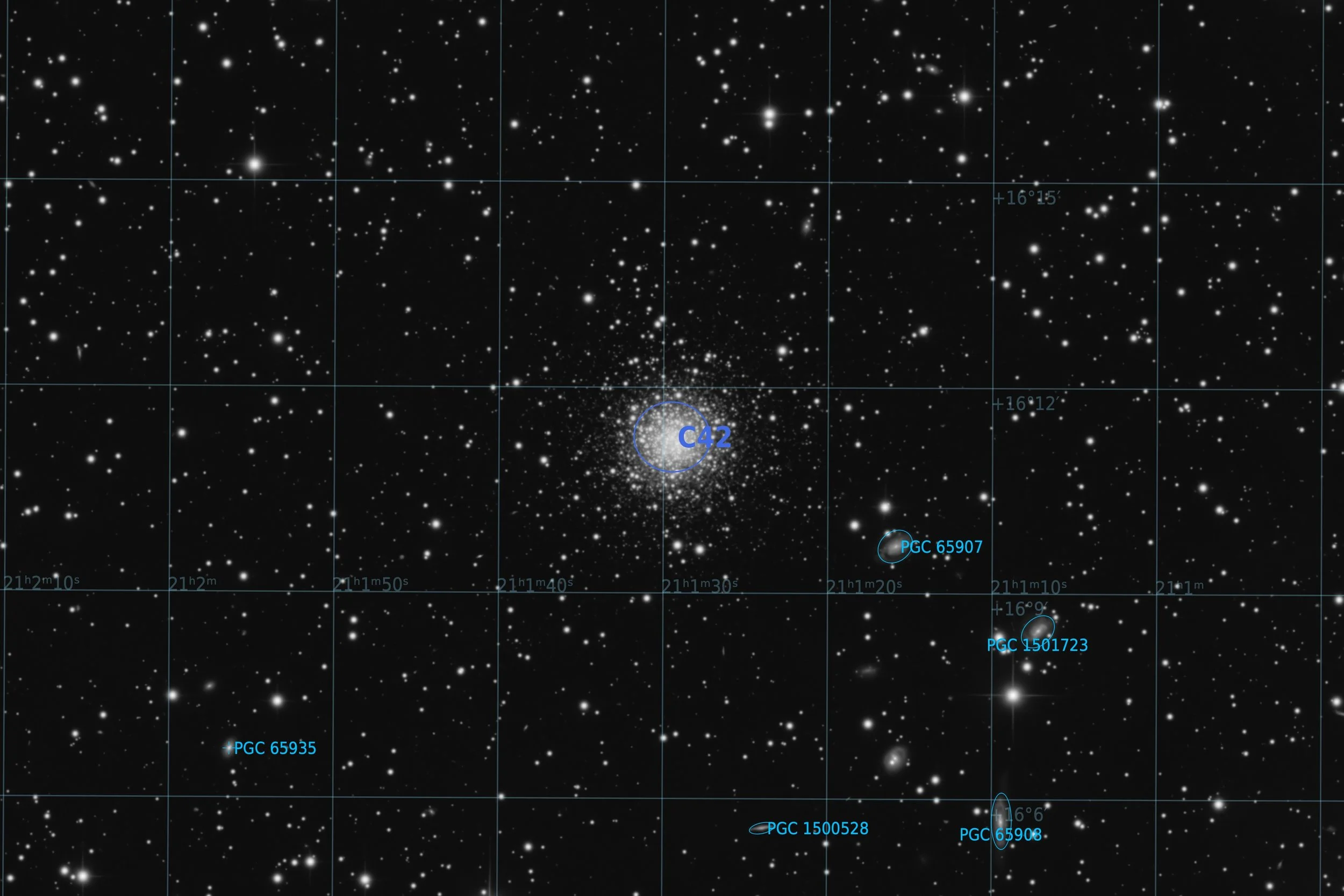
NGC 7006
19’ x 13’ | 0.3”/px | 3900 × 2600 px
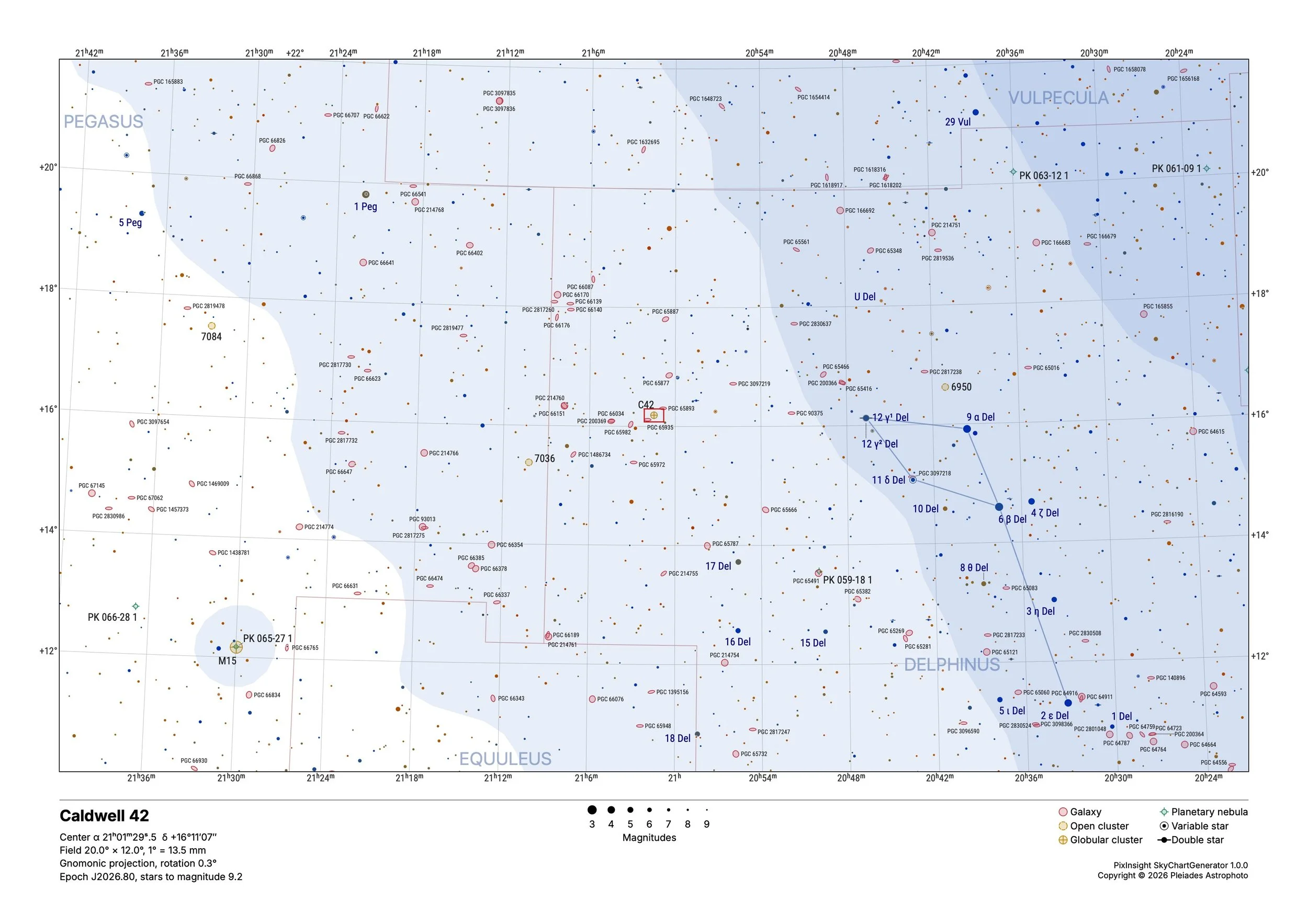
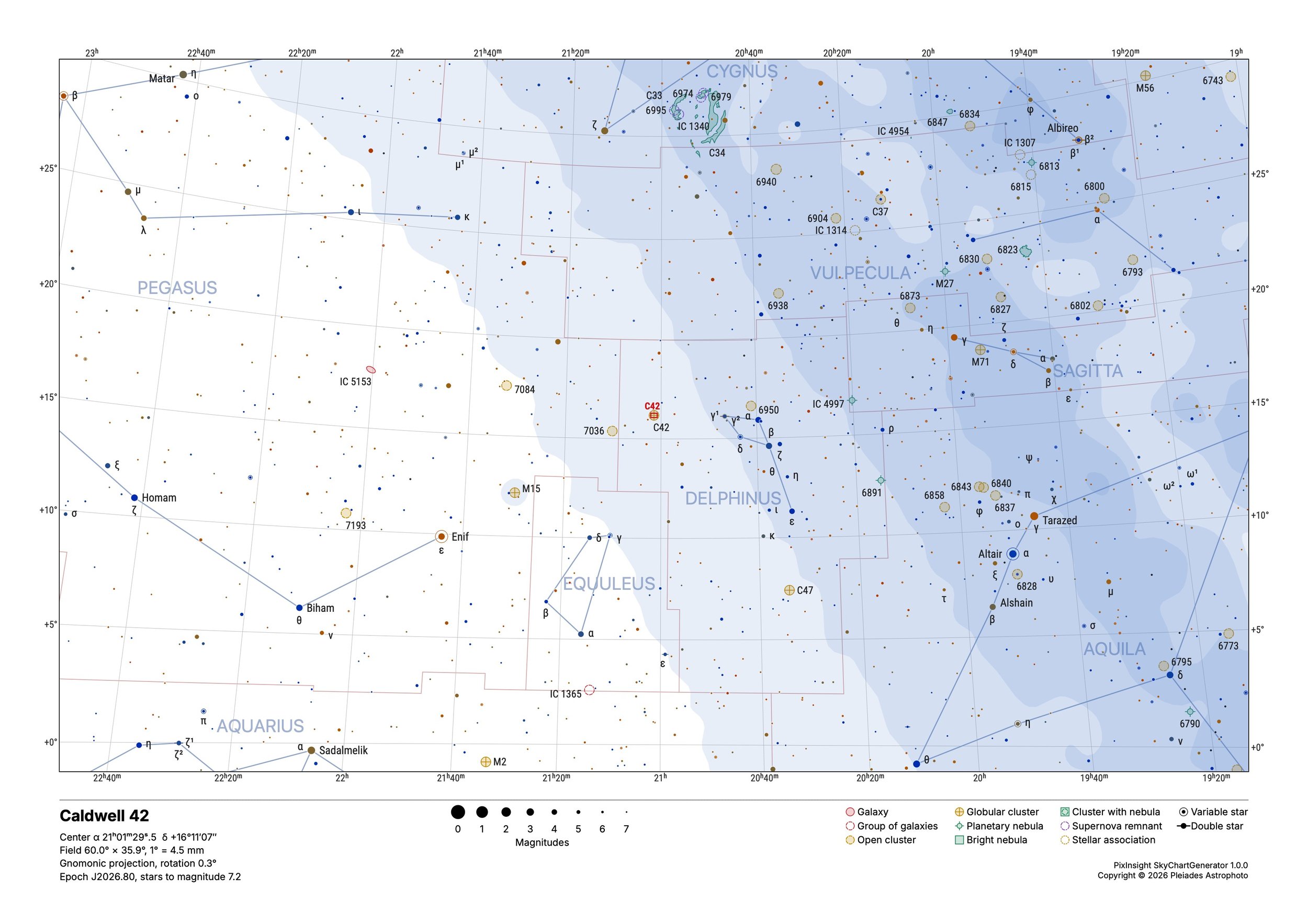
Delphinus
RA 21h 01m 29s Dec +16° 11’ 06” | 0°
Caldwell 42, also known as NGC 7006, is a globular cluster in the constellation Delphinus, the Dolphin, lying just east of the main diamond of stars near the border with Pegasus. William Herschel discovered it on 21 August 1784, and his son John confirmed the observation in 1825. NGC 7006 lies about 135,000 light-years from Earth, roughly 125,000 to 130,000 light-years from the galactic centre. This places it in the outer halo, where few globular clusters are found, and makes it one of the most distant Milky Way globulars observable with amateur telescopes. It shines at about magnitude 10.6 and appears 3 to 4 arcminutes across in most references, which corresponds to a diameter of roughly 110 to 140 light-years. It contains around 250,000 stars and is estimated to be about 12 billion years old. The cluster is best known to astronomers as the textbook example of the "second parameter problem". Its horizontal branch stars are redder than expected for a cluster with its low metal content, and no single explanation has been agreed on. NGC 7006 also follows a very elongated orbit around the Milky Way, which suggests it may have formed in a dwarf galaxy that the Milky Way later captured.
Source: Claude.ai
Data Acquisition
Data was collected during 4 nights in October 2026, using a 14” reflector telescope with full-frame camera at the remote observatory in Spain. It is a very small object, smaller than many of the other clusters in the Messier and Caldwell catalogue. Data was gathered using standard RGB filters. A total of approximately 11 hours of data was finally combined to create the final image.
Location Remote hosting facility Roboscopes in Fregenal de la Sierra, Spain (38°N 6°W)
Sessions
| Object | Session | Moon% | Moon ° | SQM | Hum % | Temp °C | Frames | Exposure |
|---|---|---|---|---|---|---|---|---|
| C42 | 2026-10-09 | 1 | 132 | 21.4 | 60 | 12 | 56 | 4h 40m |
| 2026-10-11 | 1 | 112 | 21.4 | 69 | 15 | 58 | 4h 50m | |
| 2026-10-16 | 32 | 61 | 21.4 | 65 | 17 | 7 | 0h 35m | |
| 2026-10-31 | 62 | 137 | 20.1 | 60 | 12 | 21 | 1h 45m | |
| Grand Total | 142 | 11h 50m | ||||||
Frames
| Object | Filter | Sensor °C | Bin | Gain | Exp (s) | Frames | Exposure |
|---|---|---|---|---|---|---|---|
| C42 | Chroma Red | -10 | 1 | 0 | 300 | 47 | 3h 55m |
| Chroma Blue | -10 | 1 | 0 | 300 | 45 | 3h 45m | |
| Chroma Green | -10 | 1 | 0 | 300 | 50 | 4h 10m | |
| Grand Total | 142 | 11h 50m | |||||
Equipment
Telescope
Mount
Camera
Filters
Guiding
Accessoires
Software
Planewave CDK14 (2563mm @ f/7.2), Optec Gemini Rotating focuser
10Micron GM2000HPS, custom pier
Moravian C3-61000 Pro (full frame), cooled to -10 ºC
Chroma 2” RGB unmounted, Moravian filterwheel L, 7-position
Unguided
Compulab Tensor I-22, Dragonfly, Pegasus Ultimate Powerbox v2
Voyager Advanced, Viking, Mountwizzard4, Astroplanner, PixInsight 1.9.6
Processing
All processing was done in Pixsinsight unless stated otherwise. Default features were enhanced using scripts and tools from RC-Astro, SetiAstro, GraXpert, CosmicPhotons and others. Images were calibrated using 50 Darks, 50 Flats, and 50 Flat-Darks, registered and integrated using WeightedBatchPreProcessing (WBPP). The processing workflow diagram below outlines the steps taken to create the final image.
With the removal of GraXpert as process in PixInsight (it still exists as script), I plan on making more use of the native gradient correction tool, called GradientCorrection. This was an easy target to get right, so default settings worked well. Original stretching was designed to only bring out the star cluster, and included my standard approach of ArcsinhStretch followed by HistogramTransformation. But then I noticed how many small galaxies were surrounding the cluster and I tried to bring those out just a little bit more using some selective stretching using MAS.
Other than that, the rest of the processing was straightforward and followed a standard approach. The outline below shows all processing steps applied to the image.
Processing workflow (click to enlarge)
This image has been published on Astrobin.