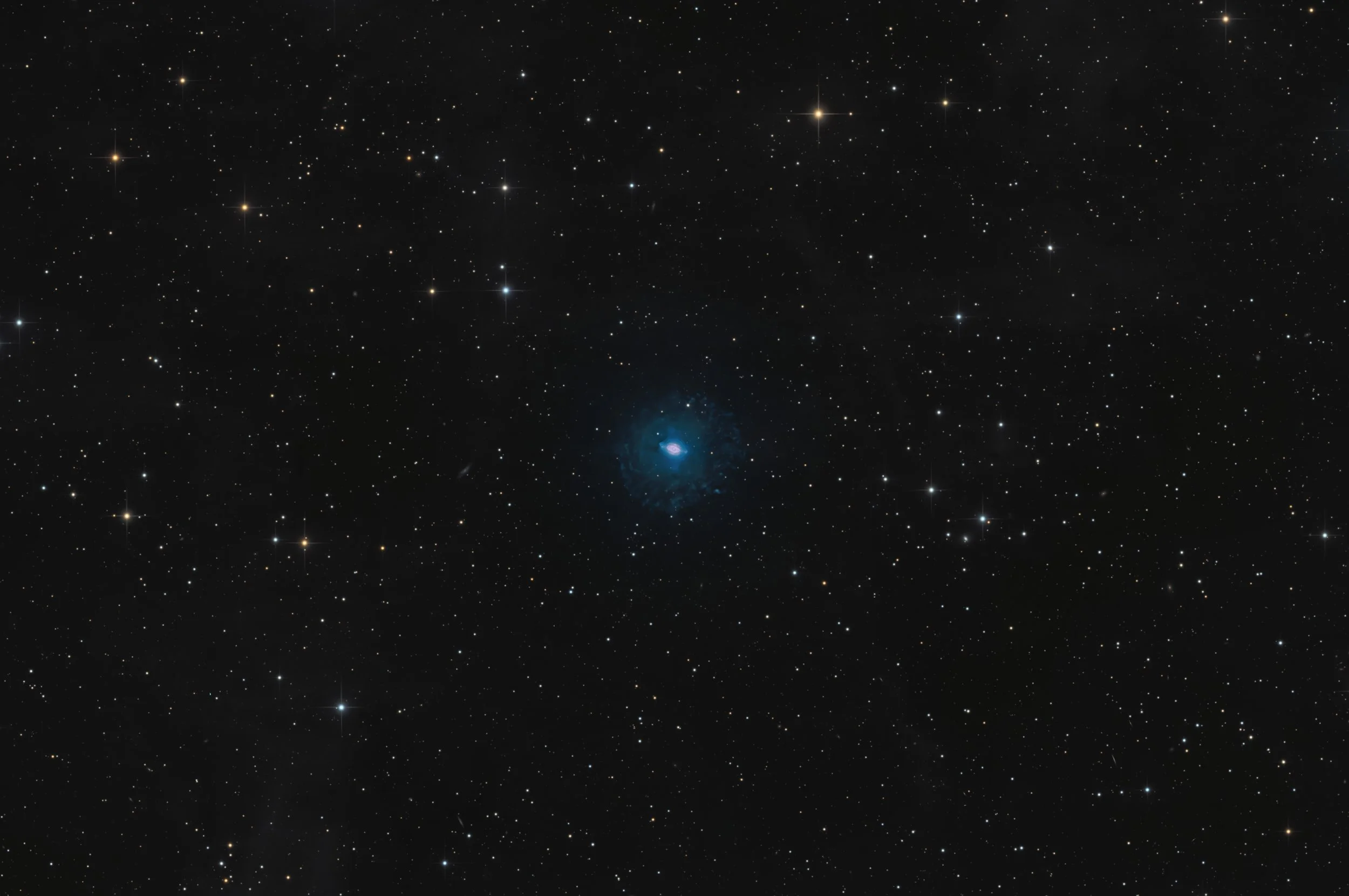
NGC 7009, Saturn Nebula
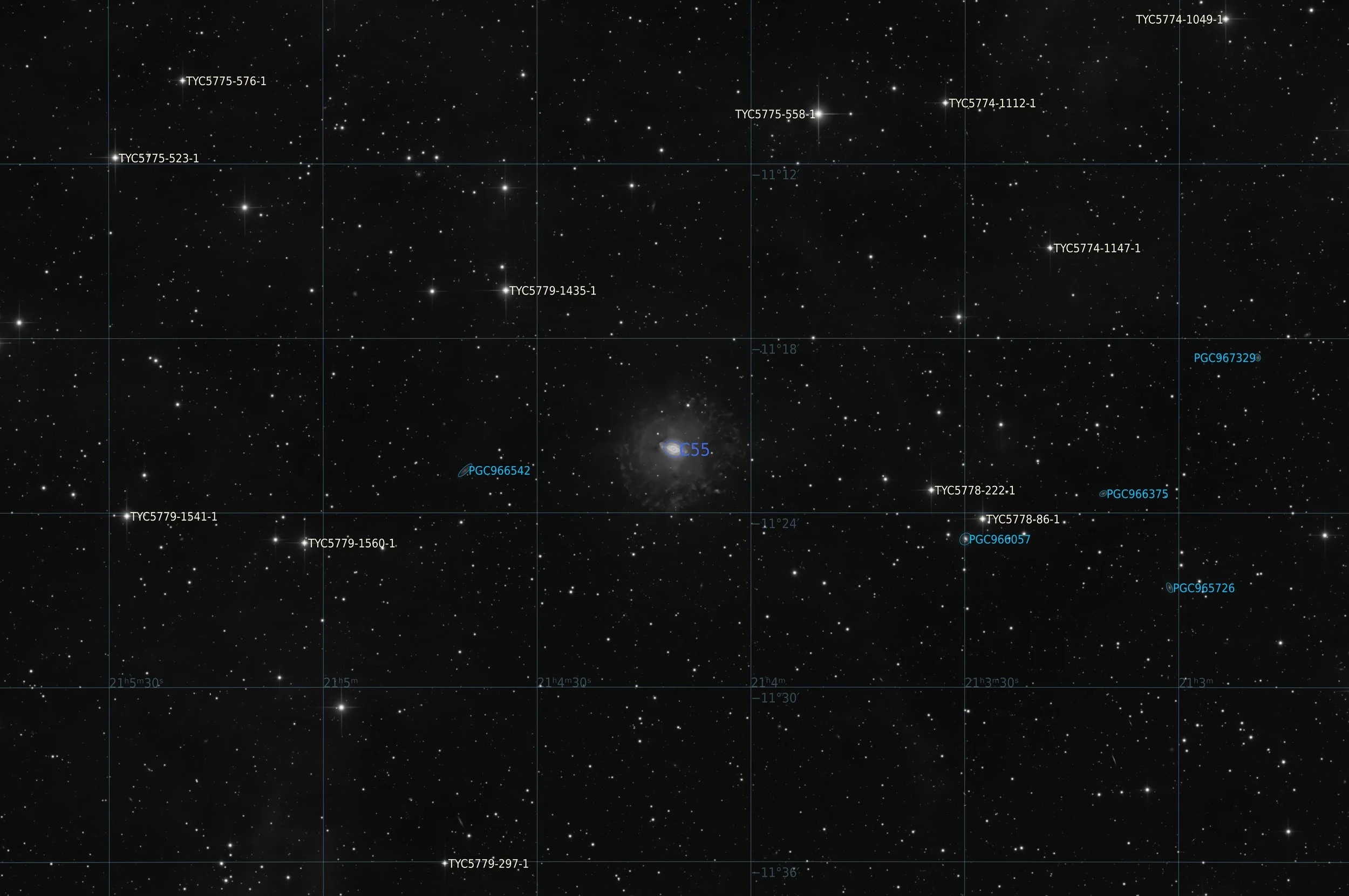
15’ x 10’ | 0.3”/px | 3156 × 2014 px
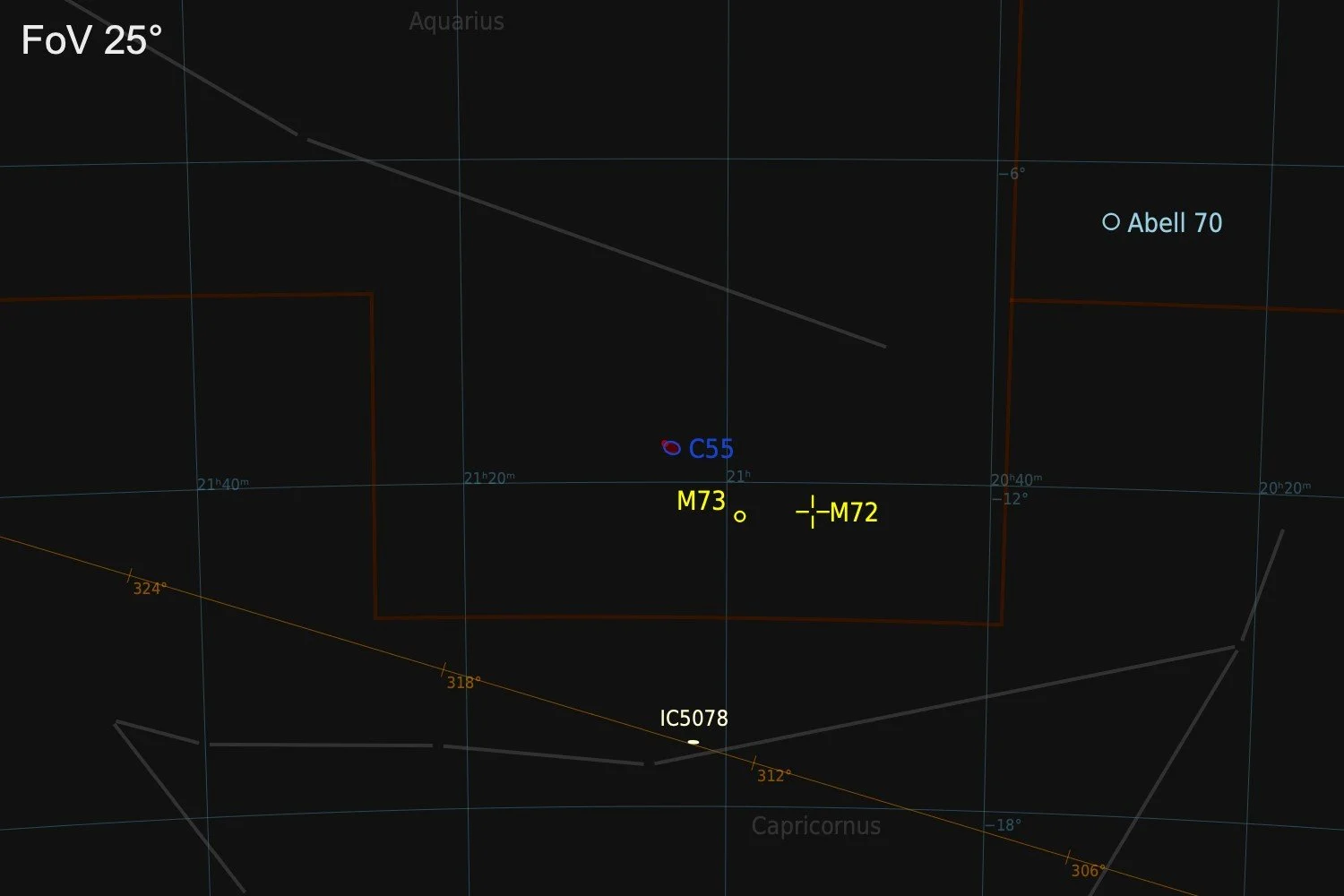
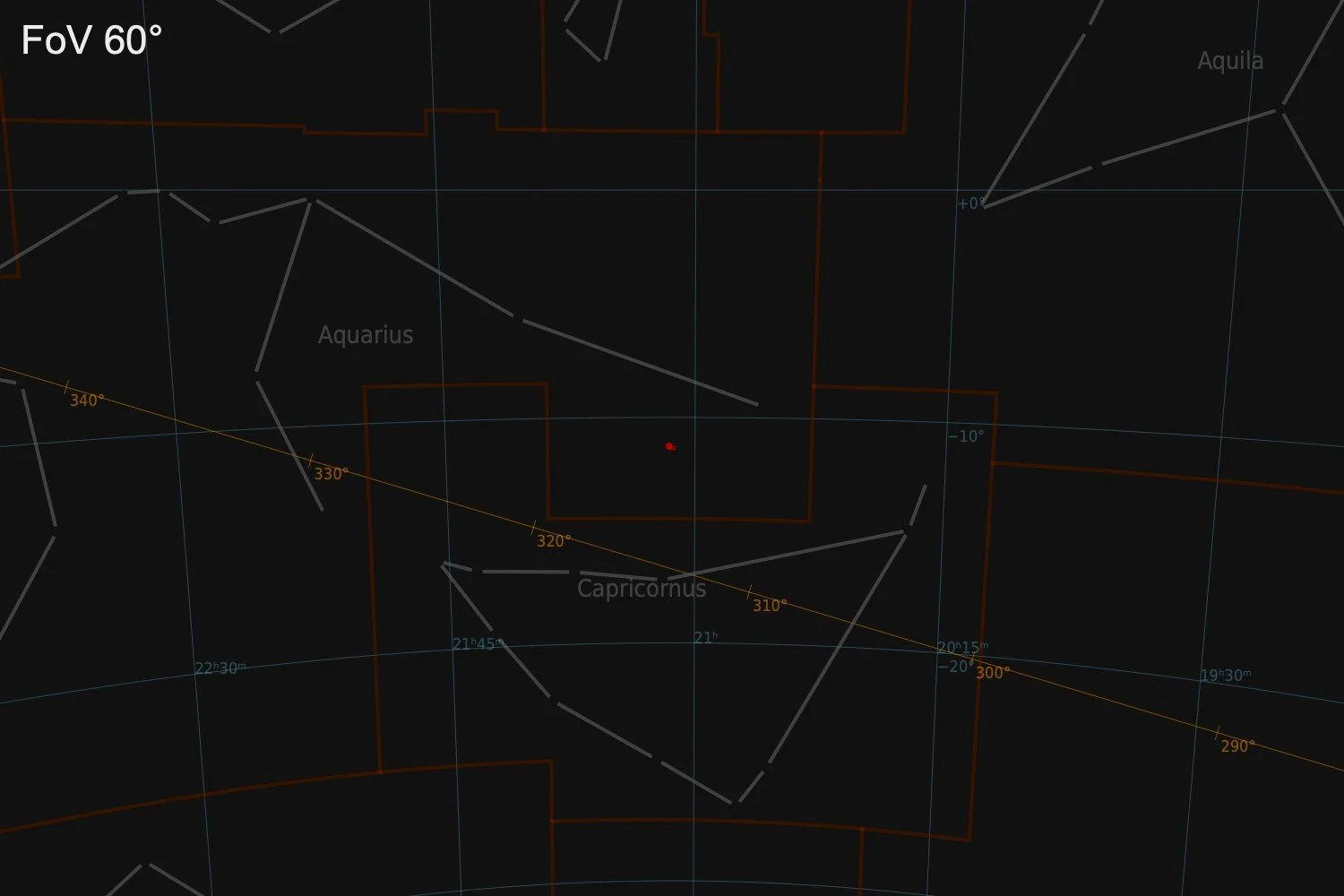
Aquarius
RA 21h 04m 11s Dec -11° 21’ 50” | 0°
Caldwell 55, also known as NGC 7009, is a planetary nebula in the constellation Aquarius, popularly known as the Saturn Nebula. William Herschel discovered it on 7 September 1782, and it was one of his earliest discoveries. It is also designated PK 37-34.1. The distance to the nebula is not well established. Estimates range from about 2,000 to 5,200 light-years. The bright central shell measures about 28 by 20 arcseconds, while the fuller outer shell extends to roughly 41 by 35 arcseconds, corresponding to a physical radius of only 0.2 to 0.4 light-years. A much fainter outer halo about 4.5 arcminutes across was only discovered in 1998. At around magnitude 8.0, it is one of the brightest planetary nebulae in the sky. Doubly ionised oxygen gives it a greenish-blue glow. The nebula gets its name from the pair of narrow protrusions on either side of the central shell, called ansae. In small telescopes these resemble the rings of Saturn seen edge-on. Studies show the ansae expand non-radially away from the central star, and similar features occur in only a few other planetary nebulae, including the Cat’s Eye Nebula (NGC 6543) and NGC 3242. Detailed observations show that Caldwell 55 has a complex structure, with multiple shells, a halo, jet-like streams, and small-scale filaments and knots. Hubble images show a bright central star in a dark cavity bounded by a football-shaped rim of dense gas.
Source: Claude.ai
Data Acquisition
Data was collected during 12 nights in from August until October 2026, using a 14” reflector telescope with full-frame camera at the remote observatory in Spain. Data was gathered using LRGB and 3nm Ha and OIII filters, using different exposure times. A total of approximately 18 hours of data was finally combined to create the final image.
The original plan was to just image the bright and very small planetary nebula which may not be bigger than something like 30 arc seconds. So I setup my typical profile including 600s HA and OIII images combined with a decent amount of LRGB data. Some of the images seen on-line were done in just LRGB, so this seemed like a good dataset to have. As the images came in, I realised that the 600s was too long. The core of the nebula was still not burnt-out, but likely detail was lost at these very long exposures. So I added a series of 60s Ha and OIII exposures. This coincidence turned out to be a very lucky one, as it resulted in an opportunity to include the much larger ~4.5 arc minute OIII outer halo. Most images only show the small bright inner part. It was not until I looked at the master of the 600s OIII channel that I realised that the large outer halo was indeed captured. I immediately did some further research, and found less than a handful of images on Astrobin that had captured this halo. Very interesting when you realise that the halo was discovered as recent as in 1998.
Location Remote hosting facility Roboscopes in Fregenal de la Sierra, Spain (38°N 6°W)
Sessions
| Object | Session | Moon% | Moon ° | SQM | Hum % | Temp °C | Frames | Exposure |
|---|---|---|---|---|---|---|---|---|
| C55 | 2026-08-18 | 37 | 95 | 21.4 | 45 | 27 | 52 | 2h 36m |
| 2026-08-20 | 56 | 71 | 21.1 | 48 | 27 | 2 | 0h 6m | |
| 2026-08-21 | 56 | 59 | 20.9 | 36 | 23 | 32 | 2h 34m | |
| 2026-08-22 | 65 | 47 | 20.5 | 44 | 22 | 10 | 1h 40m | |
| 2026-08-30 | 93 | 54 | 18.5 | 51 | 21 | 1 | 0h 10m | |
| 2026-08-31 | 78 | 67 | 18.5 | 41 | 21 | 41 | 2h 45m | |
| 2026-09-01 | 78 | 81 | 19.1 | 37 | 21 | 47 | 3h 23m | |
| 2026-09-02 | 68 | 94 | 19.9 | 44 | 22 | 5 | 0h 45m | |
| 2026-09-08 | 7 | 174 | 29 | 27 | 12 | 2h 0m | ||
| 2026-10-01 | 65 | 119 | 19.8 | 58 | 19 | 33 | 0h 33m | |
| 2026-10-04 | 37 | 161 | 21.1 | 66 | 20 | 26 | 0h 26m | |
| 2026-10-08 | 4 | 143 | 21.5 | 52 | 19 | 90 | 1h 30m | |
| Grand Total | 351 | 18h 28m | ||||||
Frames
| Object | Filter | Sensor °C | Bin | Gain | Exp (s) | Frames | Exposure |
|---|---|---|---|---|---|---|---|
| C55 | Chroma Luminance | -10 | 1 | 0 | 180 | 108 | 5h 24m |
| Chroma Blue | -10 | 1 | 0 | 300 | 17 | 1h 25m | |
| Chroma Green | -10 | 1 | 0 | 300 | 22 | 1h 50m | |
| Chroma Red | -10 | 1 | 0 | 300 | 22 | 1h 50m | |
| Chroma OIII - 3nm | -10 | 1 | 2750 | 600 | 33 | 5h 30m | |
| Chroma OIII - 3nm | -10 | 1 | 2750 | 60 | 104 | 1h 44m | |
| Chroma Ha - 3nm | -10 | 1 | 2750 | 60 | 45 | 0h 45m | |
| Grand Total | 351 | 18h 28m | |||||
Equipment
Telescope
Mount
Camera
Filters
Guiding
Accessoires
Software
Planewave CDK14 (2563mm @ f/7.2), Optec Gemini Rotating focuser
10Micron GM2000HPS, custom pier
Moravian C3-61000 Pro (full frame), cooled to -10 ºC
Chroma 2” Ha, OIII (both 3nm, LRGB unmounted, Moravian filterwheel L, 7-position
Unguided
Compulab Tensor I-22, Dragonfly, Pegasus Ultimate Powerbox v2
Voyager Advanced, Viking, Mountwizzard4, Astroplanner, PixInsight 1.9.6
Processing
All processing was done in Pixsinsight unless stated otherwise. Default features were enhanced using scripts and tools from RC-Astro, SetiAstro, GraXpert, CosmicPhotons and others. Images were calibrated using 50 Darks, 50 Flats, and 50 Flat-Darks, registered and integrated using WeightedBatchPreProcessing (WBPP). The processing workflow diagram below outlines the steps taken to create the final image.
Unfortunately the 600s exposures resulted in a very big challenge during processing. With the nebula core being so bright and small, it actually creates star spikes in the images. And not the thin somewhat elegant ones, but thick and heavy ugly ones. But the only way to bring up the outer halo was to apply a significant stretch, bringing out the spikes in all their glory. I’ve looked into various options, most of which would require some kind of manual intervention to peel the spikes out of the image, obviously with a high risk to damage the underlying halo-data. In the end I decided to try the relatively new script SpikelessAI, part of the Lighthouse Suite of PixInsight tools, developed by Neven Krcmarek. Unfortunately the tool crashed on my computer. But the support from Neven is excellent, and he helped me create a ‘spikeless’ version of my image. The spikes were not completely gone, but at least around the complex area of the nebula-halo it did a decent job of removing the spikes without leaving too many traces. The remainders of the spikes were removed using the Dodge and Burn tool, also part of the Lighthouse suite, very easy to use and with high quality results.
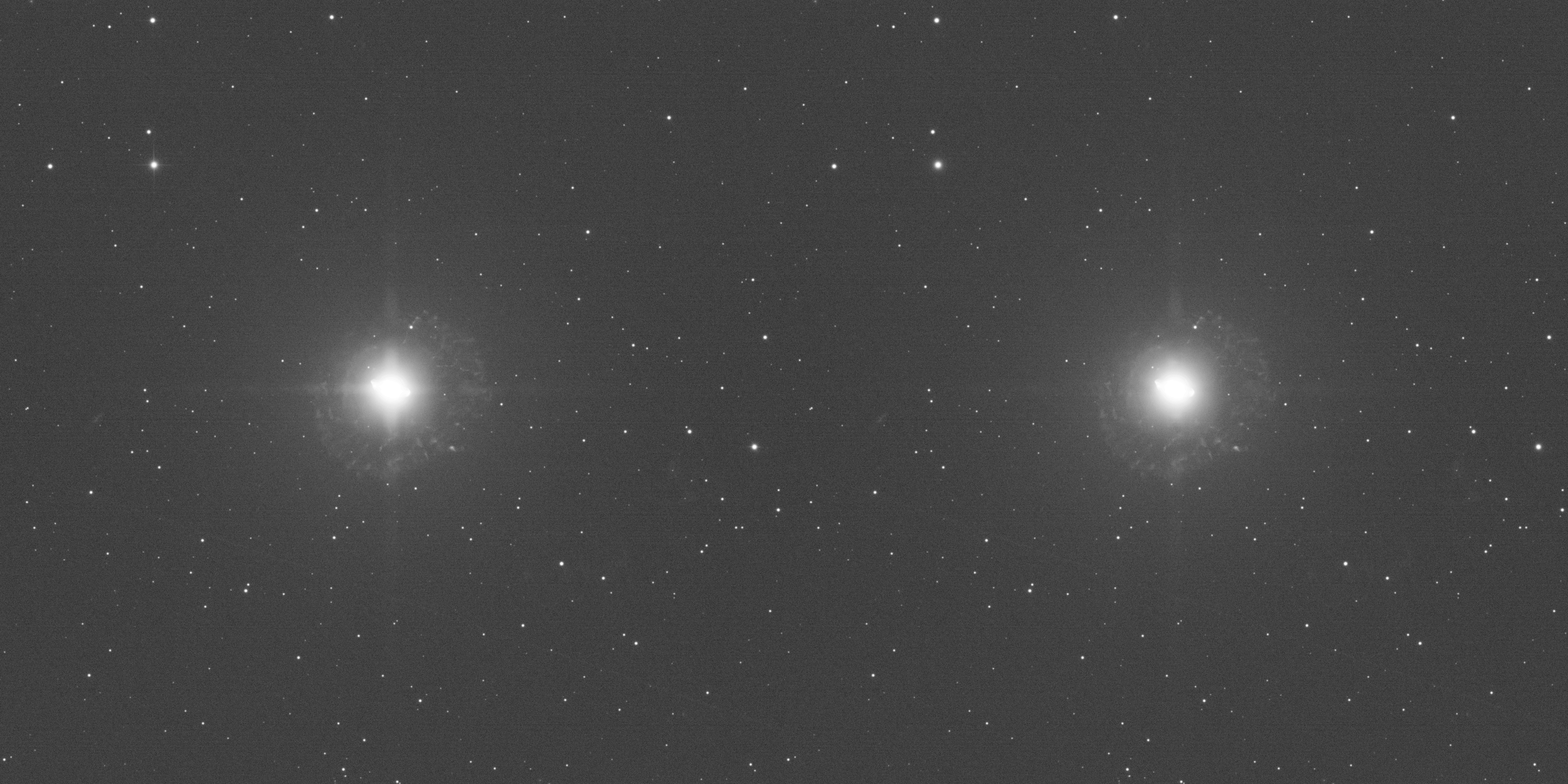
SpikelessAI did a reasonably good job in removing the spikes from the most challenging area. The remaining outer parts of the spikes were removed using Dodge & Burn.
The 60s exposures of Ha and OIII were much better suited for what many would consider ‘the’ nebula. A pretty straightforward narrowband approach, adding the colours using NBColourmapper rather than NarrowbandNormalization. In this case I found it a bit easier to get to the desired result. The core of the larger OIII nebula was substituted with the 60s HO nebula using ImageBlend. This gave a well balanced and pretty detailed view on both the bright core and faint outer halo of this nebula. The 600s Ha data were discarded. There was just nog much data in there that wasn’t already covered.
The LRGB data were closely examined. And also here, there was quite a nice bit of detail visible in the core nebula. But nothing more than in the 60s HO version. So rather than blending those two, I decided to just completely remove the nebula from the LRGB image (with Dodge & Burn) and only use the complex narrowband version of the nebula. It limited the role of the LRGB data to being not much more than a detailed capture of the star field. Perhaps a bit of a waste of data, but I did not feel that the LRGB data would add much to the final nebula result.
The outline below shows a detailed breakdown of the processing steps applied to the image, which may have been the most complex one carried out so far..
Processing workflow (click to enlarge)
This image has been published on Astrobin.