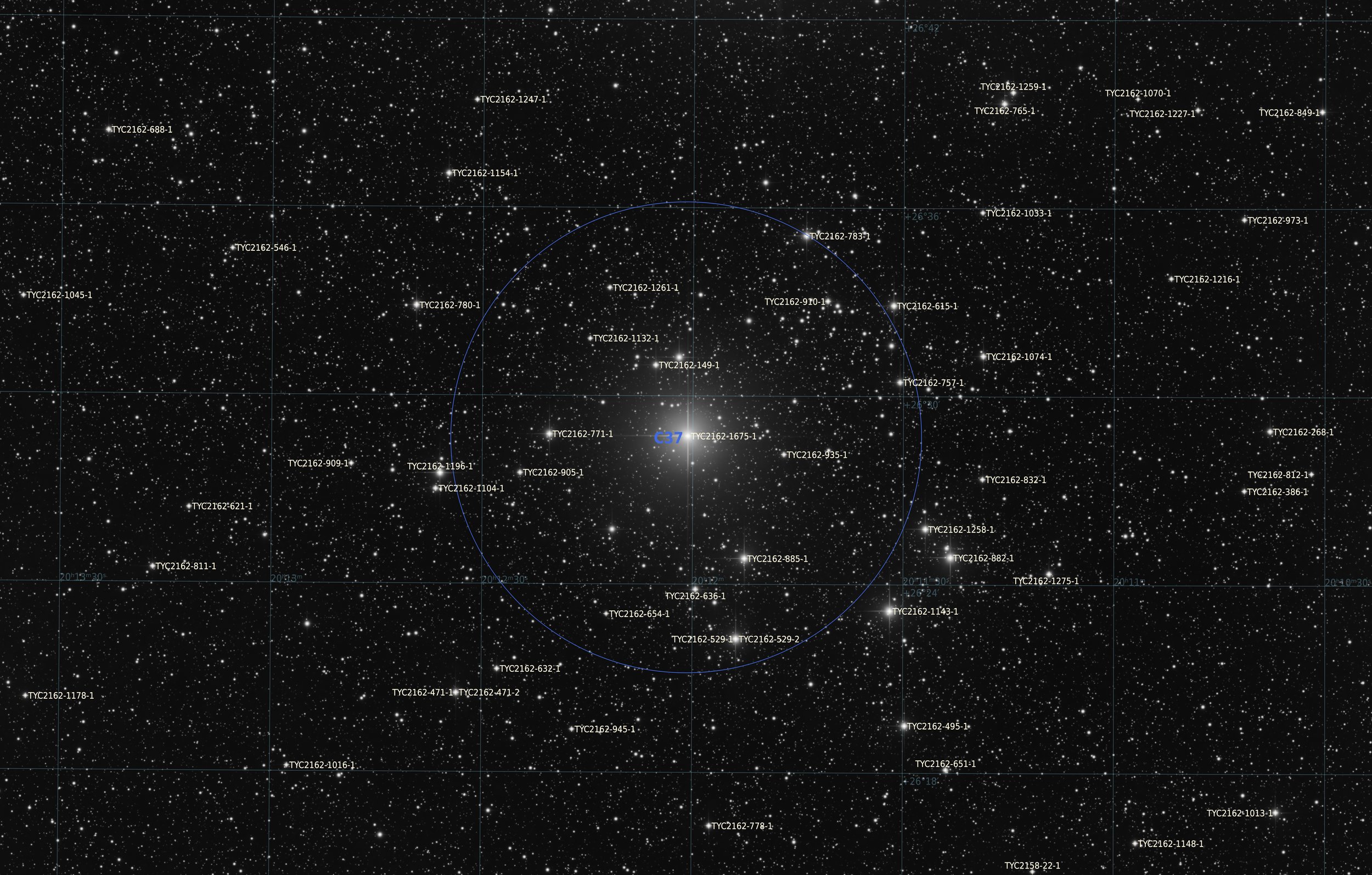
NGC 6885, 20 Vulpeculae cluster
43’ x 27’ | 0.3”/px | 8701 × 5548 px
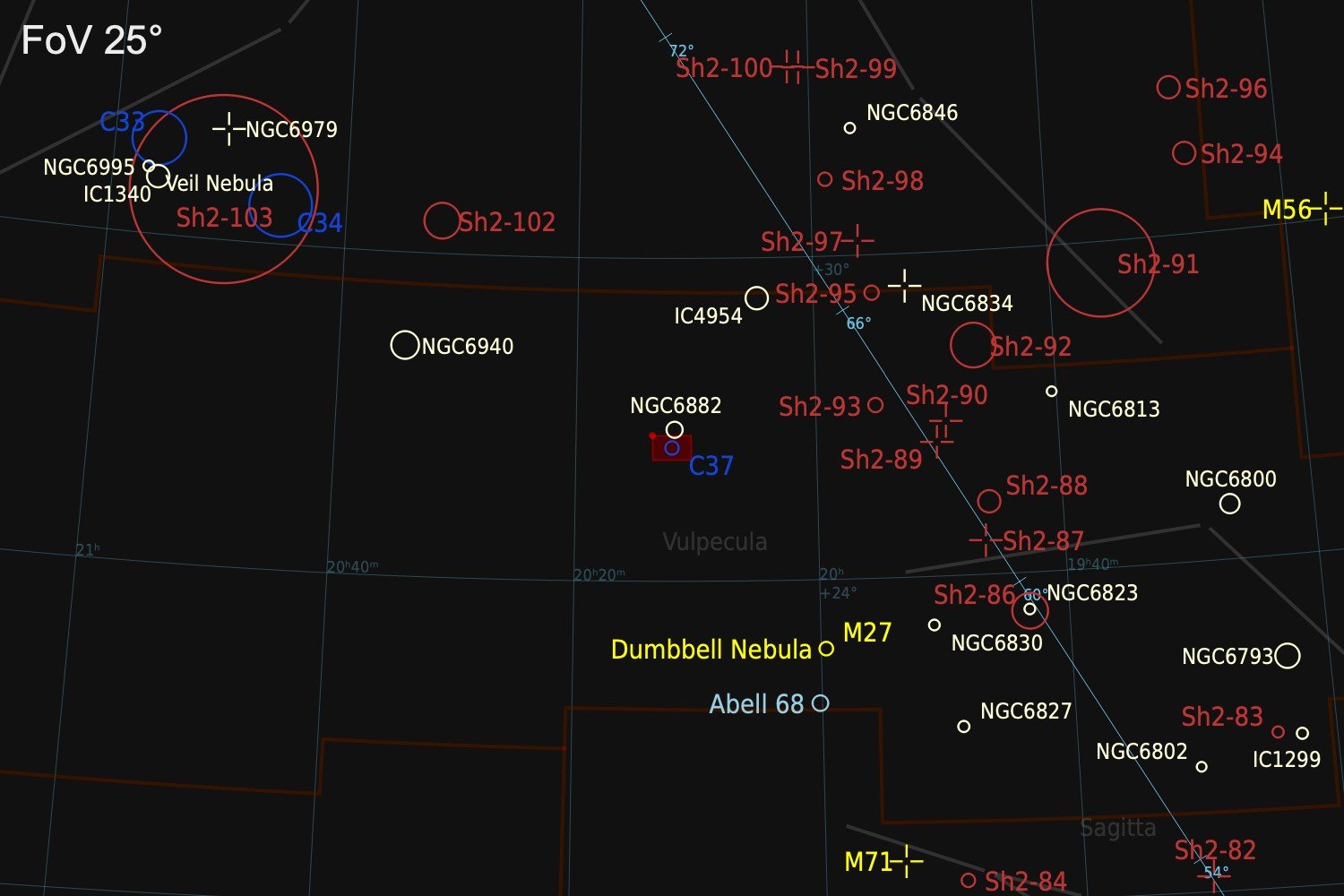
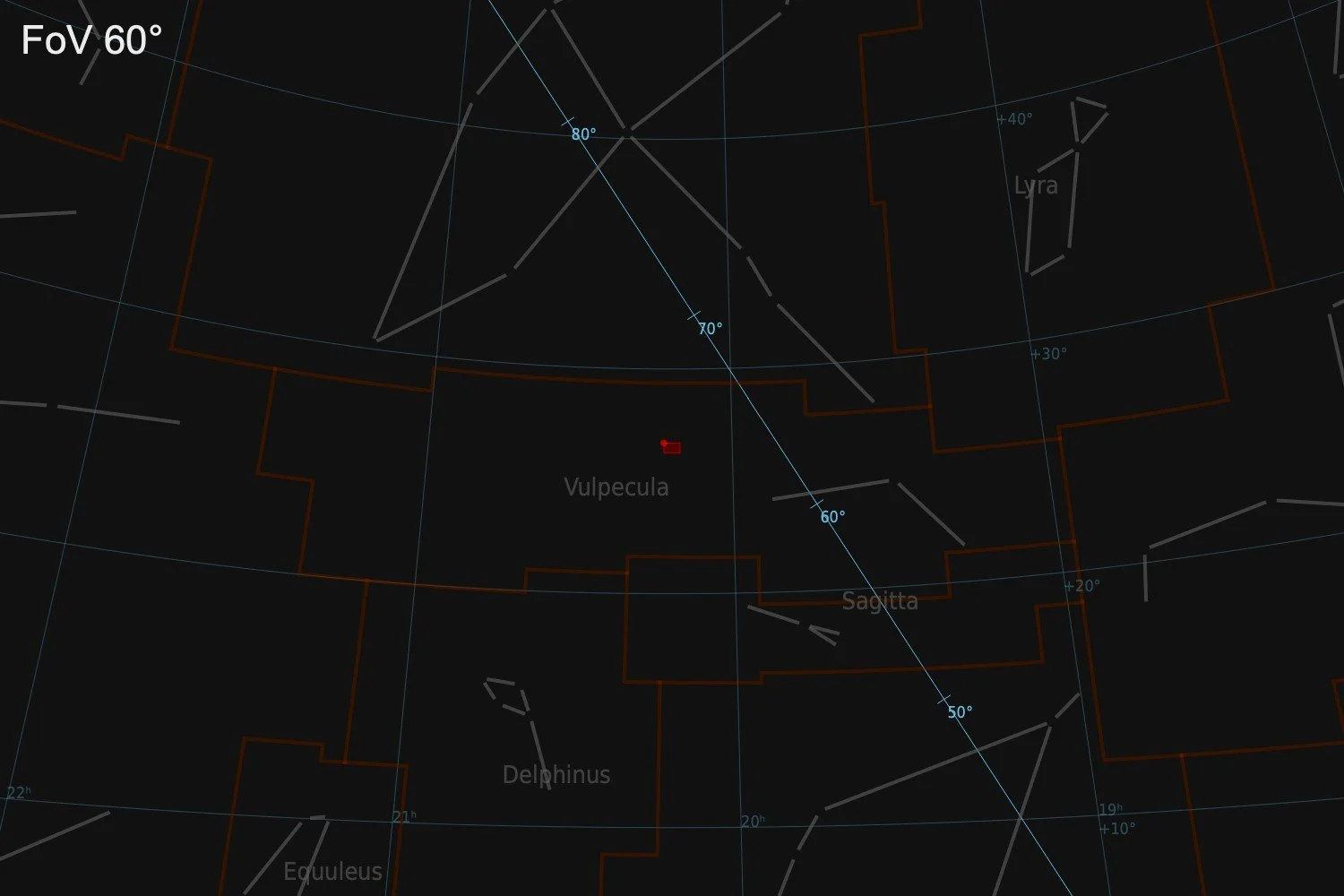
Vulpecula
RA 20h 12m 01s Dec +26° 28’ 40” | 0°
Caldwell 37, also known as NGC 6885, is an open star cluster in the constellation Vulpecula, the Fox. William Herschel discovered it in September 1784. The cluster lies about 2,000 light-years from Earth. It centres on 20 Vulpeculae, a naked-eye Be star of about magnitude 5.9. The brightest members are scattered around this star, and the glare often makes the cluster easy to miss at first glance. Quoted magnitudes range from 5.7 to 8.1, depending on whether the bright star is counted. The compact core spans about 7 arcminutes, and including the wider grouping it covers around 20 arcminutes, or roughly 12 light-years. Up to about 40 stars can be seen in a small telescope. The cluster is estimated to be around 1.4 billion years old, which makes it an old open cluster. Its history is somewhat confusing. Herschel catalogued two clusters on the same night, NGC 6882 and NGC 6885, with nearly identical descriptions. Many astronomers think NGC 6882 was a repeated observation of the same group. Others identify it with the fainter, smaller cluster Collinder 416, which lies at the northwestern edge of NGC 6885. In practice the two overlap so much that the region often looks like a single loose grouping of stars.
Source: Claude.ai
Data Acquisition
Data was collected during 2 nights in October 2026, using a 14” reflector telescope with full-frame camera at the remote observatory in Spain. Data was gathered using standard RGB filters, mainly during full moon periods. Clusters like this are ideal targets for these otherwise challenging periods. A total of approximately 7 hours of data was finally combined to create the final image.
Location Remote hosting facility Roboscopes in Fregenal de la Sierra, Spain (38°N 6°W)
Sessions
| Object | Session | Moon% | Moon ° | SQM | Hum % | Temp °C | Frames | Exposure |
|---|---|---|---|---|---|---|---|---|
| C37 | 2026-10-21 | 78 | 48 | 19.6 | 72 | 12 | 78 | 3h 54m |
| 2026-10-22 | 86 | 53 | 18.9 | 58 | 12 | 67 | 3h 21m | |
| Grand Total | 145 | 7h 15m | ||||||
Frames
| Object | Filter | Sensor °C | Bin | Gain | Exp (s) | Frames | Exposure |
|---|---|---|---|---|---|---|---|
| C37 | Chroma Red | -10 | 1 | 0 | 180 | 49 | 2h 27m |
| Chroma Blue | -10 | 1 | 0 | 180 | 49 | 2h 27m | |
| Chroma Green | -10 | 1 | 0 | 180 | 47 | 2h 21m | |
| Grand Total | 145 | 7h 15m | |||||
Equipment
Telescope
Mount
Camera
Filters
Guiding
Accessoires
Software
Planewave CDK14 (2563mm @ f/7.2), Optec Gemini Rotating focuser
10Micron GM2000HPS, custom pier
Moravian C3-61000 Pro (full frame), cooled to -10 ºC
Chroma 2” RGB unmounted, Moravian filterwheel L, 7-position
Unguided
Compulab Tensor I-22, Dragonfly, Pegasus Ultimate Powerbox v2
Voyager Advanced, Viking, Mountwizzard4, Astroplanner, PixInsight 1.9.5
Processing
All processing was done in Pixsinsight unless stated otherwise. Default features were enhanced using scripts and tools from RC-Astro, SetiAstro, GraXpert, CosmicPhotons and others. Images were calibrated using 50 Darks, 50 Flats, and 50 Flat-Darks, registered and integrated using WeightedBatchPreProcessing (WBPP). The processing workflow diagram below outlines the steps taken to create the final image.
The critical element in this image is the very bright star 20 Vulpeculae. It quickly overpowers the whole image, so stretching should be done very carefully. For star clusters I do find the old-fashioned method of using ArcsinhStretch followed by HistogramTransformation very effective. And also in this case it provided enough flexibility to find a proper balance between the very bright central star and the rest of the cluster. The one thing that ArcsinhStretch can be sensitive to is contracting of the star-core to a little disc with very sharp edges. The typical way I deal with that is a little convolution of such a star core, using a technique that is described in detail here.
Other than that, the rest of the processing was very straightforward and followed a pretty standard approach. The outline below shows a detailed breakdown of the processing steps applied to the image.
Processing workflow (click to enlarge)
This image has been published on Astrobin.