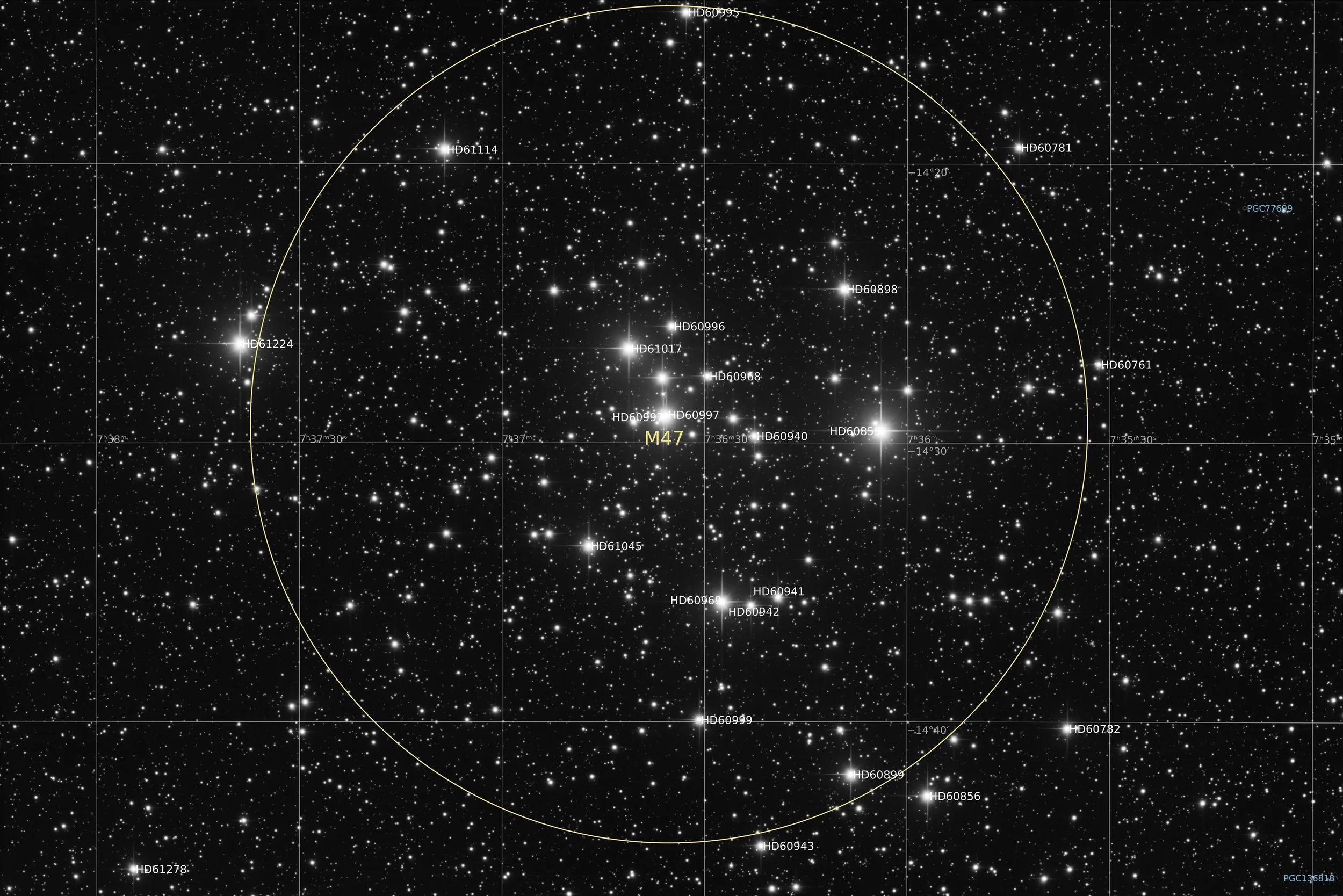
M47
Messier 47, NGC 2422
48’ x 32’ | 0.3”/px | 9576 × 6388 px
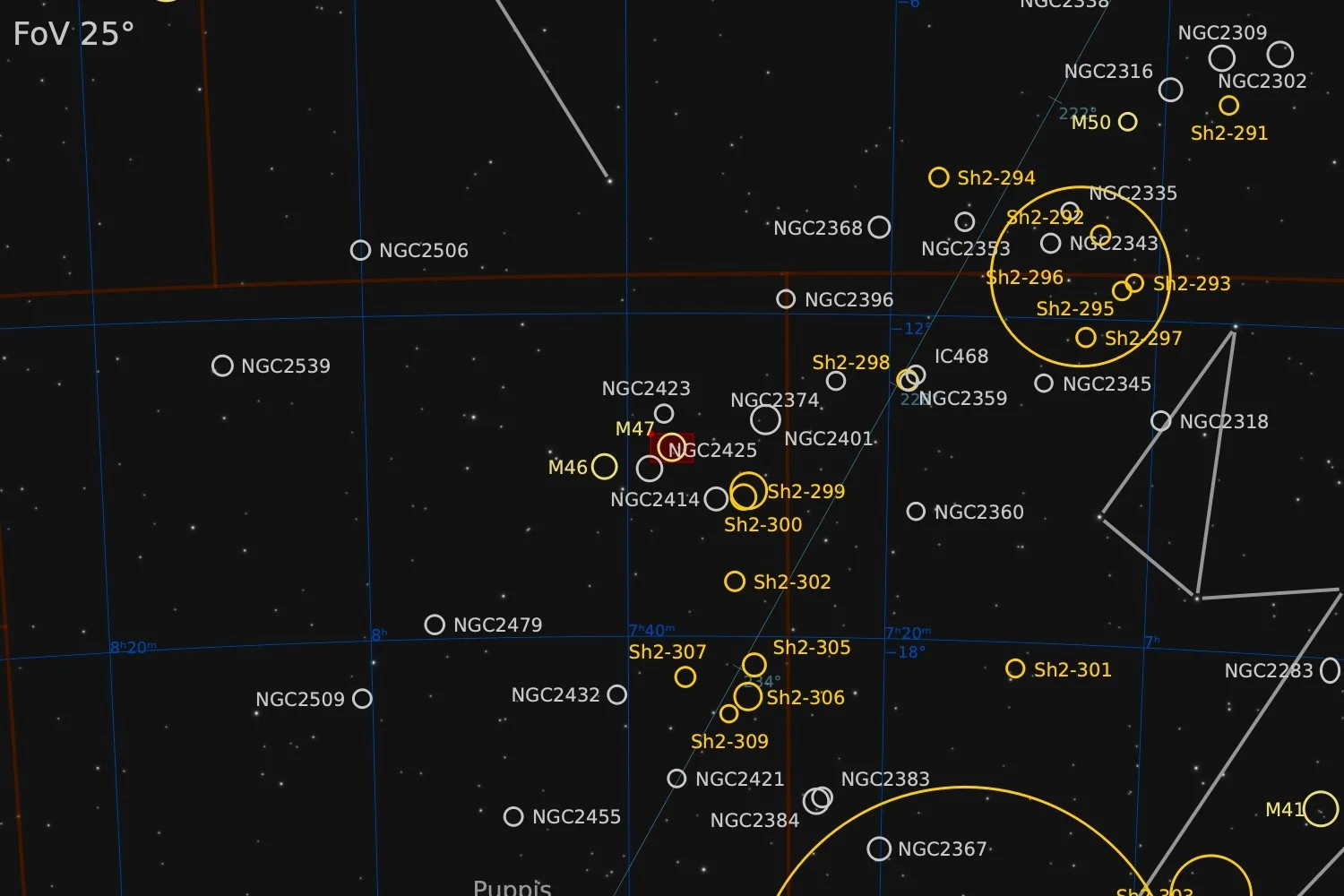
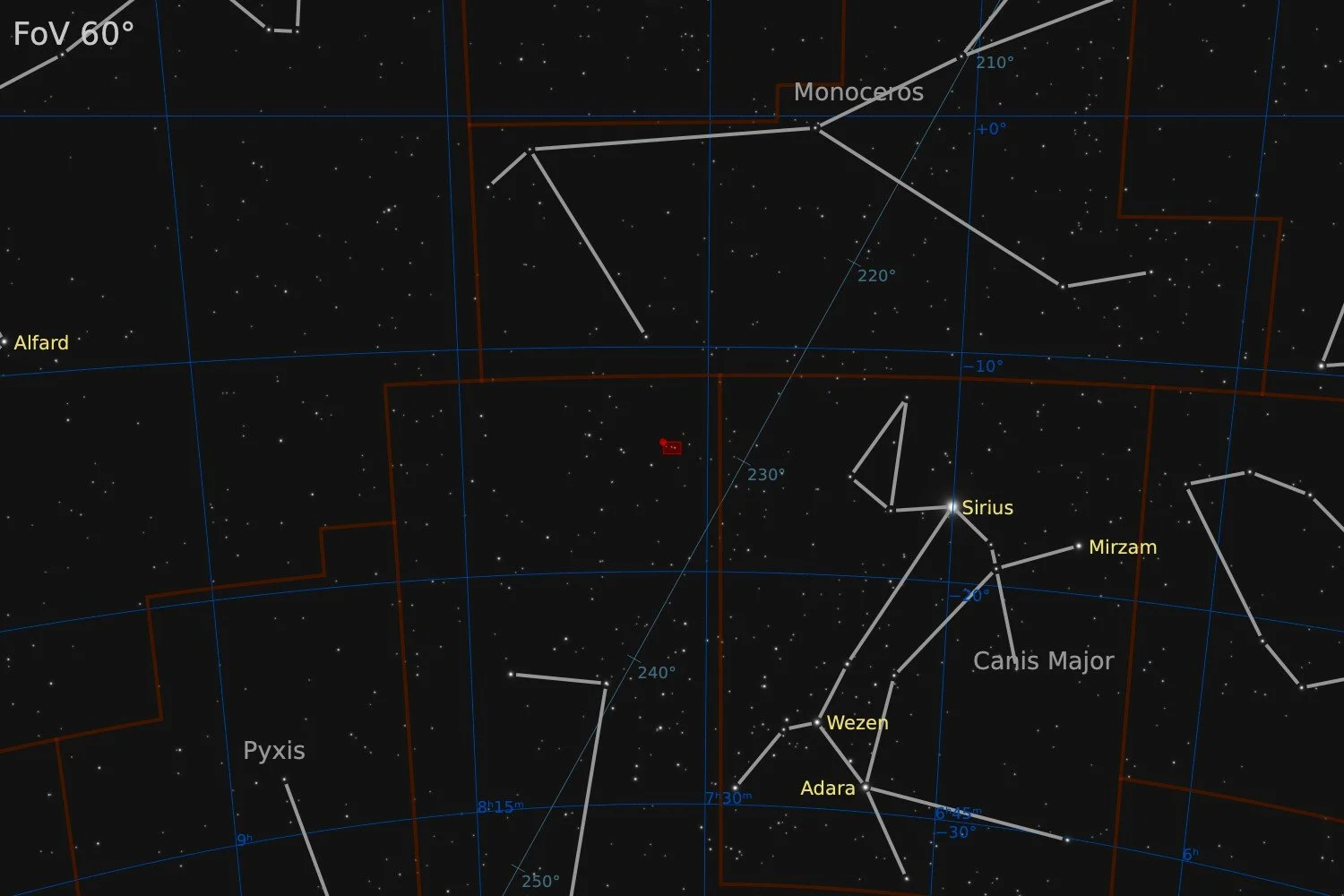
Puppis
RA 07h 36m 35s Dec -14° 30’ 11” | 0°
Messier 47, also known as NGC 2422, is an open star cluster located in the constellation Puppis. It was first observed by Giovanni Batista Hodierna before 1654 and later independently noted by Charles Messier on February 19, 1771. Due to a sign error in Messier's original position recording, the cluster was listed for many years as a missing or unidentified object before being matched to NGC 2422 in the 20th century. M47 lies at a distance of approximately 1,600 light-years from Earth and spans a true diameter of roughly 12 light-years. It is a relatively young cluster, estimated at around 78 million years old, and contains approximately 50 to 80 stars, several of which are bright enough to be seen with the naked eye. The cluster as a whole reaches a combined apparent magnitude of around 4.4, making it one of the more conspicuous open clusters in the winter sky. The cluster is dominated by several hot, blue-white stars of spectral type B, which give it a distinctive appearance. It also contains at least two orange giant stars. M47 is very close to the neighbouring open cluster M46, which lies only about 1.3 degrees to the east, making the pair a popular target as well. M46 is notably older and more distant.
Source: Claude.ai
Data Acquisition
Data was collected during 3 nights in Februari and March 2026, using a 14” reflector telescope with full-frame camera at the remote observatory in Spain. Data was gathered using standard RGB filters. A total of approximately 6 hours of data was finally combined to create the final image.
Location Remote hosting facility IC Astronomy in Oria, Spain (37°N 2°W)
Sessions
Frames
Equipment
Telescope
Mount
Camera
Filters
Guiding
Accessoires
Software
Planewave CDK14 (2563mm @ f/7.2), Optec Gemini Rotating focuser
10Micron GM2000HPS, custom pier
Moravian C3-61000 Pro (full frame), cooled to -10 ºC
Chroma 2” RGB unmounted, Moravian filterwheel L, 7-position
Unguided
Compulab Tensor I-22, Dragonfly, Pegasus Ultimate Powerbox v2
Voyager Advanced, Viking, Mountwizzard4, Astroplanner, PixInsight 1.9.3
Processing
All processing was done in Pixsinsight unless stated otherwise. Default features were enhanced using scripts and tools from RC-Astro, SetiAstro, GraXpert, CosmicPhotons and others. Images were calibrated using 50 Darks, 50 Flats, and 50 Flat-Darks, registered and integrated using WeightedBatchPreProcessing (WBPP). The processing workflow diagram below outlines the steps taken to create the final image.
Processing followed a very short and pretty simple workflow. There was only R, G and B data to deal with, each of which responded very well to the GradientCorrection tool for background correction. The MultiscaleAdaptiveStretch once again proved very easy to use with great results. With the right settings, It keeps star-shapes and colours well balanced. The only additional step in the process was the reception of a bit of green from the background, using SCNR.
See the outline below for a detailed breakdown of the processing applied to the image.
Processing workflow (click to enlarge)
This image has been published on Astrobin.