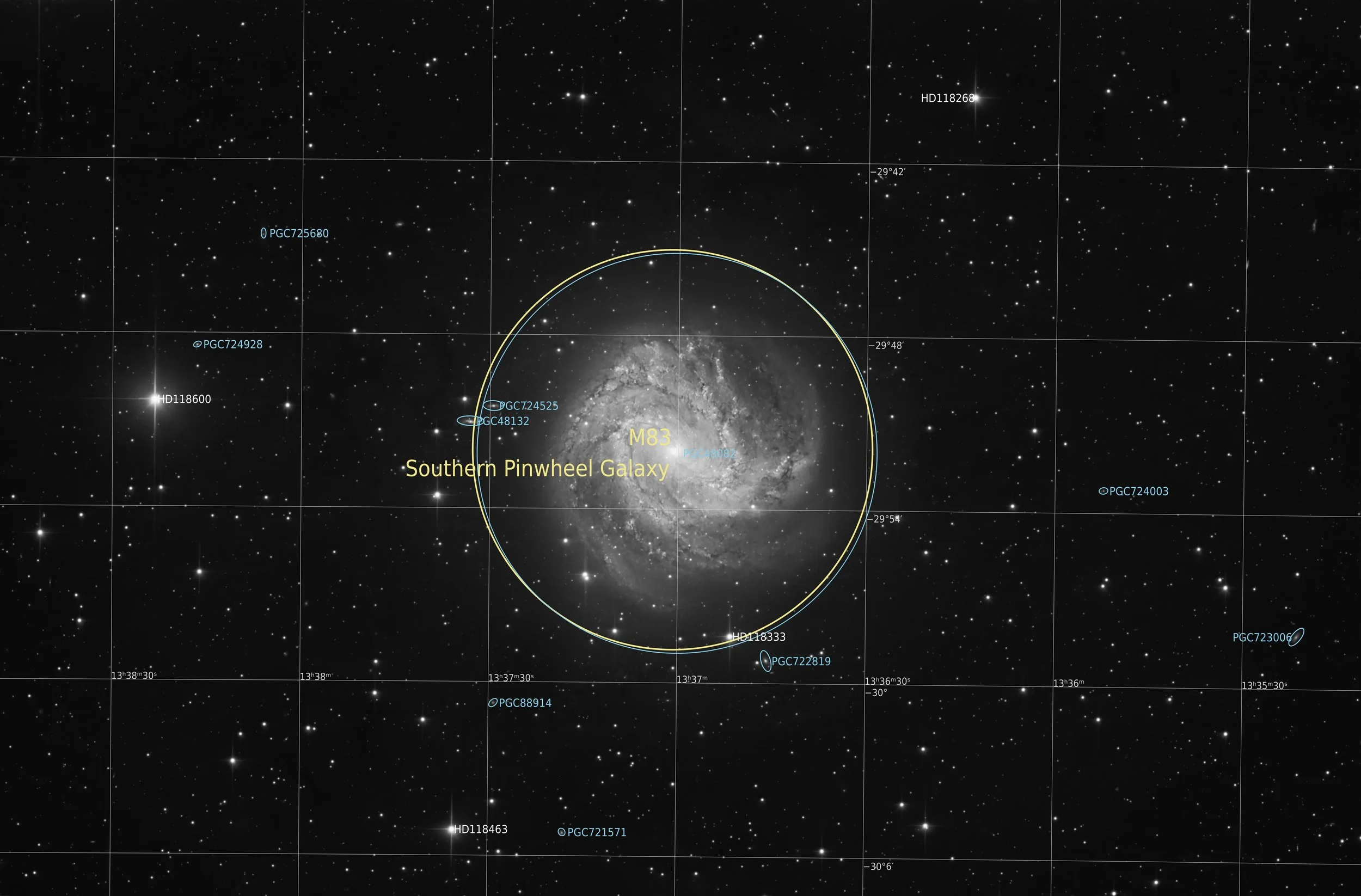
M83
NGC 5236, Southern pinwheel galaxy
46’ x 30’ | 0.3”/px | 9338 × 6150 px
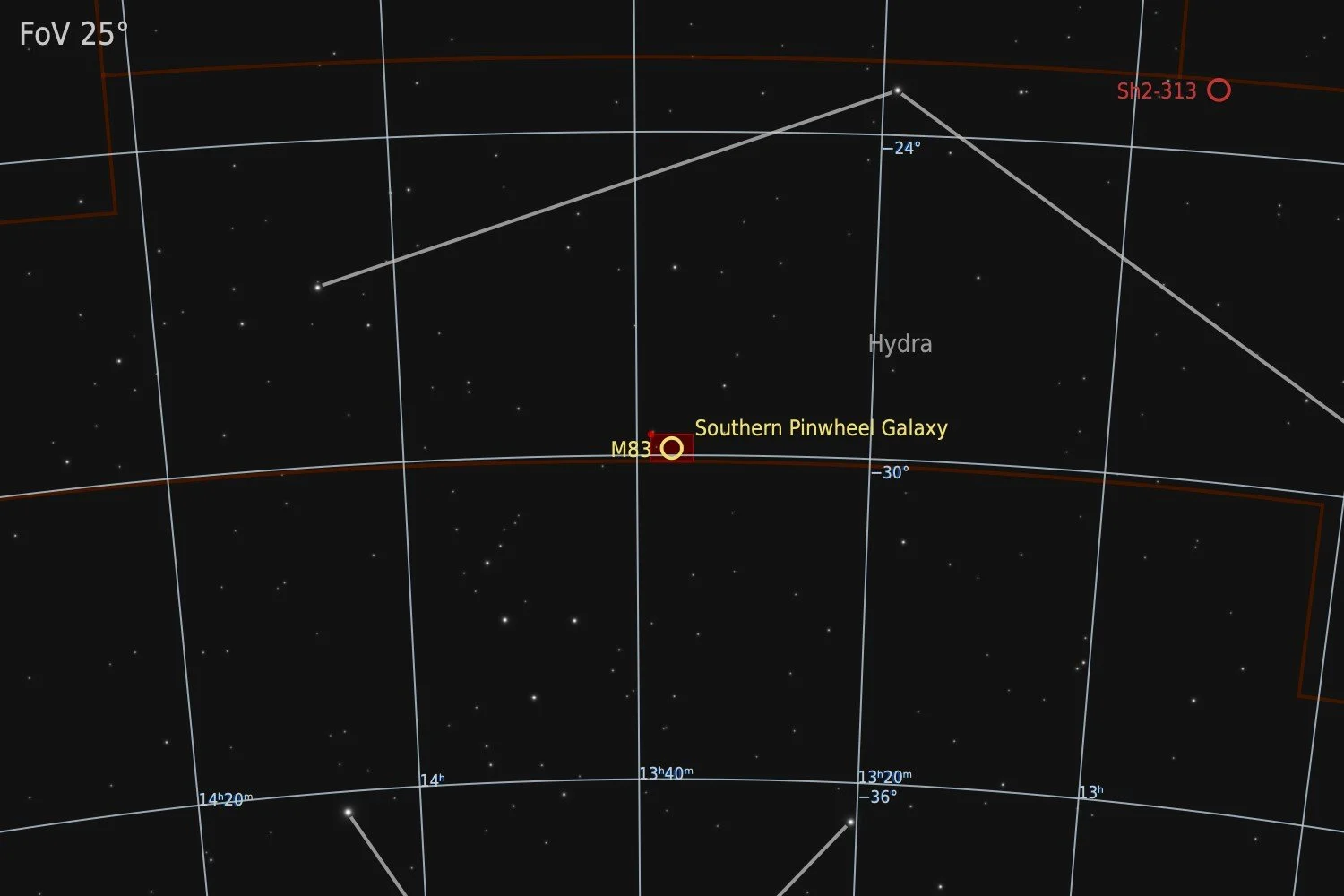
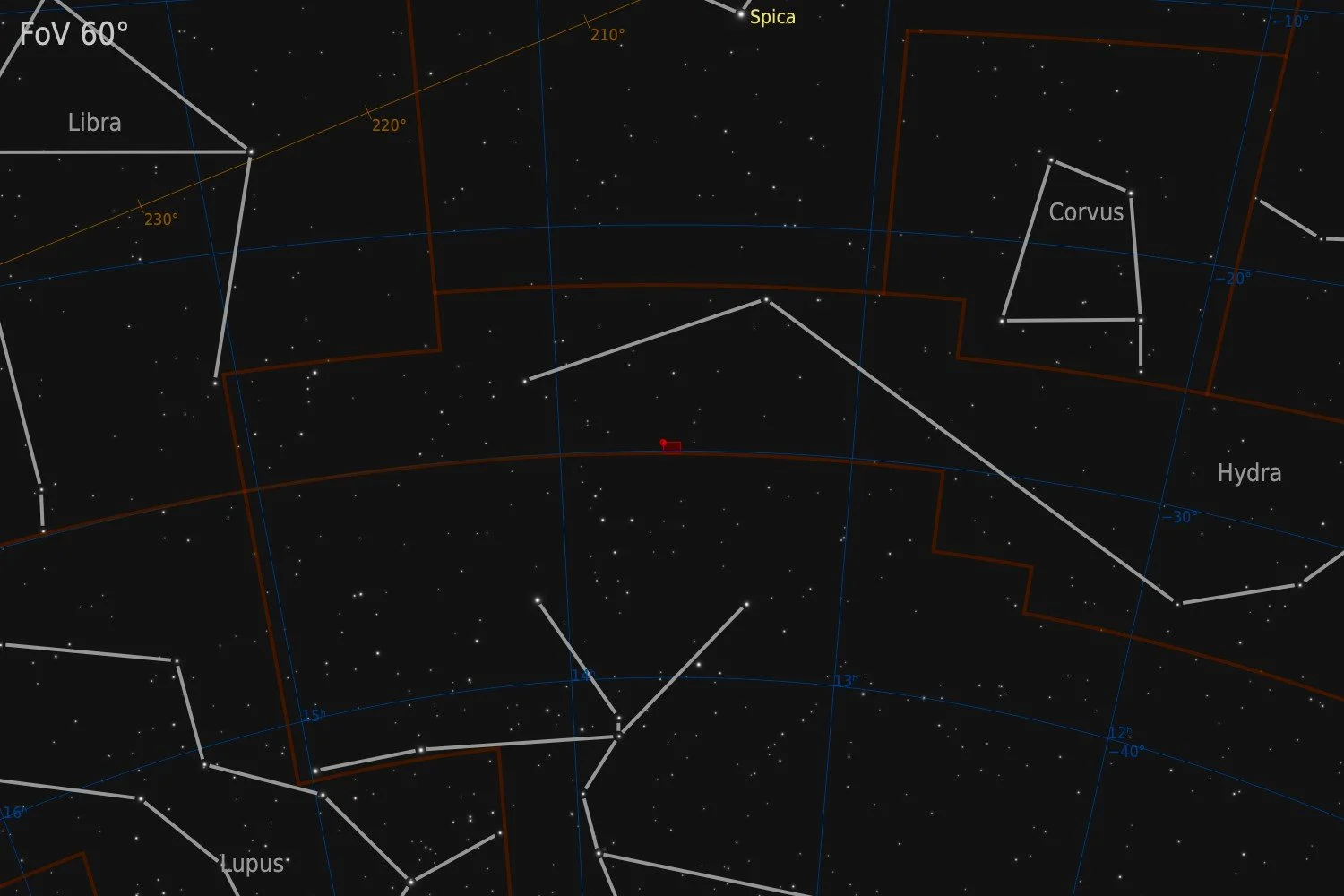
Hydra
RA 13h 37m 00s Dec -29° 51’ 53” | 0°
Messier 83, also known as NGC 5236, is a barred spiral galaxy located in the constellation Hydra, near the border with Centaurus. It was discovered by Nicolas Louis de Lacaille on February 23, 1752, during an observing expedition to the Cape of Good Hope in South Africa, making it one of the few Messier objects first observed from the southern hemisphere. It was later catalogued by Charles Messier in 1781. The galaxy is commonly known as the Southern Pinwheel Galaxy, a name that reflects both its face-on spiral appearance and its southerly position in the sky. M83 lies at a distance of approximately 15 million light-years from Earth, making it one of the closest and most visually striking barred spiral galaxies in the sky. It spans roughly 40,000 light-years in diameter. With an apparent magnitude of around 7.5, it is one of the brightest galaxies in the Messier catalogue. Its nearly face-on orientation reveals a well-defined central bar, tightly wound spiral arms rich in star-forming regions, and prominent dust lanes threading through the disc. M83 is one of the most prolific supernova host galaxies known, with six confirmed supernovae recorded since 1923, among the highest count for any single galaxy observed. The galaxy is also a site of intense and ongoing star formation, particularly along its spiral arms, which glow prominently in hydrogen-alpha emission. It is the brightest member of the Centaurus A and M83 Group, a loose association of galaxies that represents one of the nearest galaxy groups to the Local Group.
Source: Claude.ai
Data Acquisition
Data was collected during 8 nights in April, May and June of 2026, using a 14” reflector telescope with full-frame camera at the remote observatory in Spain. Data was gathered using standard LRGB filters. A total of approximately 10 hours of data was finally combined to create the final image.
Location Remote hosting facility Roboscopes in Fregenal de la Sierra, Spain (38°N 6°W)
Sessions
Frames
Equipment
Telescope
Mount
Camera
Filters
Guiding
Accessoires
Software
Planewave CDK14 (2563mm @ f/7.2), Optec Gemini Rotating focuser
10Micron GM2000HPS, custom pier
Moravian C3-61000 Pro (full frame), cooled to -10 ºC
Chroma 2” LRGB unmounted, Moravian filterwheel L, 7-position
Unguided
Compulab Tensor I-22, Dragonfly, Pegasus Ultimate Powerbox v2
Voyager Advanced, Viking, Mountwizzard4, Astroplanner, PixInsight 1.9.4
Processing
All processing was done in Pixsinsight unless stated otherwise. Default features were enhanced using scripts and tools from RC-Astro, SetiAstro, GraXpert, CosmicPhotons and others. Images were calibrated using 50 Darks, 50 Flats, and 50 Flat-Darks, registered and integrated using WeightedBatchPreProcessing (WBPP). The processing workflow diagram below outlines the steps taken to create the final image.
There are still no new flat images made at the new remote hosting site. And especially for the luminance channel this becomes a bit of an issue, as during the move clearly the dust motes on the luminance filter have changed. So while processing the luminance, I had to hard-handedly remove some remaining spots in the starless version, using the clonestamp tool.
Furthermore I applied GHS stretching again, after having used the MutiscaleAdaptiveStretch tool for several images in succession. For a detailed galaxy like this, the additional fine-regulation that GHS allows comes in quite handy and provides a lot more flexibility to selectively control the various areas of the object, from the super bright core to the faint outer spiral arms.
For the rest processing followed a very standard workflow, as outlined below.
Processing workflow (click to enlarge)
This image has been published on Astrobin.