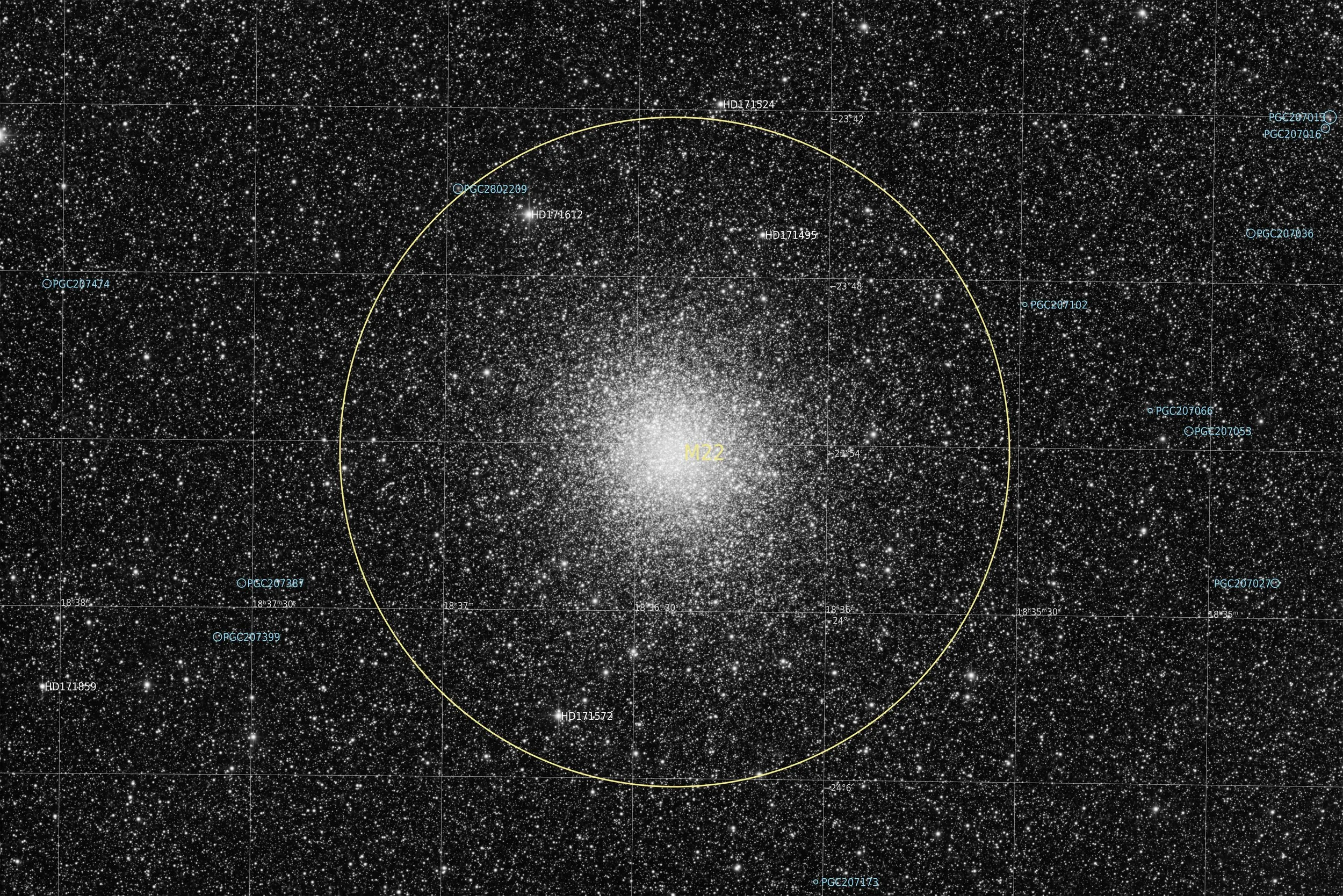
M22
Messier 22, NGC 6656, Great Sagittarius Cluster
48’ x 32’ | 0.3”/px | 9576 × 6388 px
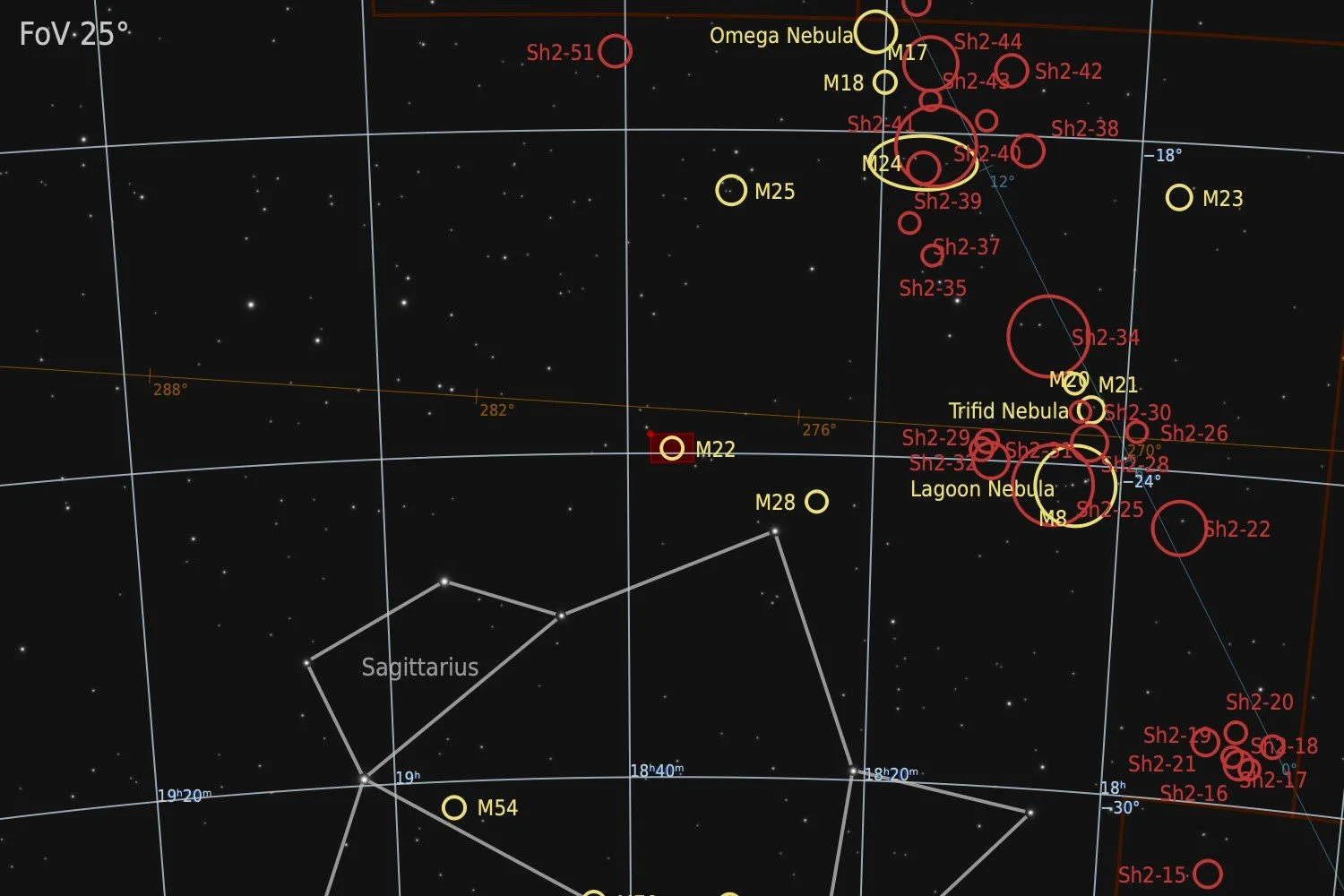
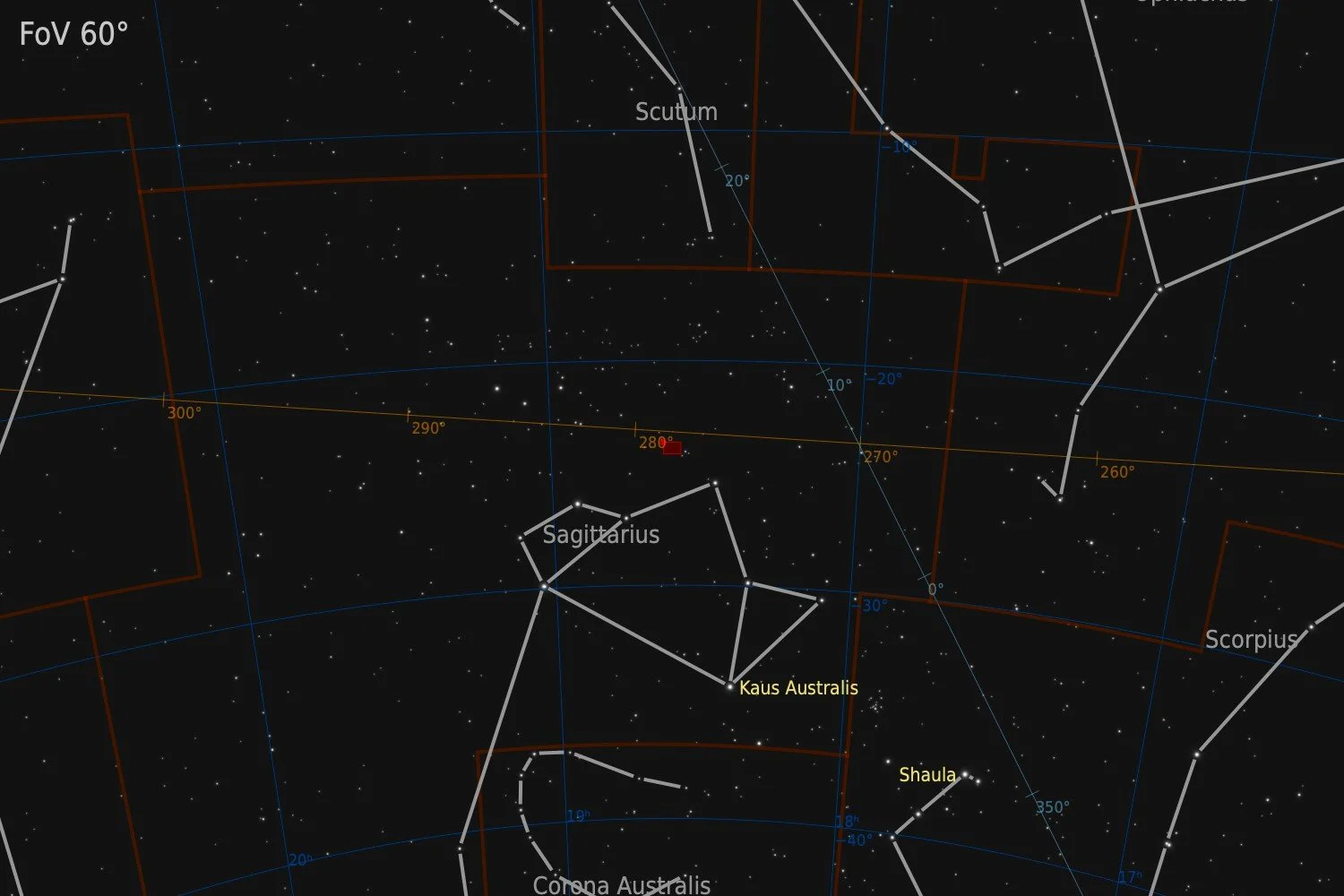
Sagittarius
RA 18h 36m 24s Dec -23° 54’ 08” | 0°
Messier 22, also known as NGC 6656, is a globular cluster located in the constellation Sagittarius, positioned just northeast of the prominent star Kaus Borealis that marks the top of the Teapot asterism. It is one of the earliest globular clusters to be discovered, first noted by Johann Abraham Ihle in 1665, and later catalogued by Charles Messier on June 5, 1764. The cluster is occasionally referred to simply as the Sagittarius Cluster. M22 lies at a distance of approximately 10,600 light-years from Earth, making it one of the closest globular clusters to the solar system and one of the nearest to the galactic centre. It spans a true diameter of roughly 100 light-years and has an apparent diameter of around 32 arcminutes, making it one of the largest globular clusters in apparent size as seen from Earth. It contains an estimated 70,000 to 100,000 stars and reaches an apparent magnitude of around 5.1, making it one of the brightest globular clusters in the sky and readily visible to the naked eye under dark conditions. M22 is one of only four globular clusters known to contain a planetary nebula within its boundaries, a rare and somewhat unexpected finding first confirmed in the early 1990s. It also contains a number of black hole candidates detected through radio observations, and early microlensing surveys conducted toward the galactic bulge using M22 as a background field contributed to broader studies of dark compact objects in the Milky Way.
Source: Claude.ai
Data Acquisition
Data was collected during 5 nights in May 2026, using a 14” reflector telescope with full-frame camera at the remote observatory in Spain. Data was gathered using standard RGB filters. A total of approximately 5 hours of data was finally combined to create the final image.
Location Remote hosting facility Roboscopes in Fregenal de la Sierra, Spain (38°N 6°W)
Sessions
Frames
Equipment
Telescope
Mount
Camera
Filters
Guiding
Accessoires
Software
Planewave CDK14 (2563mm @ f/7.2), Optec Gemini Rotating focuser
10Micron GM2000HPS, custom pier
Moravian C3-61000 Pro (full frame), cooled to -10 ºC
Chroma 2” RGB unmounted, Moravian filterwheel L, 7-position
Unguided
Compulab Tensor I-22, Dragonfly, Pegasus Ultimate Powerbox v2
Voyager Advanced, Viking, Mountwizzard4, Astroplanner, PixInsight 1.9.4
Processing
All processing was done in Pixsinsight unless stated otherwise. Default features were enhanced using scripts and tools from RC-Astro, SetiAstro, GraXpert, CosmicPhotons and others. Images were calibrated using 50 Darks, 50 Flats, and 50 Flat-Darks, registered and integrated using WeightedBatchPreProcessing (WBPP). The processing workflow diagram below outlines the steps taken to create the final image.
During color calibration using SPCC, I generally use the S0 galaxy as a white reference. This results in a slightly cooler look than the more usual ‘Average Spiral Galaxy’, with a touch more blue generally in the image. In this case I chose the Average Spiral Galaxy as the white reference, which resulted in very nice warm colours of the overall cluster. But I could not resist the urge to manually enhance the blue tints a bit, using a combination of the CurvesTransformation (CIE b* component) and ColorSaturation tool.
The processing followed a very standard approach. See the outline below for a detailed breakdown of the processing applied to the image.
Processing workflow (click to enlarge)
This image has been published on Astrobin and received Top Pick Nomination status.