M93
Messier 93, NGC 2447, Butterfly Cluster
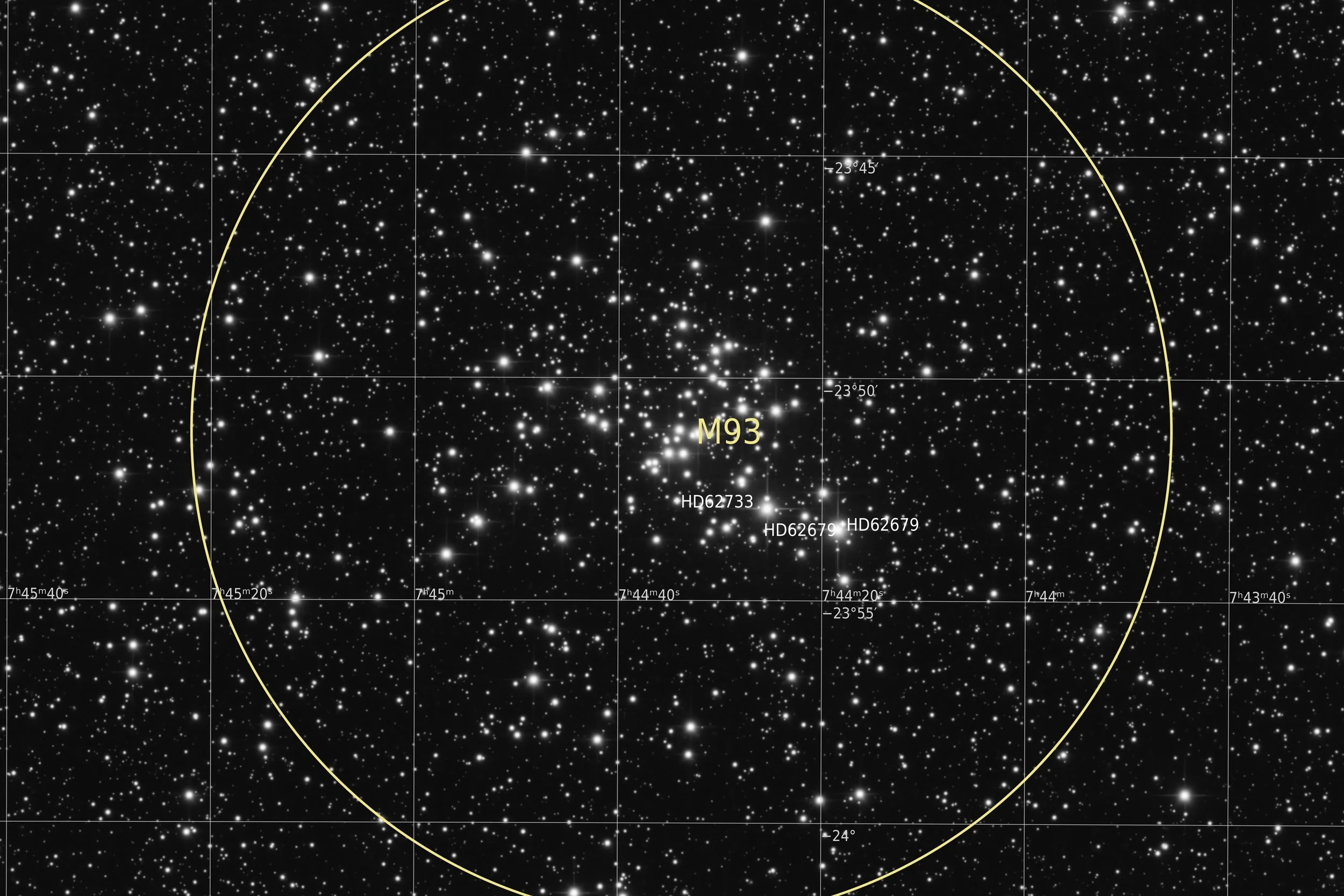
30’ x 20’ | 0.3”/px | 6000 × 4000 px
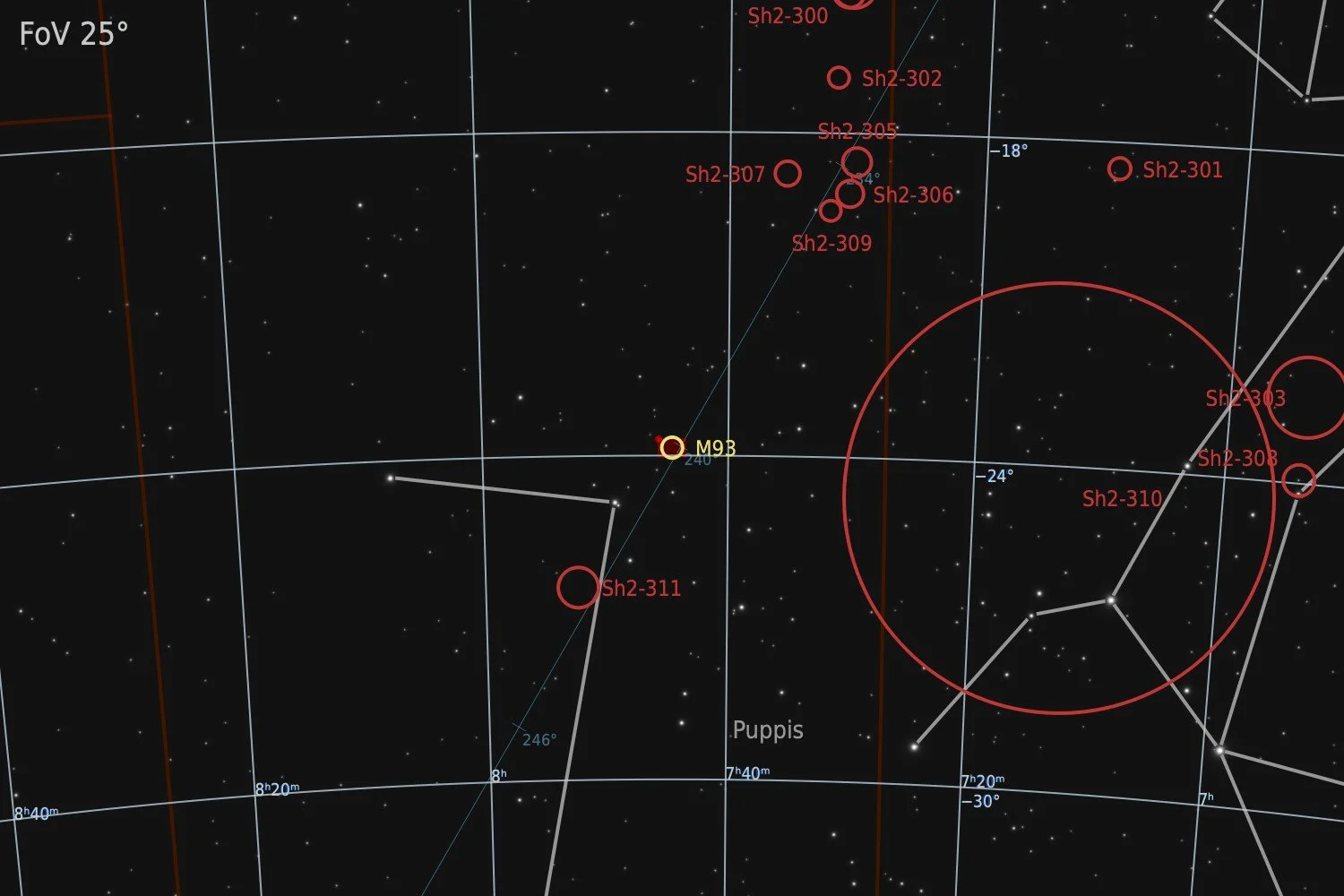
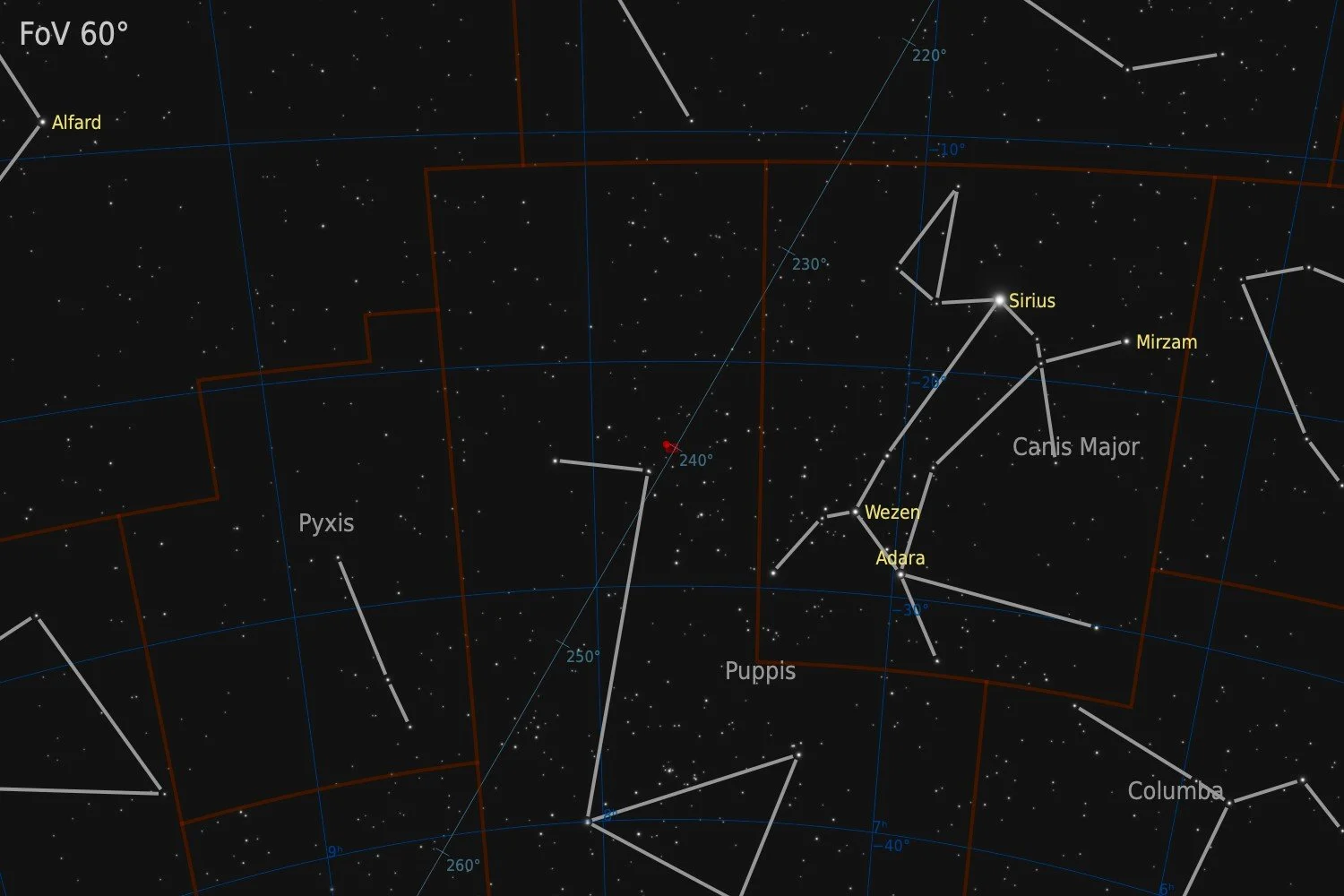
Puppis
RA 07h 44m 35s Dec -23° 51’ 34” | 0°
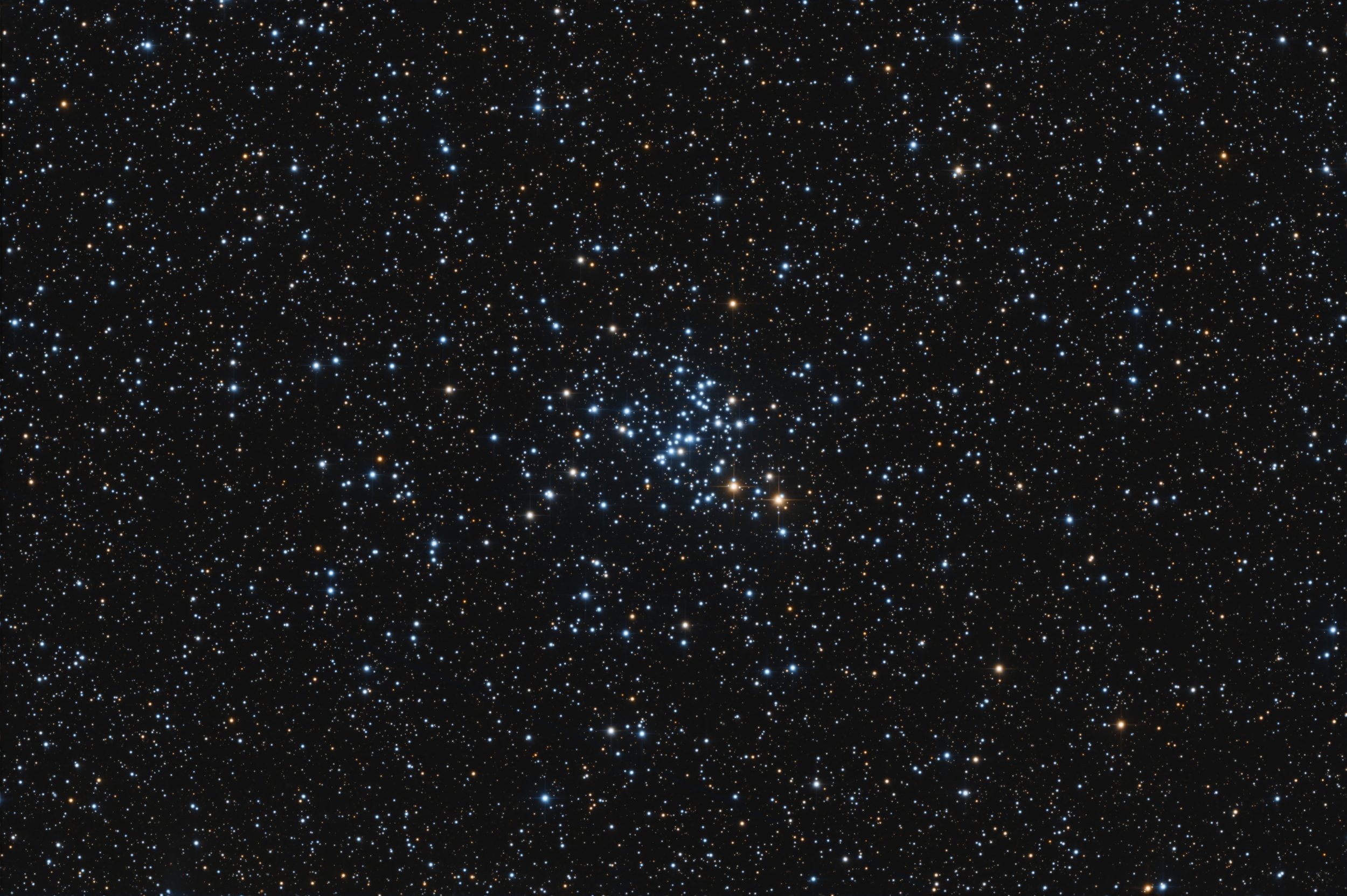
Messier 93, also known as NGC 2447, is an open star cluster located in the constellation Puppis, in the same rich stretch of the winter Milky Way that contains several other Messier open clusters including M46 and M47. It was discovered by Charles Messier on March 20, 1781. The cluster has no widely used common name, though its somewhat triangular or wedge-shaped arrangement of brighter stars has occasionally drawn informal comparisons to a starfish or butterfly pattern among observers. M93 lies at a distance of approximately 3,600 light-years from Earth and spans a true diameter of roughly 25 light-years. It is estimated to be around 100 million years old, making it somewhat older than M21 or M47 but still a relatively young open cluster. It contains approximately 80 confirmed members, with several bright blue-white stars of spectral type B prominent among them, along with a handful of orange giant stars that provide a subtle colour contrast.
Source: Claude.ai
Data Acquisition
Data was collected during 3 nights in February and March 2026, using a 14” reflector telescope with full-frame camera at the remote observatory in Spain. Data was gathered using standard RGB filters. A total of approximately 6 hours of data was finally combined to create the final image.
Location Remote hosting facility IC Astronomy in Oria, Spain (37°N 2°W)
Sessions
Frames
Equipment
Telescope
Mount
Camera
Filters
Guiding
Accessoires
Software
Planewave CDK14 (2563mm @ f/7.2), Optec Gemini Rotating focuser
10Micron GM2000HPS, custom pier
Moravian C3-61000 Pro (full frame), cooled to -10 ºC
Chroma 2” RGB unmounted, Moravian filterwheel L, 7-position
Unguided
Compulab Tensor I-22, Dragonfly, Pegasus Ultimate Powerbox v2
Voyager Advanced, Viking, Mountwizzard4, Astroplanner, PixInsight 1.9.4
Processing
All processing was done in Pixsinsight unless stated otherwise. Default features were enhanced using scripts and tools from RC-Astro, SetiAstro, GraXpert, CosmicPhotons and others. Images were calibrated using 50 Darks, 50 Flats, and 50 Flat-Darks, registered and integrated using WeightedBatchPreProcessing (WBPP). The processing workflow diagram below outlines the steps taken to create the final image.
The processing followed a very standard approach. See the outline below for a detailed breakdown of the processing applied to the image.
Processing workflow (click to enlarge)
This image has been published on Astrobin.