M84
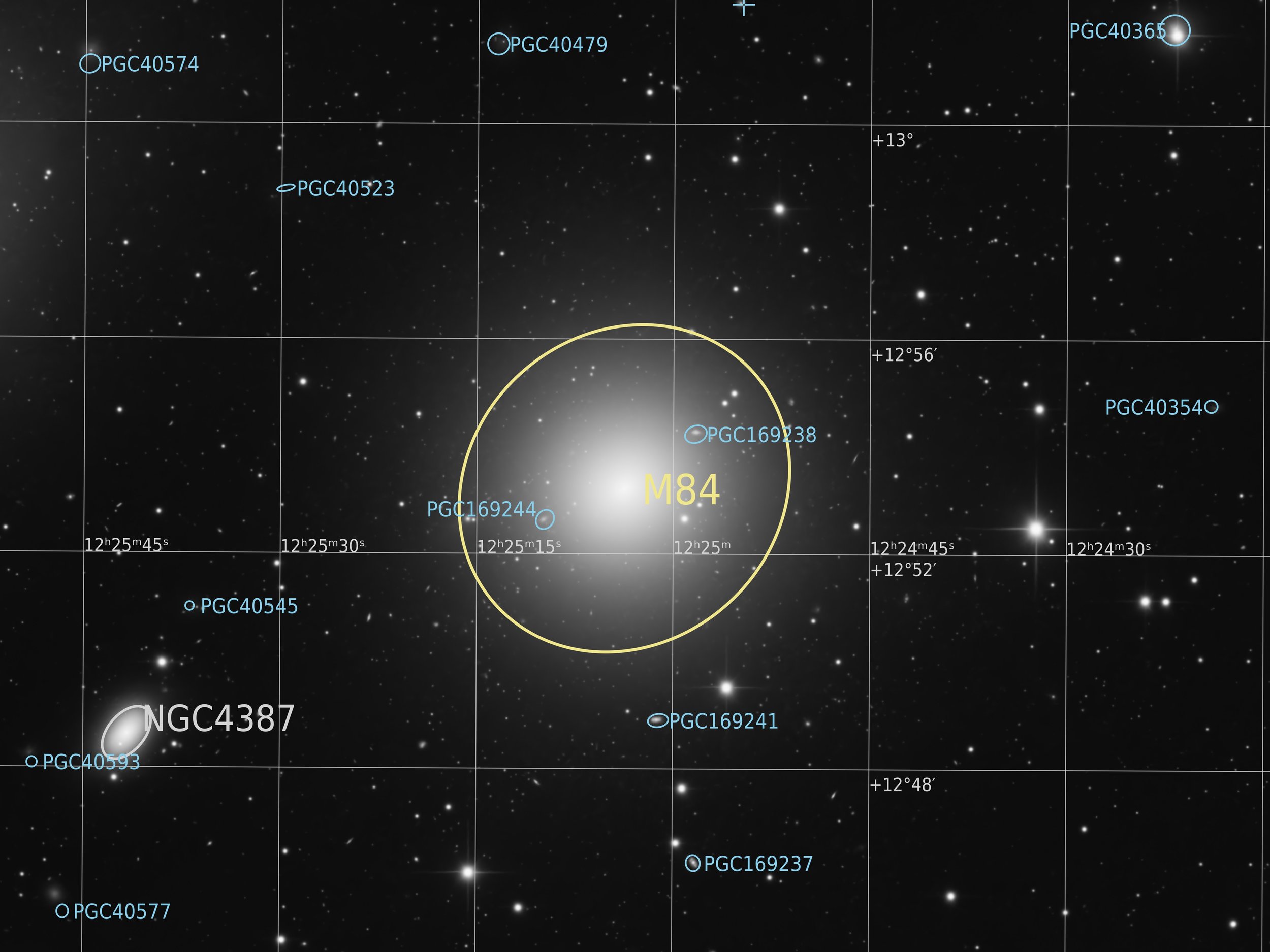
NGC 4374, NGC 4387
23’ x 17’ | 0.3”/px | 4700 × 3525 px
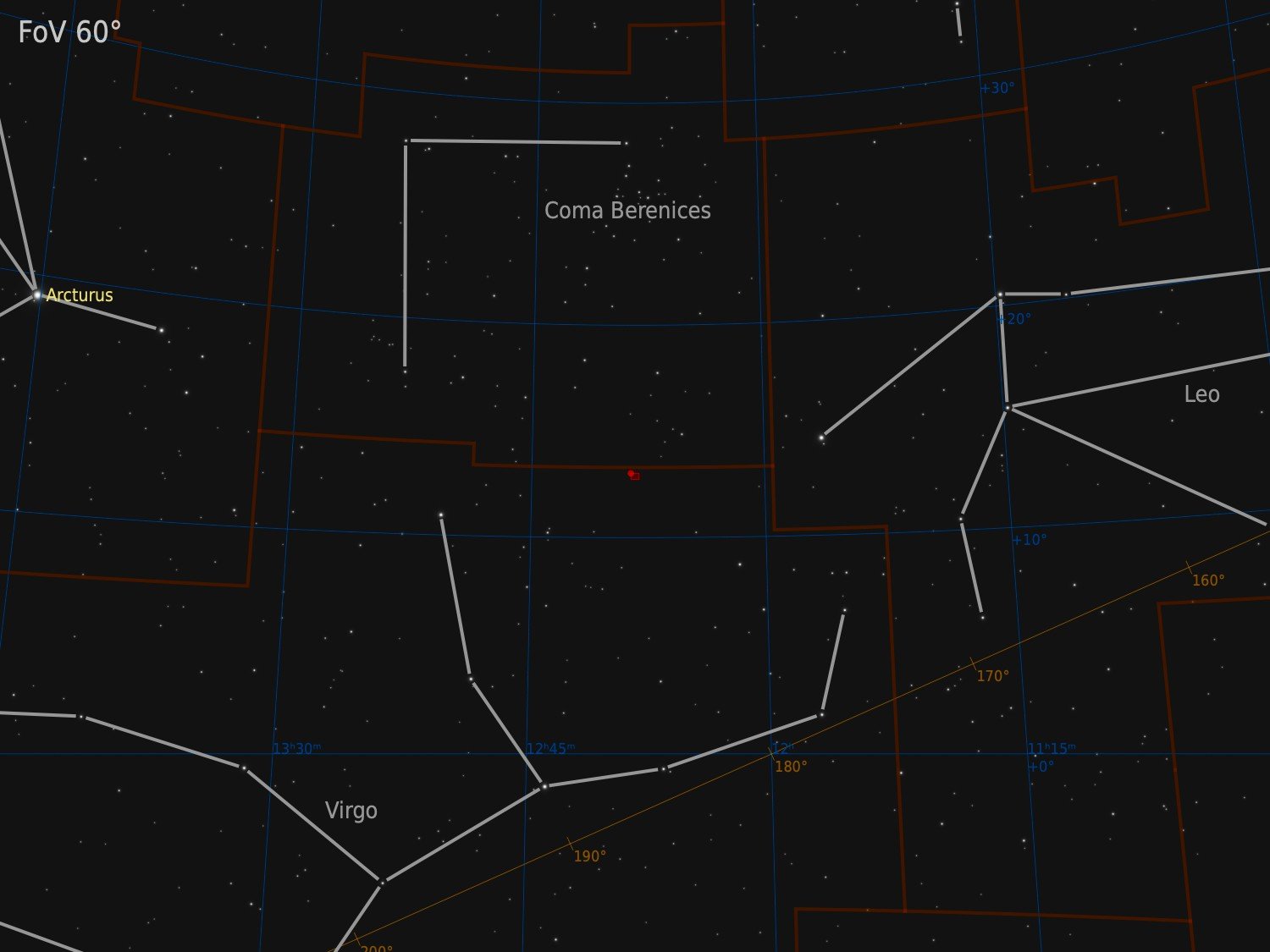
Virgo
RA 12h 25m 03s Dec +12° 53’ 27” | 0°
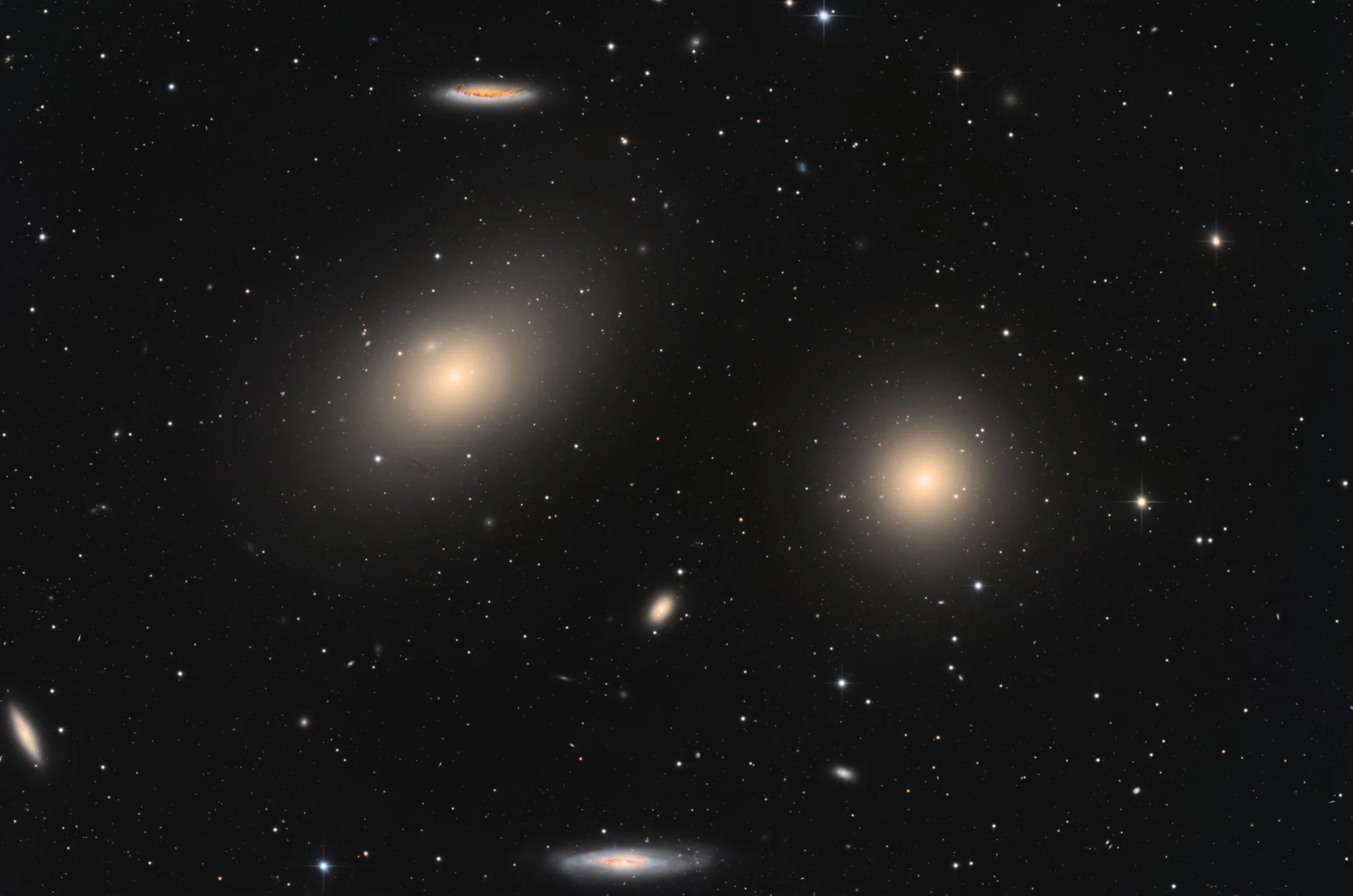
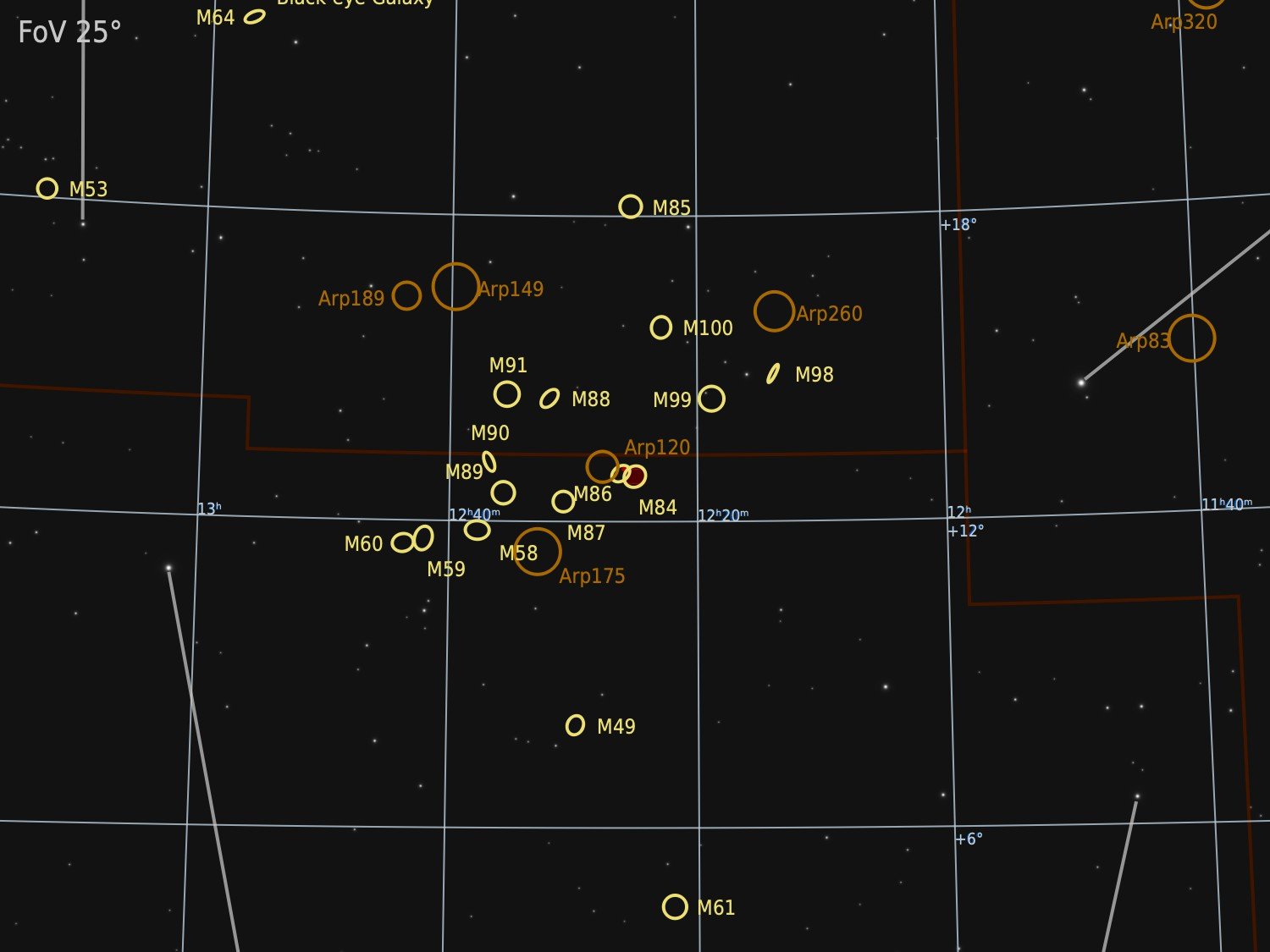
Messier 84, also known as NGC 4374, is a lenticular or elliptical galaxy located in the constellation Virgo. It was discovered by Charles Messier on March 18, 1781, during the same observing session that yielded several other Virgo Cluster entries. M84 lies at a distance of approximately 60 million light-years from Earth and is one of the most prominent members of the Virgo Cluster, sitting near the heart of Markarian's Chain — an alignment of galaxies that includes M84, M86, and several NGC objects. M84 itself spans roughly 80,000 light-years in diameter and reaches an apparent magnitude of around 9.1.Despite its apparently passive elliptical or lenticular appearance, M84 is far from inactive at its core. It hosts a supermassive black hole with a mass estimated at approximately 1.5 billion solar masses, one of the more massive black holes known in the local universe. Observations with the Hubble Space Telescope revealed high-velocity gas motions near the nucleus that provided early strong evidence for this enormous mass concentration. M84 is also a significant source of radio emission and has been observed to produce prominent jets of material extending outward from its nucleus, visible at radio wavelengths, classifying it as a low-luminosity active galactic nucleus.
M84 is most naturally photographed as part of the full Markarian's Chain composition rather than as an isolated target. However, in a quest to image all Messier objects, it felt right to make more of a close-up image. The full image captured included M86, this is a crop of that image.
Source: Claude.ai
Data Acquisition
Data was collected during 6 nights in February and March of 2026, using a 14” reflector telescope with full-frame camera at the remote observatory in Spain. Data was gathered using standard LRGB filters. A total of approximately 15 hours of data was finally combined to create the final image.
Location Remote hosting facility IC Astronomy in Oria, Spain (37°N 2°W)
Sessions
Frames
Equipment
Telescope
Mount
Camera
Filters
Guiding
Accessoires
Software
Planewave CDK14 (2563mm @ f/7.2), Optec Gemini Rotating focuser
10Micron GM2000HPS, custom pier
Moravian C3-61000 Pro (full frame), cooled to -10 ºC
Chroma 2” LRGB unmounted, Moravian filterwheel L, 7-position
Unguided
Compulab Tensor I-22, Dragonfly, Pegasus Ultimate Powerbox v2
Voyager Advanced, Viking, Mountwizzard4, Astroplanner, PixInsight 1.9.4
Processing
All processing was done in Pixsinsight unless stated otherwise. Default features were enhanced using scripts and tools from RC-Astro, SetiAstro, GraXpert, CosmicPhotons and others. Images were calibrated using 50 Darks, 50 Flats, and 50 Flat-Darks, registered and integrated using WeightedBatchPreProcessing (WBPP). The processing workflow diagram below outlines the steps taken to create the final image.
The original image of M84 and M86 combined was processed to a final image. From that image, individual crops were created for each individual galaxy.
The rest of the processing followed a fairly standard workflow, as outlined below.
Processing workflow (click to enlarge)
This image has been published on Astrobin and received Top Pick Nomination status.