Sh2-138 | Sh2-139
Sh2-138, Sh2-139
47’ x 30’ | 0.3”/px | 9352 × 6150 px
Cepheus
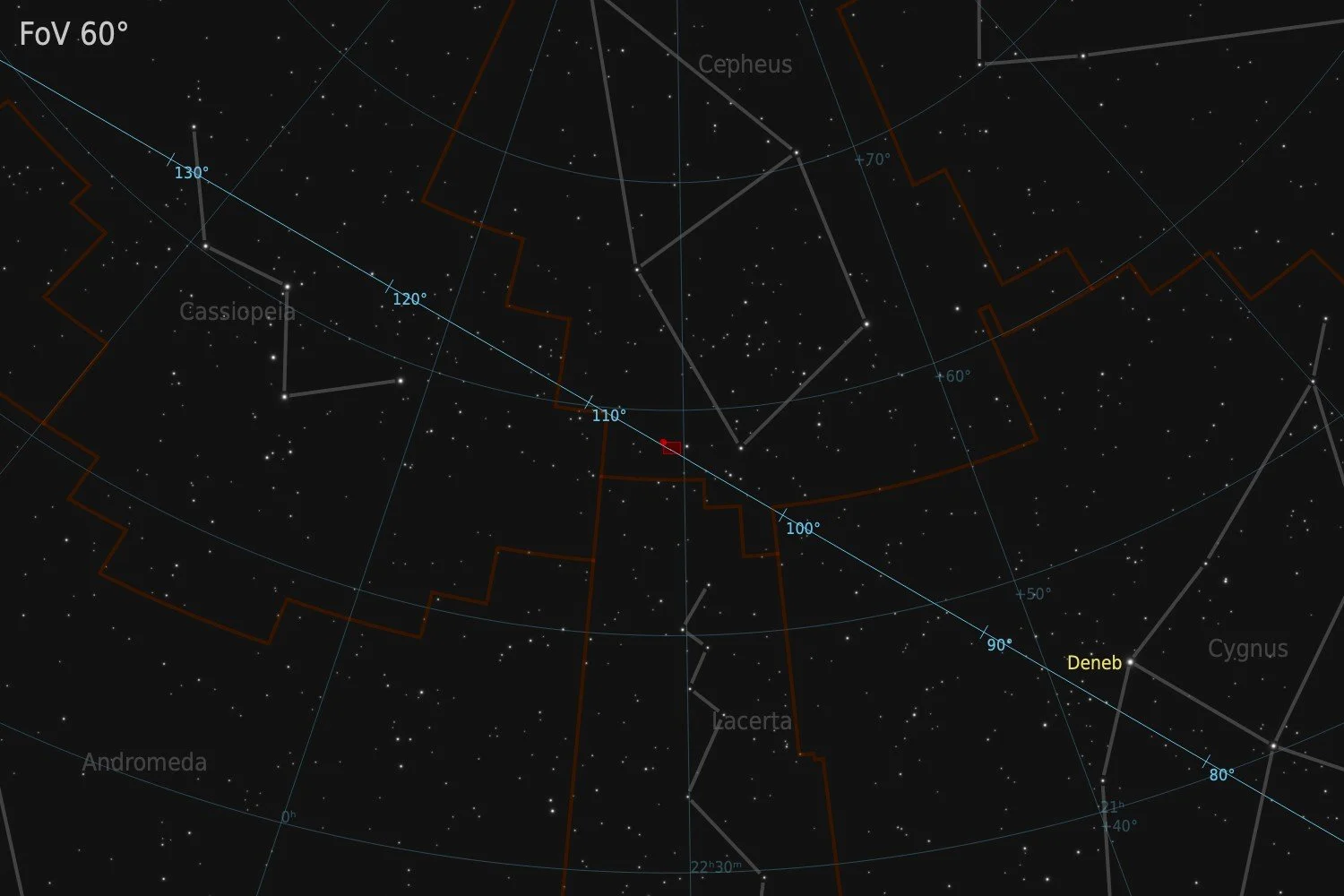
RA 22h 34m 03s Dec +58° 19’ 09” | 0°
Sh2-139
Sh2-138
Sh2-138 and Sh2-139 are emission nebulae located in the constellation Cepheus. They are part of the Sharpless catalogue, compiled by Stewart Sharpless and published in 1959. It is a busy area when it comes to Sharpless objects, with the well known Wizard Nebula (Sh2-142) nearby. Sh2-138 is classified as a classical HII region and its brightness is enhanced by a small cluster of hot young stars embedded within or immediately adjacent to the nebula. Sh2-138 has been identified as a hub-filament system, a configuration in which multiple elongated filaments of molecular gas converge on a central dense hub where active star formation is concentrated. The combination of its hub-filament structure, embedded young stellar cluster, and ongoing accretion makes Sh2-138 an example of high-mass star formation in the outer galactic plane. Sh2-139 is a much wider and dimmer HII region. It is ionised by two giant stars and is otherwise not very well studied. There is a lot of controversy about the distance of these two objects, with estimates ranging from around 2,500 light-years up to 10,000 light-years.
Source: various.


Data Acquisition
Data was collected during 12 nights in July and September of 2026, using a 14” reflector telescope with full-frame camera at the remote observatory in Spain. Data was gathered 3nm Ha, OIII and SII narrowband filters. The SII data did not reveal any information, so is left out of this image entirely. A total of approximately 15 hours of data was finally combined to create the final image.
Location Remote hosting facility Roboscopes in Fregenal de la Sierra, Spain (38°N 6°W)
Sessions
Frames
Equipment
Telescope
Mount
Camera
Filters
Guiding
Accessoires
Software
Planewave CDK14 (2563mm @ f/7.2), Optec Gemini Rotating focuser
10Micron GM2000HPS, custom pier
Moravian C3-61000 Pro (full frame), cooled to -10 ºC
Chroma 2” Ha and OIII (3nm) unmounted, Moravian filterwheel L, 7-position
Unguided
Compulab Tensor I-22, Dragonfly, Pegasus Ultimate Powerbox v2
Voyager Advanced, Viking, Mountwizzard4, Astroplanner, PixInsight 1.9.4
Processing
All processing was done in Pixsinsight unless stated otherwise. Default features were enhanced using scripts and tools from RC-Astro, SetiAstro, GraXpert, CosmicPhotons and others. Images were calibrated using 50 Darks, 50 Flats, and 50 Flat-Darks, registered and integrated using WeightedBatchPreProcessing (WBPP). The processing workflow diagram below outlines the steps taken to create the final image.
Background correction was done using MultiscaleGradientCorreciton (MGC). A nebulous region can make it hard for other gradient correction tools to identify what is background and what is faint nebulosity. MGC compares the image with a database of well characterised images of the region (the MARS database) and makes corrections accordingly. For Ha these data exist in the database as a unique filter. The database does not hold OIII data, so I used the green channel data instead.
Most images of these dimmer Sharpless objects are taken in Ha only. When I started imaging this object I made some test shots in OIII and SII as well. There was some faint signal in the OIII bandwidth. SII did not show any signal whatsoever. So the imaging was focused on Ha and OIII. During the processing specific focus was put on bringing out the OIII signal in this images besides the overwhelming presence of Ha. So after combining the two channels several steps were taken to this purpose. That started with a more routine NarrowbandNormalisation, but then moved into making small tweaks in the signal using GeneralisedHyperbolicStretch and CurvesTransformation, sometimes working on individual color channels, sometimes working on the total. The result is a still somewhat pale, but clearly defined OIII region adjacent to Sh2-139.
It is quite common to shoot RGB images for the stars only. However, tools have become available to combine narrowband data into proper RGB star images and in this case the latter was used. The tool NB to RGB Starcombination from SetiAstro was the tool used. I even compared it to a regular HOO combination and run SPCC for colour calibration, but that came out very bad. The SetiAstro script came out quite nicely though.
The rest of the processing followed a very standard approach. The outline below shows a detailed breakdown of all processing steps applied to the image.
Processing workflow (click to enlarge)
This image has been published on Astrobin.