Caldwell 18
NGC 185
47’ x 31’ | 0.3”/px | 9366 × 6199 px
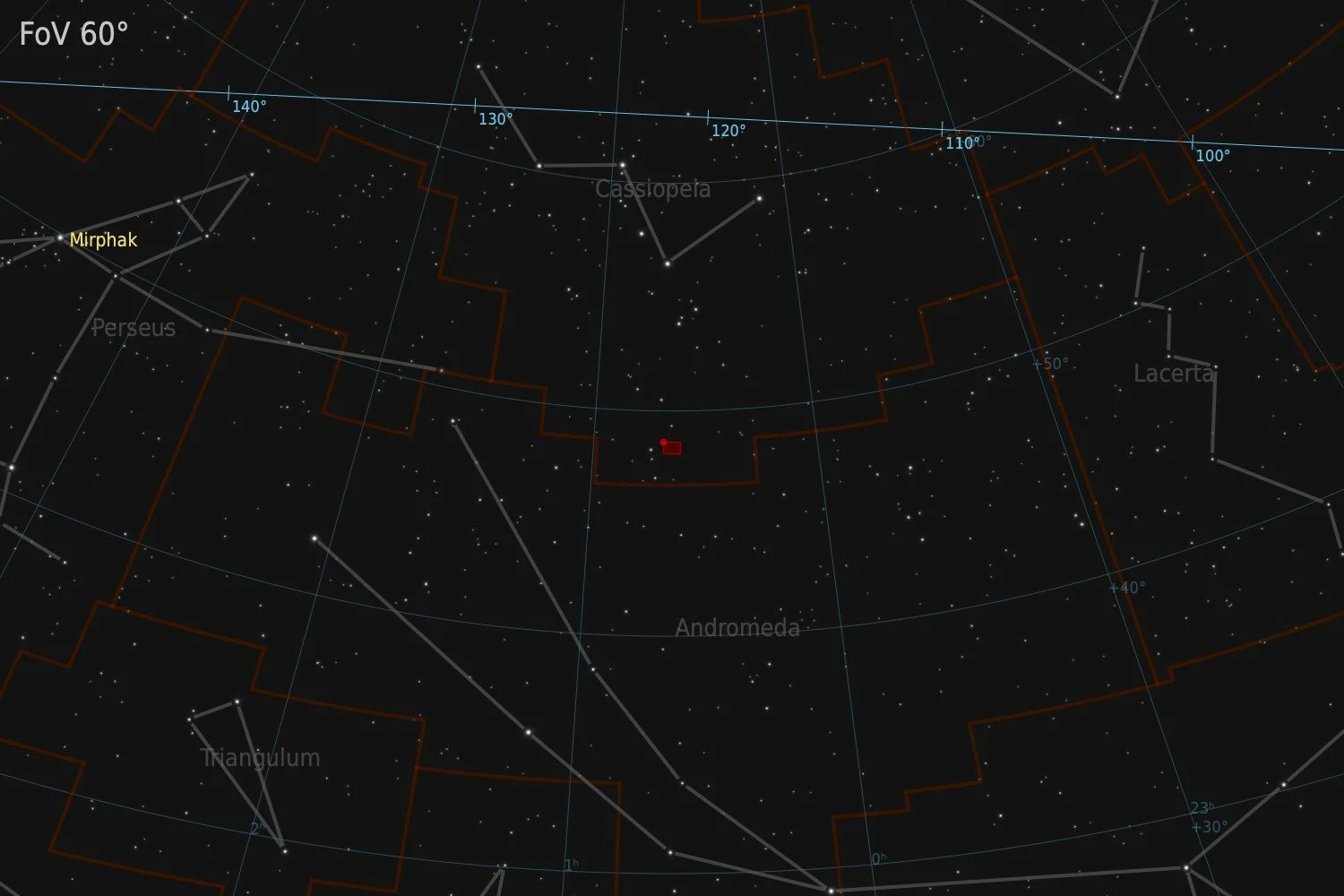
Cassiopeia
RA 0h 38m 55s Dec +48° 20’ 45” | 0°
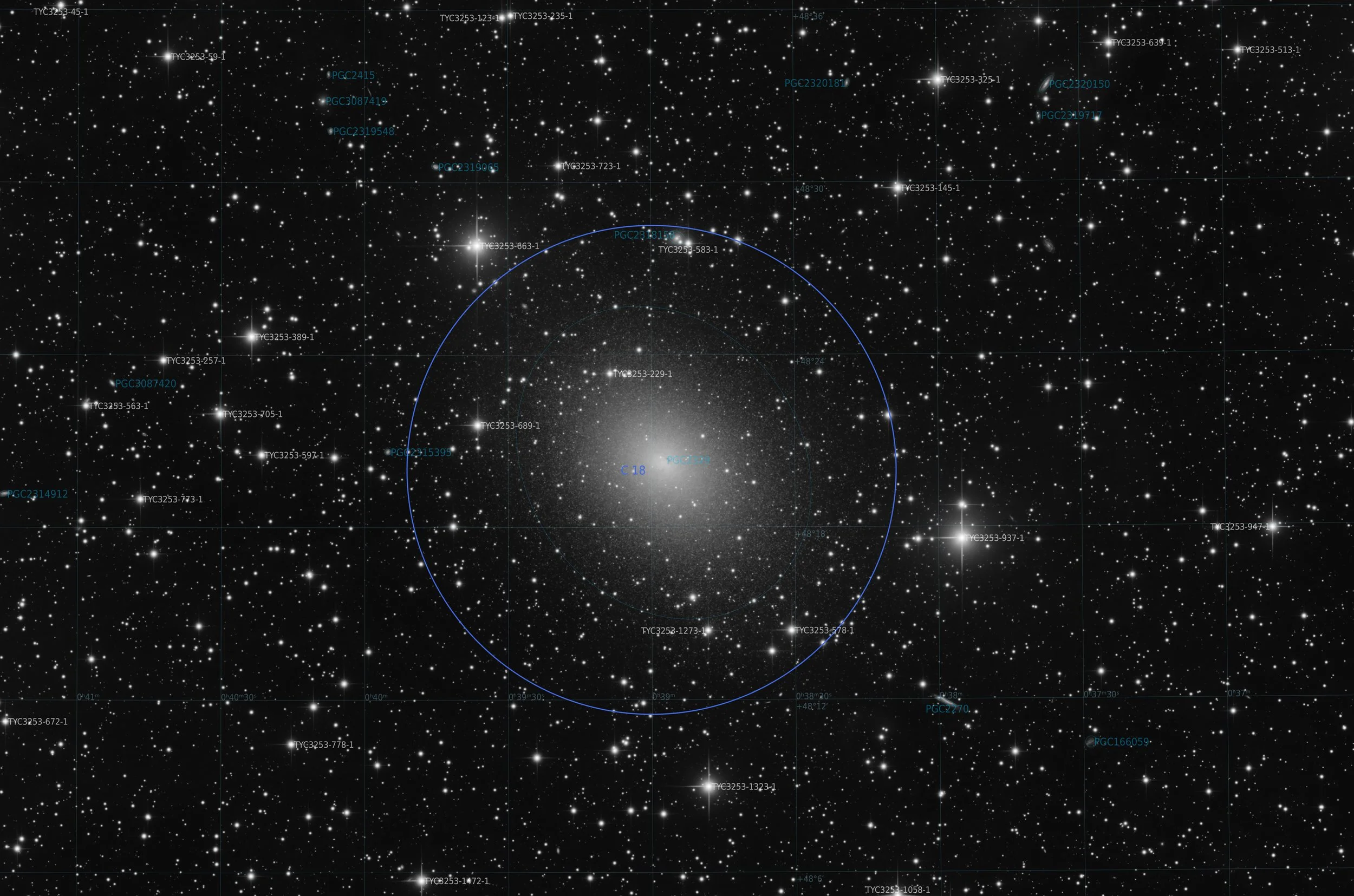
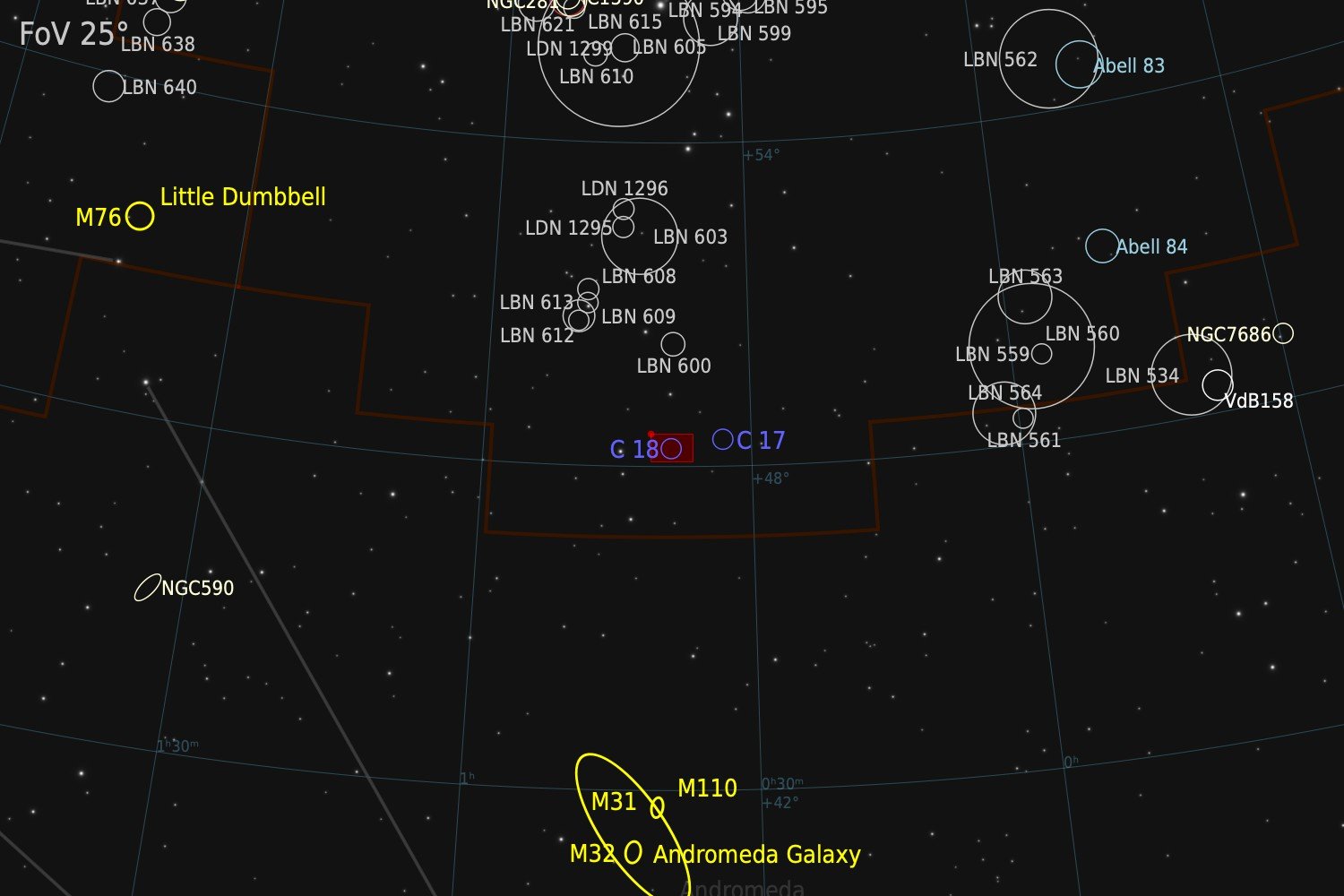
Caldwell 18, also known as NGC 185, is a dwarf spheroidal galaxy located in the constellation Cassiopeia. It was discovered by William Herschel on November 30, 1787. Caldwell 18 lies at a distance of approximately 2 million light-years from Earth, placing it firmly within the Local Group and making it a satellite galaxy of the Andromeda Galaxy, M31. It spans a true diameter of roughly 8,000 light-years and reaches an apparent magnitude of around 9.2. It is often discussed alongside its close neighbour Caldwell 17 (NGC 147), another dwarf spheroidal satellite of Andromeda that lies only about 1 degree away on the sky, and the two are thought to form a gravitationally bound pair in orbit around M31. As a dwarf spheroidal galaxy, NGC 185 consists predominantly of older, evolved stars and might be expected to show little in the way of recent activity. It is therefore notable for containing a small but distinct nucleus with evidence of relatively recent star formation, along with patches of dust and gas near its centre — features that are unusual for a galaxy of this type and set it apart from most other dwarf spheroidals in the Local Group. It also hosts a small number of carbon stars and several globular clusters, and there is evidence suggesting the presence of a central black hole, making it one of the smallest galaxies known to potentially harbour one.
Source: Claude.ai
Data Acquisition
Data was collected during 8 nights in July and August 2026, using a 14” reflector telescope with full-frame camera at the remote observatory in Spain. Data was gathered using standard LRGB filters. A total of approximately 14 hours of data was finally combined to create the final image.
Location Remote hosting facility Roboscopes in Fregenal de la Sierra, Spain (38°N 6°W)
Sessions
Frames
Equipment
Telescope
Mount
Camera
Filters
Guiding
Accessoires
Software
Planewave CDK14 (2563mm @ f/7.2), Optec Gemini Rotating focuser
10Micron GM2000HPS, custom pier
Moravian C3-61000 Pro (full frame), cooled to -10 ºC
Chroma 2” LRGB unmounted, Moravian filterwheel L, 7-position
Unguided
Compulab Tensor I-22, Dragonfly, Pegasus Ultimate Powerbox v2
Voyager Advanced, Viking, Mountwizzard4, Astroplanner, PixInsight 1.9.4
Processing
All processing was done in Pixsinsight unless stated otherwise. Default features were enhanced using scripts and tools from RC-Astro, SetiAstro, GraXpert, CosmicPhotons and others. Images were calibrated using 50 Darks, 50 Flats, and 50 Flat-Darks, registered and integrated using WeightedBatchPreProcessing (WBPP). The processing workflow diagram below outlines the steps taken to create the final image.
Unfortunately I’m battling some dynamic dust motes on my sensor and filters at the moment. The original method of making fresh flats every few months therefore does not work anymore and instead I have to make flats much more frequently. It also means that from time to time I have datasets which are not corrected for dust motes for the full 100%. This dataset was one of them. So at the start of the processing, a starless image was created and dust motes were carefully removed using the clonestamp tool. After removing the dust specks, starless and starry image were put together again using Pixelmath.
Deconvolution using BXT was performed with very mild settings. While the latest (ML5) BXT model is very good in preventing artefacts in dense star fields, in a speckled environment such as a nearby galaxy like this, artefacts can still occur when not careful. As a consequence, the stars in this image are also a bit more pronounced than in most of my other images.
The rest of the processing followed a very standard approach. The outline below shows a detailed breakdown of the processing steps applied to the image.
Processing workflow (click to enlarge)
This image has been published on Astrobin.