Caldwell 54
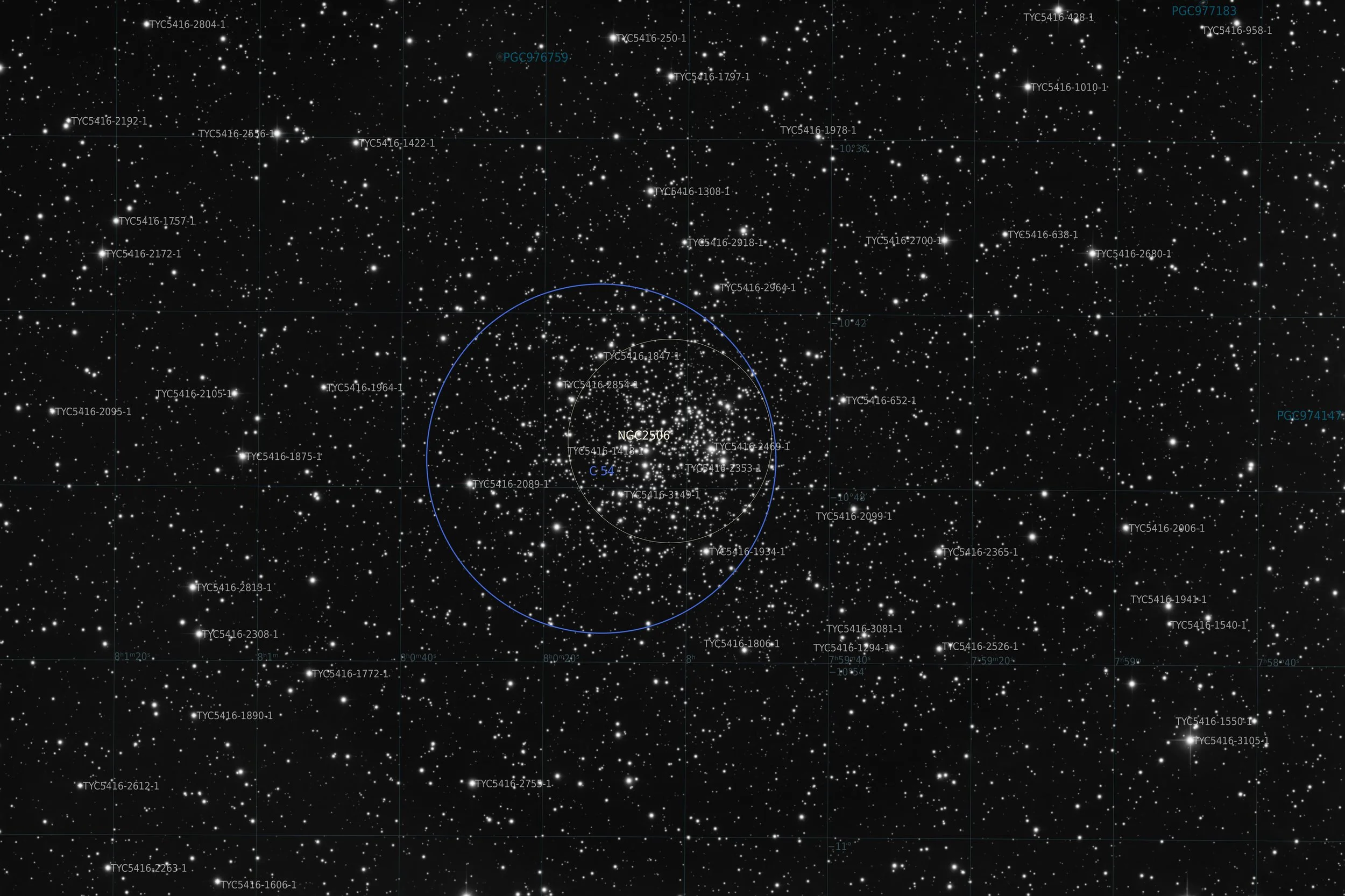
NGC 2506
46’ x 30’ | 0.3”/px | 9198 × 6129 px
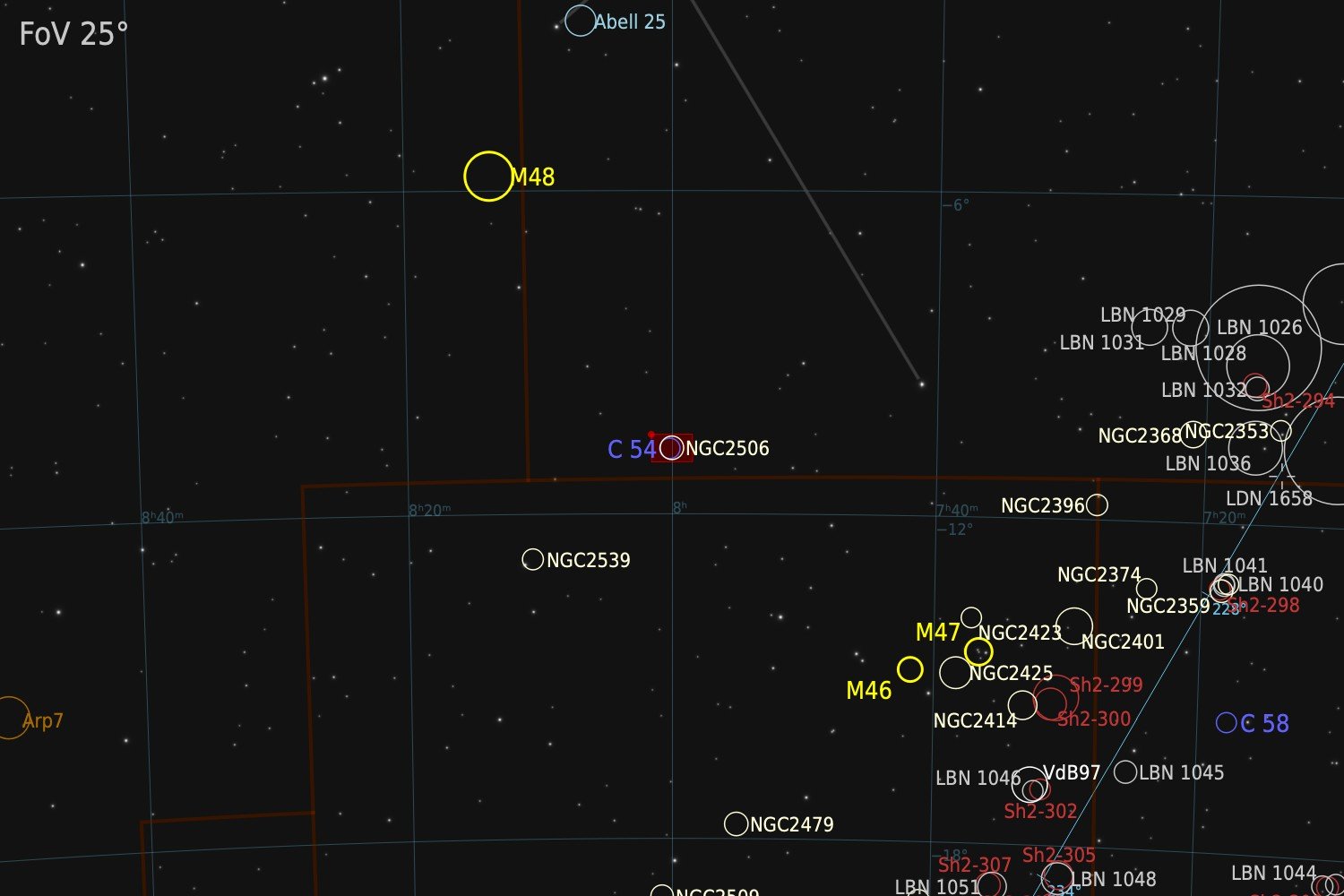
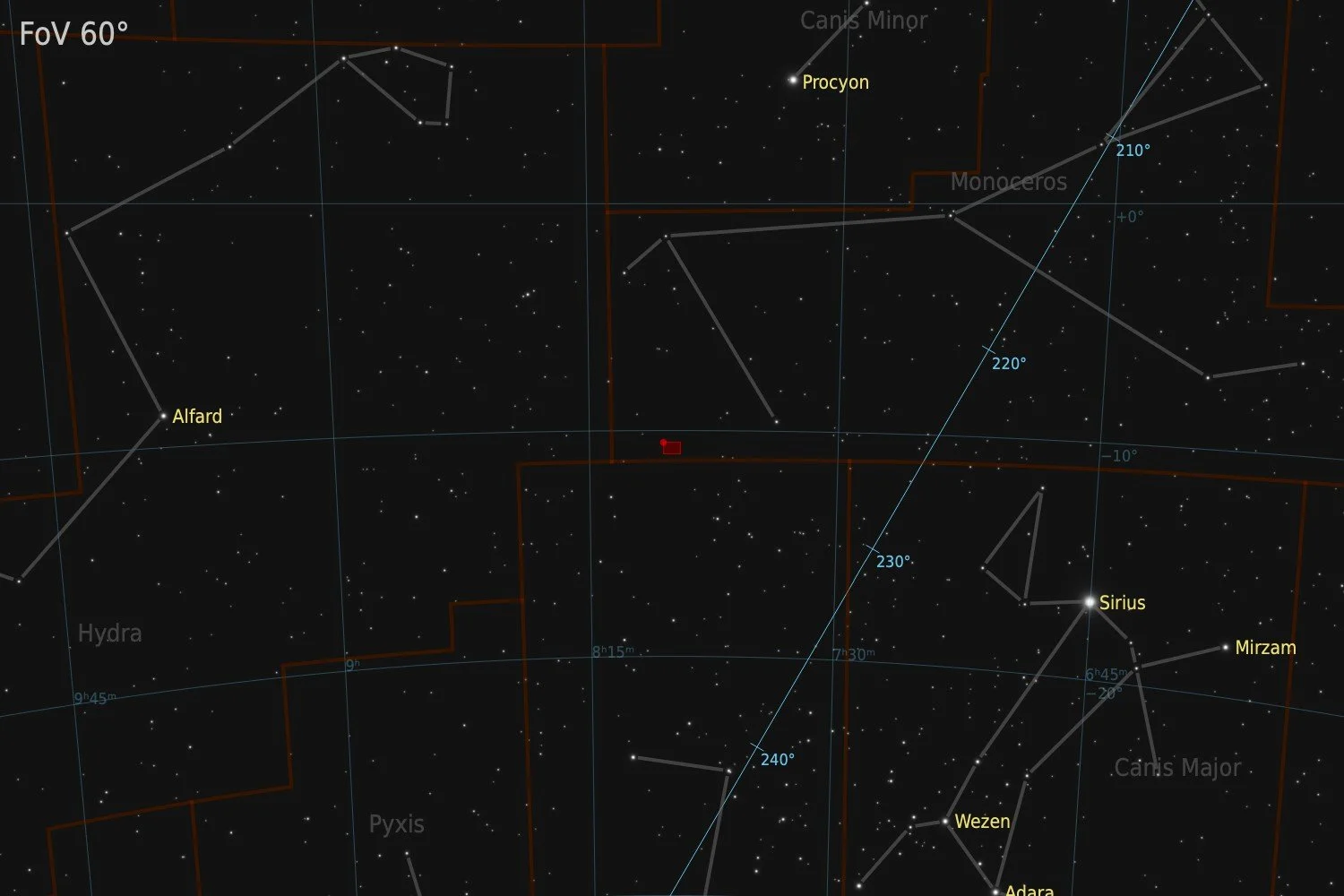
Monoceros
RA 8h 00m 02s Dec -10° 46’ 37” | 0°
Caldwell 54, also known as NGC 2506, is an open star cluster located in the constellation Monoceros, the Unicorn. It was discovered by William Herschel on March 1, 1791. NGC 2506 lies at a distance of approximately 10,000 light-years from Earth. This is considerably further away than the majority of Messier open clusters. It spans a true diameter of roughly 25 light-years and reaches an apparent magnitude of around 7.6. One of the defining characteristics is its age, estimated at around 1.8 to 2 billion years old. It makes it one of the oldest known open clusters. Most open clusters disperse within a few hundred million years. This is also reflected in its metal-poor composition which points to formation during an earlier, less chemically enriched period of the Milky Way's history.
Source: Claude.ai
Data Acquisition
Data was collected during 4 nights in March until May2026, using a 14” reflector telescope with full-frame camera at the remote observatory in Spain. Data was gathered using standard RGB filters, mainly during full moon periods. Clusters like this are ideal targets for these otherwise challenging periods. Data were partially collected at ICAstronomy and imaging was completed at Roboscopes, the observatory the telescope was moved to in early April 2026. This object is the last one that still has data from the previous observatory. A total of approximately 6 hours of data was finally combined to create the final image.
Location Remote hosting facilities IC Astronomy in Oria, Spain (37°N 2°W) and Roboscopes in Fregenal de la Sierra, Spain (38°N 6°W)
Sessions
Frames
Equipment
Telescope
Mount
Camera
Filters
Guiding
Accessoires
Software
Planewave CDK14 (2563mm @ f/7.2), Optec Gemini Rotating focuser
10Micron GM2000HPS, custom pier
Moravian C3-61000 Pro (full frame), cooled to -10 ºC
Chroma 2” RGB unmounted, Moravian filterwheel L, 7-position
Unguided
Compulab Tensor I-22, Dragonfly, Pegasus Ultimate Powerbox v2
Voyager Advanced, Viking, Mountwizzard4, Astroplanner, PixInsight 1.9.4
Processing
All processing was done in Pixsinsight unless stated otherwise. Default features were enhanced using scripts and tools from RC-Astro, SetiAstro, GraXpert, CosmicPhotons and others. Images were calibrated using 50 Darks, 50 Flats, and 50 Flat-Darks, registered and integrated using WeightedBatchPreProcessing (WBPP). The processing workflow diagram below outlines the steps taken to create the final image.
The processing followed a very standard approach. The outline below shows a detailed breakdown of the processing steps applied to the image.
Over time, the annotation scripts have changed a bit, and I was not happy anymore with both the very contrasty results and the lack of relevant labeling of objects. So a slightly modified colour palette was applied and some more catalogues were used to label the objects in the images. A modified annotation script, written by Scott Sterling, called AnnotateImageExt was used for this, which includes more libraries.
Processing workflow (click to enlarge)
This image has been published on Astrobin.