Abell 39
PN A66 39
30’ x 20’ | 0.3”/px | 6000 × 4000 px
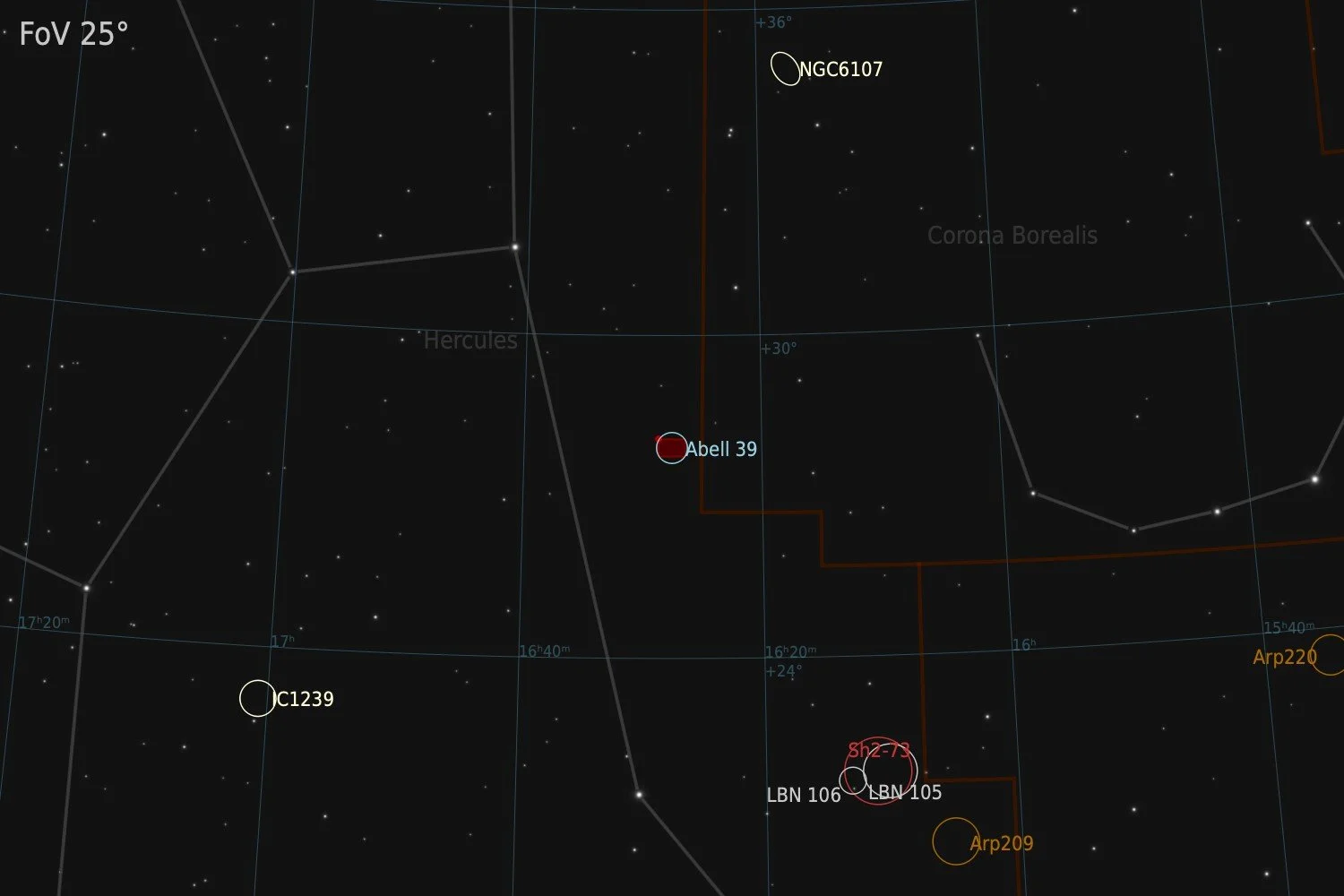
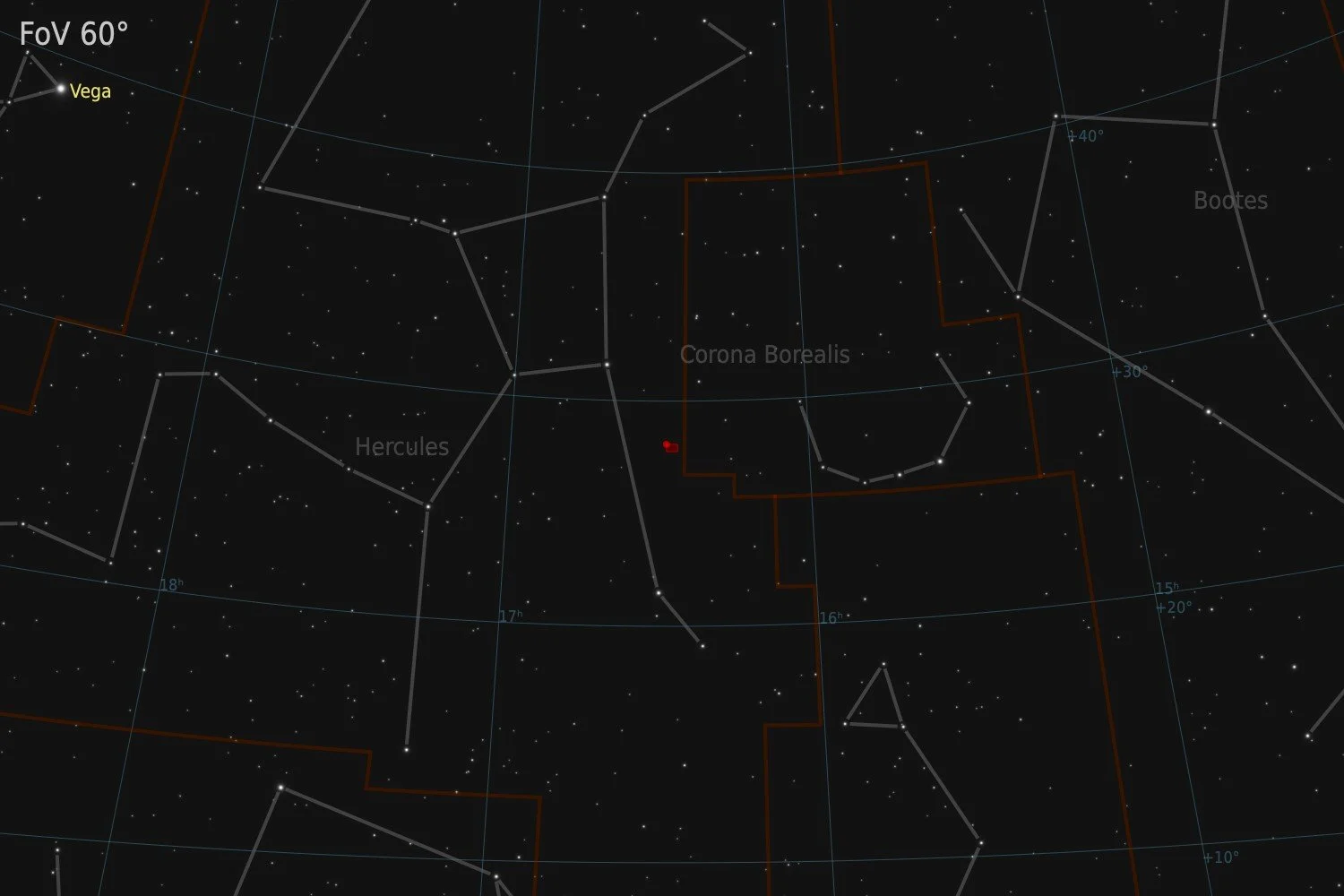
Hercules
RA 16h 27m 34s Dec +27° 54’ 33” | 0°
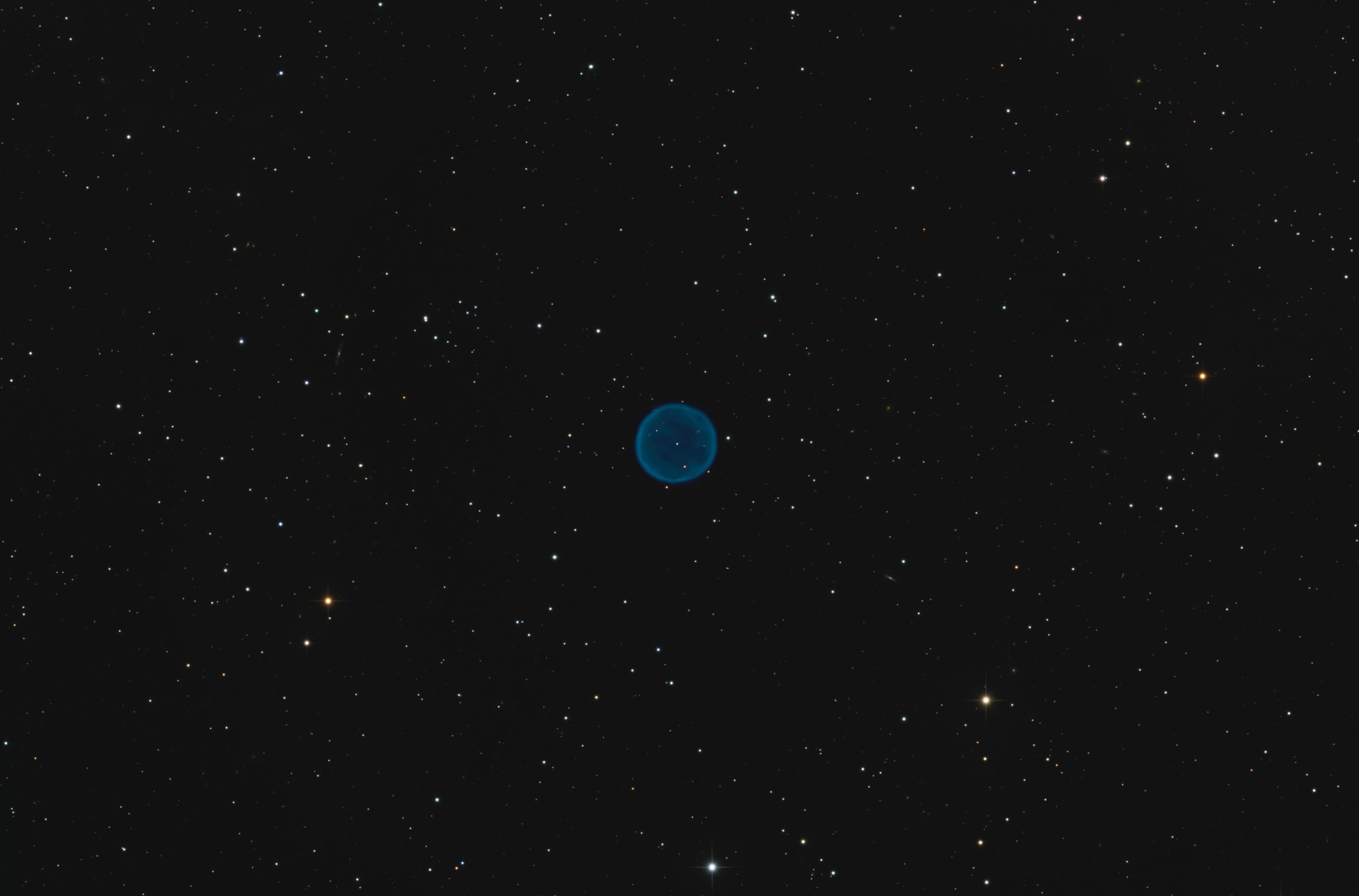
Abell 39, also known as PN A66 39, is a planetary nebula located in the constellation Hercules. Abell 39 lies at a distance of approximately 6,800 light-years from Earth and is one of the largest and most geometrically perfect spherical planetary nebulae known. It spans a true diameter of roughly 5 light-years and has an apparent diameter of around 2.7 arcminutes on the sky. Its shell is remarkably uniform in thickness and roundness, making it a visually satisfying planetary nebula for imaging purposes. At its centre sits a hot white dwarf, the remnant of the star that shed its outer layers to create the nebula, estimated to have occurred around 22,000 years ago.
Source: Claude.ai
Data Acquisition
Data was collected during 5 nights in June and July of 2026, using a 14” reflector telescope with full-frame camera at the remote observatory in Spain. Data was gathered using a 3nm OIII narrowband filter as well as standard RGB filters. The nebula is pretty much exclusively visible in the OIII narrowband bandwidth, so there was no reason to include any of the other narrowband filters and the RGB data are primarily to create a representative image of the star field. A total of approximately 9 hours of data was finally combined to create the final image.
Location Remote hosting facility Roboscopes in Fregenal de la Sierra, Spain (38°N 6°W)
Sessions
Frames
Equipment
Telescope
Mount
Camera
Filters
Guiding
Accessoires
Software
Planewave CDK14 (2563mm @ f/7.2), Optec Gemini Rotating focuser
10Micron GM2000HPS, custom pier
Moravian C3-61000 Pro (full frame), cooled to -10 ºC
Chroma 2” OIII (3nm) and RGB unmounted, Moravian filterwheel L, 7-position
Unguided
Compulab Tensor I-22, Dragonfly, Pegasus Ultimate Powerbox v2
Voyager Advanced, Viking, Mountwizzard4, Astroplanner, PixInsight 1.9.4
Processing
All processing was done in Pixsinsight unless stated otherwise. Default features were enhanced using scripts and tools from RC-Astro, SetiAstro, GraXpert, CosmicPhotons and others. Images were calibrated using 50 Darks, 50 Flats, and 50 Flat-Darks, registered and integrated using WeightedBatchPreProcessing (WBPP). The processing workflow diagram below outlines the steps taken to create the final image.
The nebula is an almost 100% OIII target. In the RGB data there was a very faint impression of the nebula, showing up in the Green and Blue channels, but there was no reason to emphasise this. In order to have freedom stretching the stars, without the nebula getting in the way of the OIII signal, the RGB image was still processed in a starless version, mainly to build the background. After stretching, the stars were put back in.
For the OIII the opposite approach was used, the stars were taken out and the starless image was stretched to maximally reveal the data of the nebula. This was blended into the RGB image with the hue filter and blended in using the Lighten blend mode. The chosen hue was 202 with a saturation of 0.7.
When the image was ready I still wanted to brighten up the nebula a tiny bit more, and accomplished this using a range mask from the OIII image and increased the brightness of the masked ORGB image. A more logical way would have been to do this during the stretching of the OIII, or during the blending process.
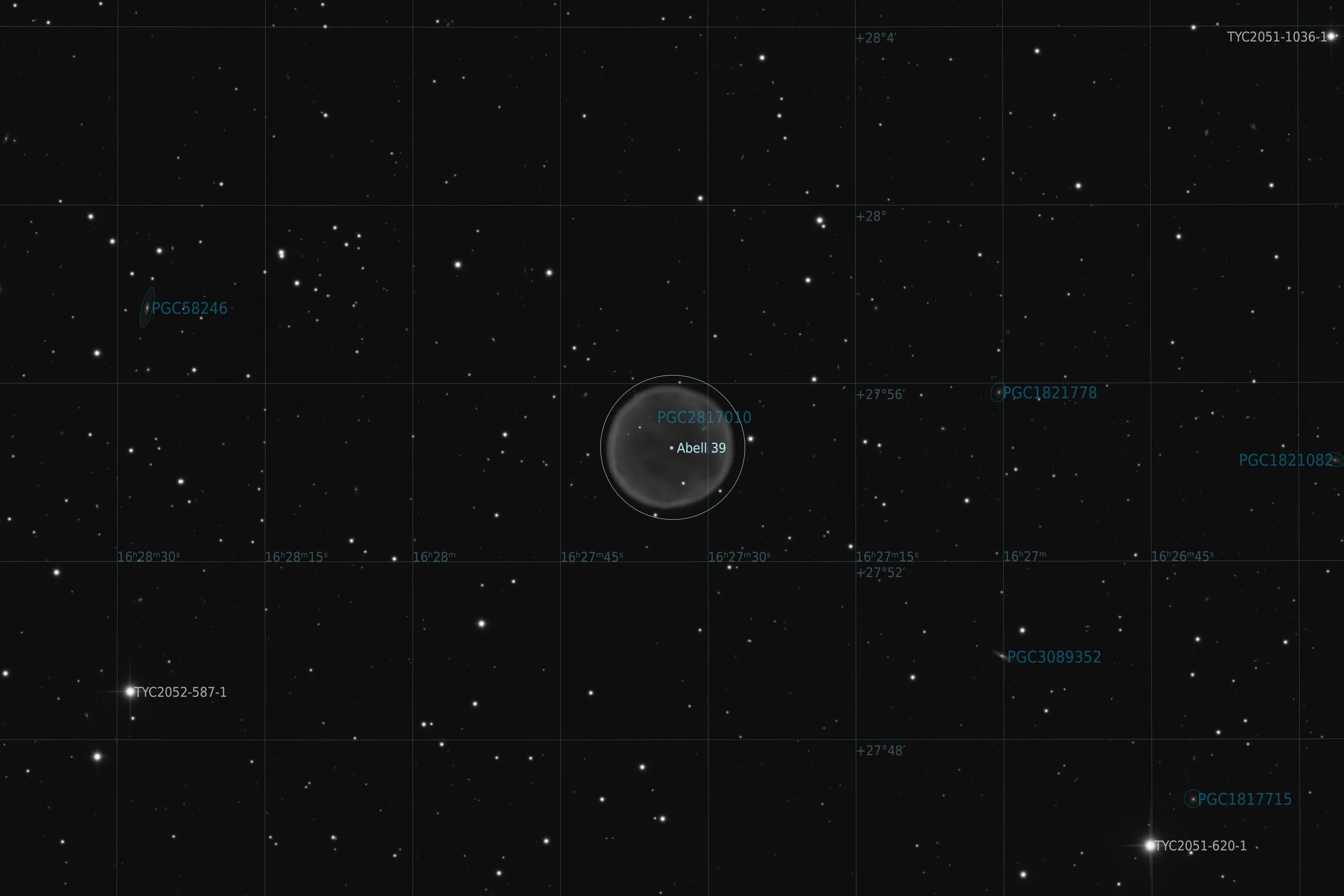
For annotation, there was no database available. Therefore I downloaded an excel file from Sky&Telescope. The object sizes were all enlarged by 20%, just to give the circles in the annotated image a bit of space to highlight the object without clipping the edges. The excel file was reformatted to the PixInsight required csv format using Claude AI.
Rest of the processing followed a very standard approach. The outline below shows a detailed breakdown of the processing steps applied to the image.
Processing workflow (click to enlarge)
This image has been published on Astrobin.