Abell 43
PN A66 43, PN G036.0+17.6
12’ x 8’ | 0.3”/px | 2400 × 1600 px
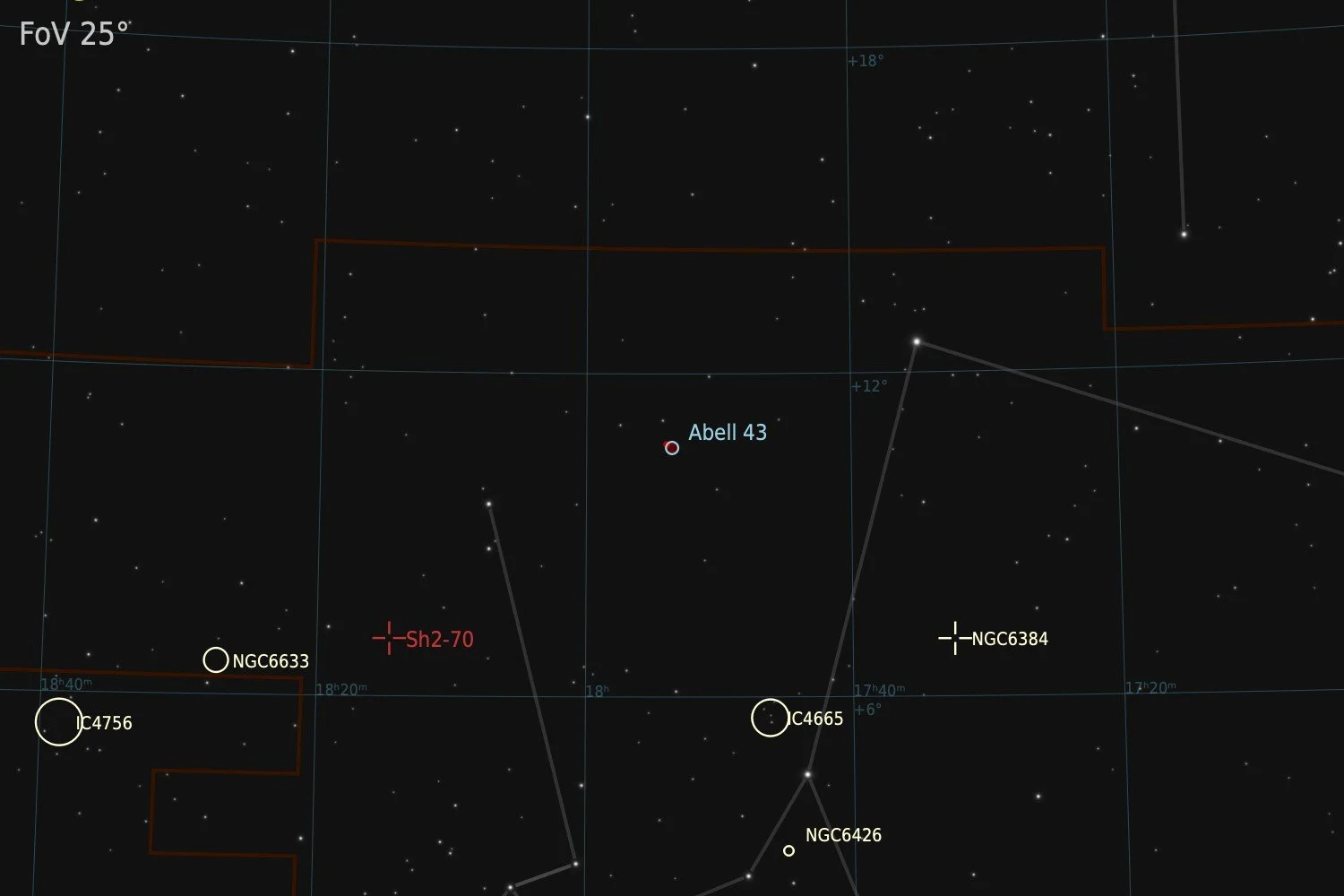
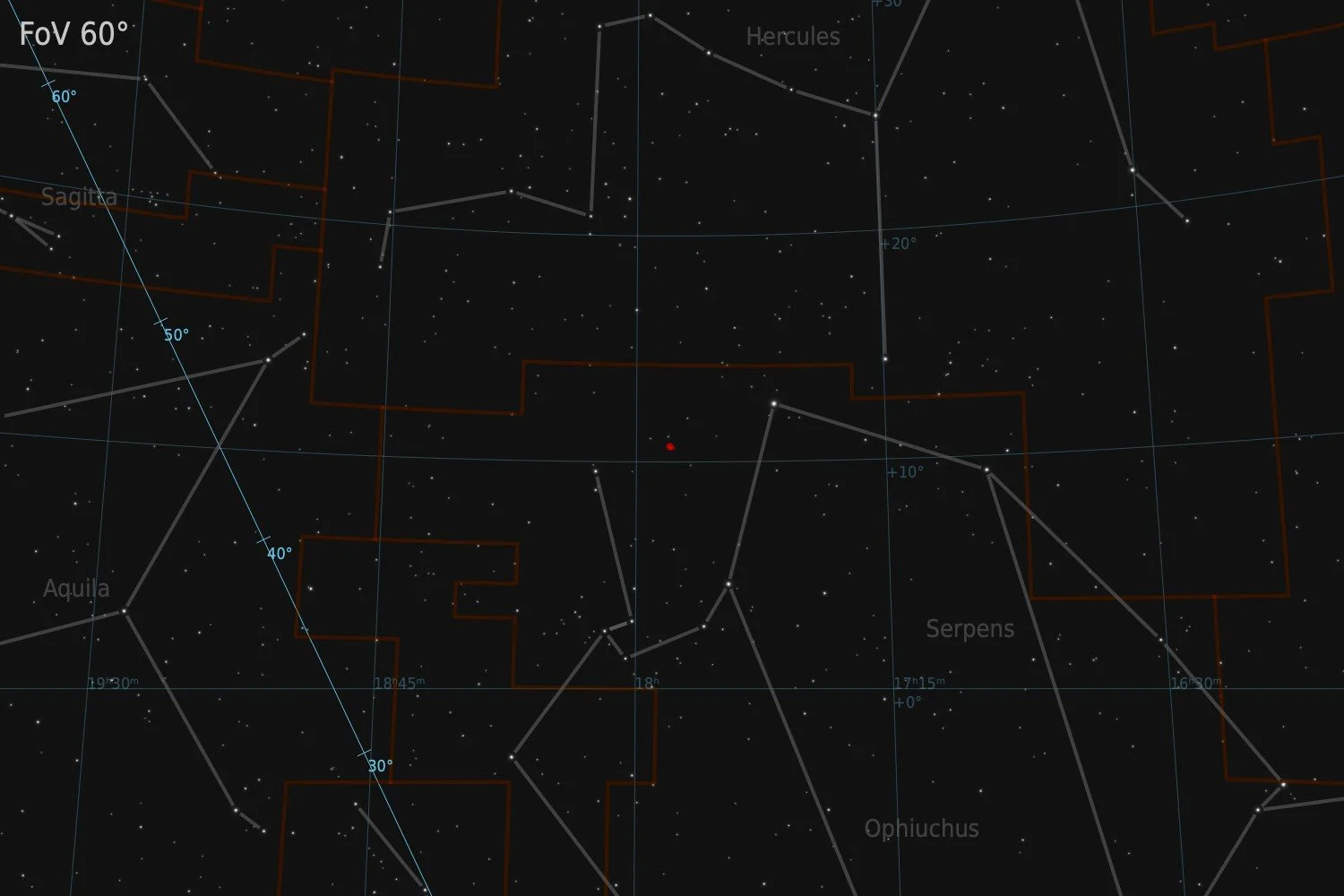
Ophiuchus
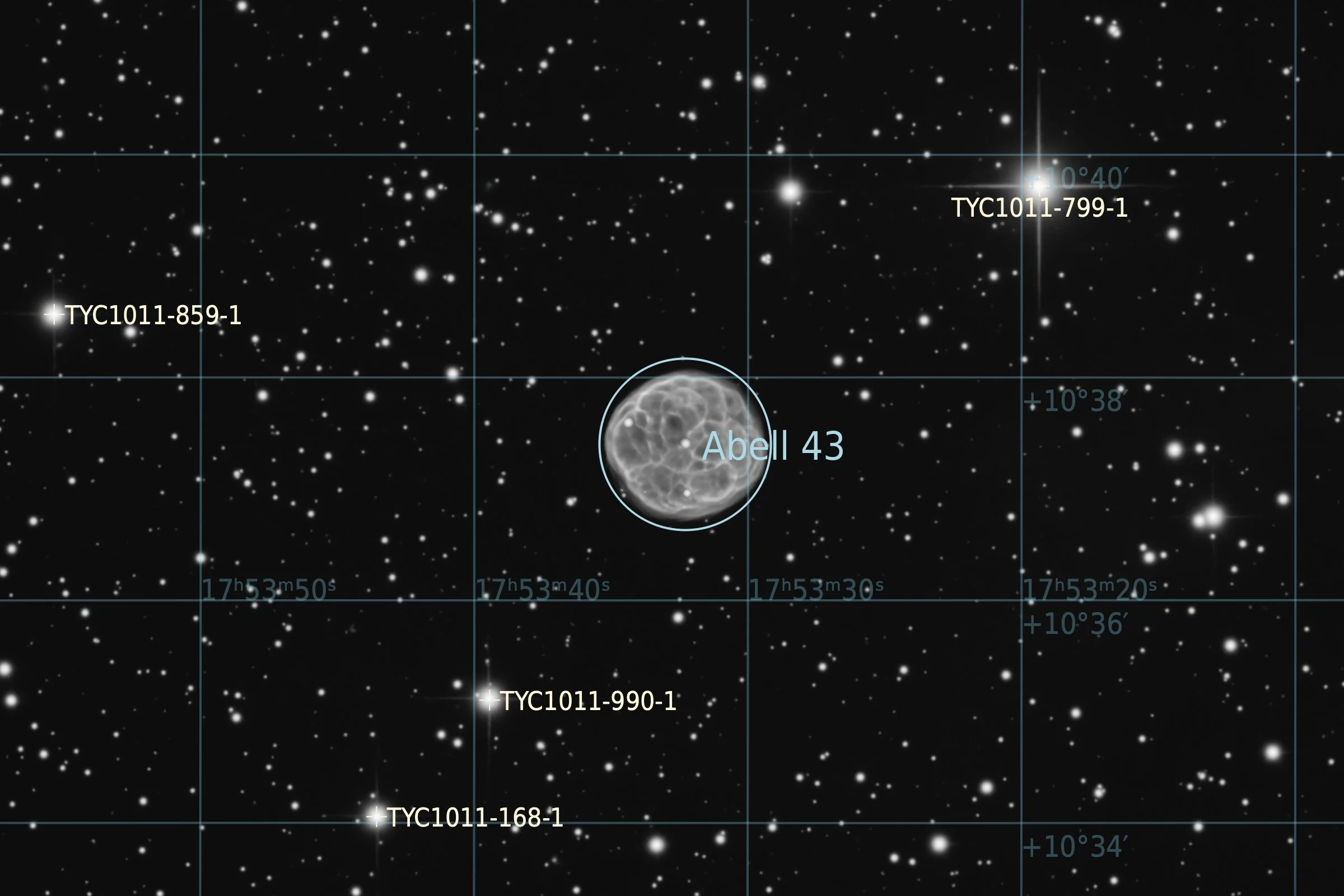
RA 17h 53m 33s Dec +10° 37’ 22” | 0°
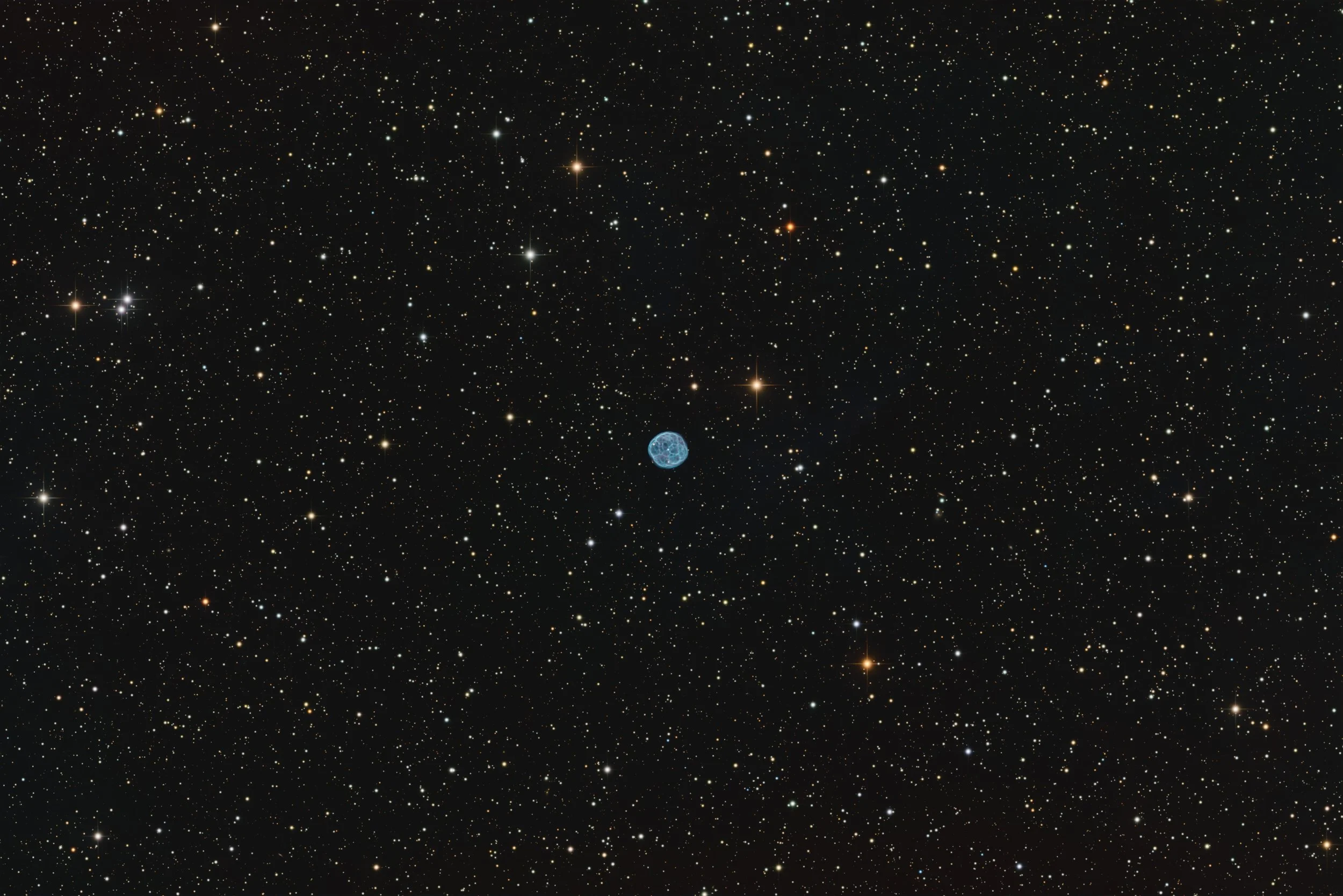
Abell 43, also known as PN G036.0+17.6, is a planetary nebula located in the constellation Ophiuchus. It was discovered by George Ogden Abell in 1955 on photographic plates from the Palomar Observatory Sky Survey, initially listed as object number 31 in his first publication, and subsequently catalogued as Abell 43 in his completed list of 86 planetary nebulae published in 1966. Abell described it as a homogeneous ring. The nebula has an apparent diameter of approximately 80 arcseconds on the sky. Distance estimates vary, but place it in the range of a few thousand light-years. It is described as almost perfectly round and is thought to have expanded into a relatively undisturbed void in the interstellar medium, which accounts for its symmetrical shell. Along with the similar object NGC 7094, due to the filamentary surface structures of Abell 43, it has been informally referred to as one of the galactic soccer balls. These structures are thought to arise from instabilities in the dense, expanding nebular shell.
The central star of Abell 43, designated WD 1751+10, is an extremely hot evolved star with a surface temperature of around 110,000 Kelvin. It belongs to a rare class known as hybrid PG 1159 stars. These are intermediate objects transitioning from planetary nebula central stars to white dwarfs. The star has been confirmed as a pulsating variable, with brightness variations occurring over periods of roughly 2,400 to 6,000 seconds — the longest pulsation periods known among this type of star at the time of discovery.
Source: Claude.ai.
Data Acquisition
Data was collected during 6 nights in July of 2026, using a 14” reflector telescope with full-frame camera at the remote observatory in Spain. Data was gathered with 3nm Ha and OIII narrowband filters, as well as with broadband RGB filters for the stars. A total of approximately 18 hours of data was finally combined to create the final image.
Location Remote hosting facility Roboscopes in Fregenal de la Sierra, Spain (38°N 6°W)
Sessions
Frames
Equipment
Telescope
Mount
Camera
Filters
Guiding
Accessoires
Software
Planewave CDK14 (2563mm @ f/7.2), Optec Gemini Rotating focuser
10Micron GM2000HPS, custom pier
Moravian C3-61000 Pro (full frame), cooled to -10 ºC
Chroma 2” Ha, OIII (both 3nm), R, G and B unmounted, Moravian filterwheel L, 7-position
Unguided
Compulab Tensor I-22, Dragonfly, Pegasus Ultimate Powerbox v2
Voyager Advanced, Viking, Mountwizzard4, Astroplanner, PixInsight 1.9.5
Processing
All processing was done in Pixsinsight unless stated otherwise. Default features were enhanced using scripts and tools from RC-Astro, SetiAstro, GraXpert, CosmicPhotons and others. Images were calibrated using 50 Darks, 50 Flats, and 50 Flat-Darks, registered and integrated using WeightedBatchPreProcessing (WBPP). The processing workflow diagram below outlines the steps taken to create the final image.
As for many other images this summer, some dust motes had been travelling around my filters, making my flat frames inadequate to fully correct for them. Also in the RGB image of Abell 43, there was one dust mote left, which was removed using the CloneStamp tool in the absence of stars.
The stars were stretched the old-fashioned way, using a combination of ArcsinhStretch and HistogramTransformation. Most other (semi)automatic stretching methods involve some kind of hyperbolic stretch, which can easily cause the star-cores to be odd shaped, with a very intense core, a very large initial drop-off in intensity, followed by an exceptionally slow drop-off towards the outer edges of the stars. Sometimes the arcsinhstretch method can give some blown out star cores, but not so this time.
It was rather difficult to find the right balance between the OIII signal and the much weaker Ha signal. Ha was abundantly more present than in many other planetary nebulae, but still a lot less than OIII. Normally the NarrowbandNormalisation process would handle this, but in this case I found it to be not effective enough. Therefore I ensured that the brightness of the Ha signal of the nebula was somewhat similar to the OIII signal during the stretching process, which was achieved by some extra brightness adjustments using CurvesTransformation.
The rest of the processing followed a very standard approach. The outline below shows a detailed breakdown of all processing steps applied to the image.
Processing workflow (click to enlarge)
This image has been published on Astrobin.