Caldwell 17
NGC147
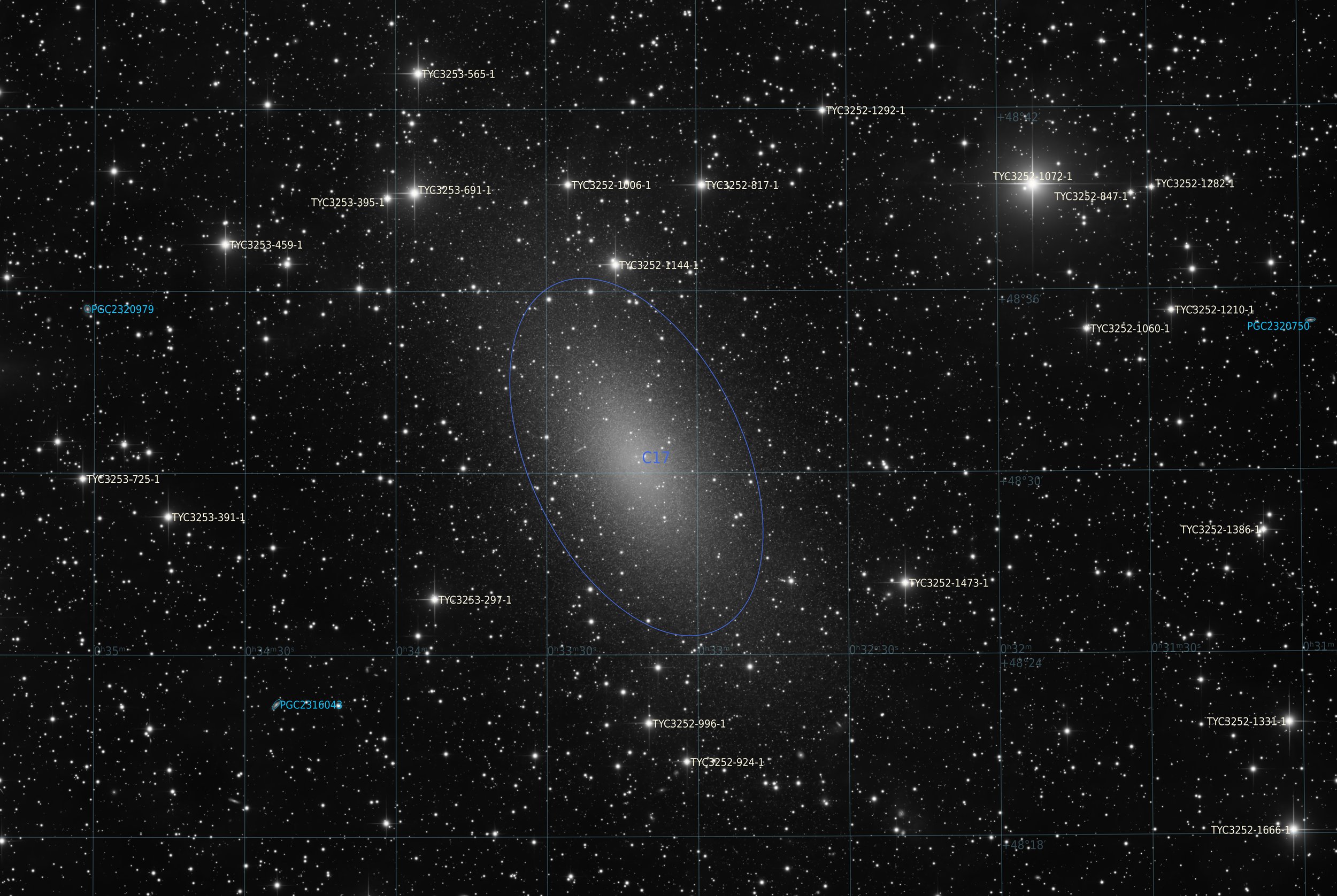
44’ x 29’ | 0.3”/px | 8769 × 5877 px
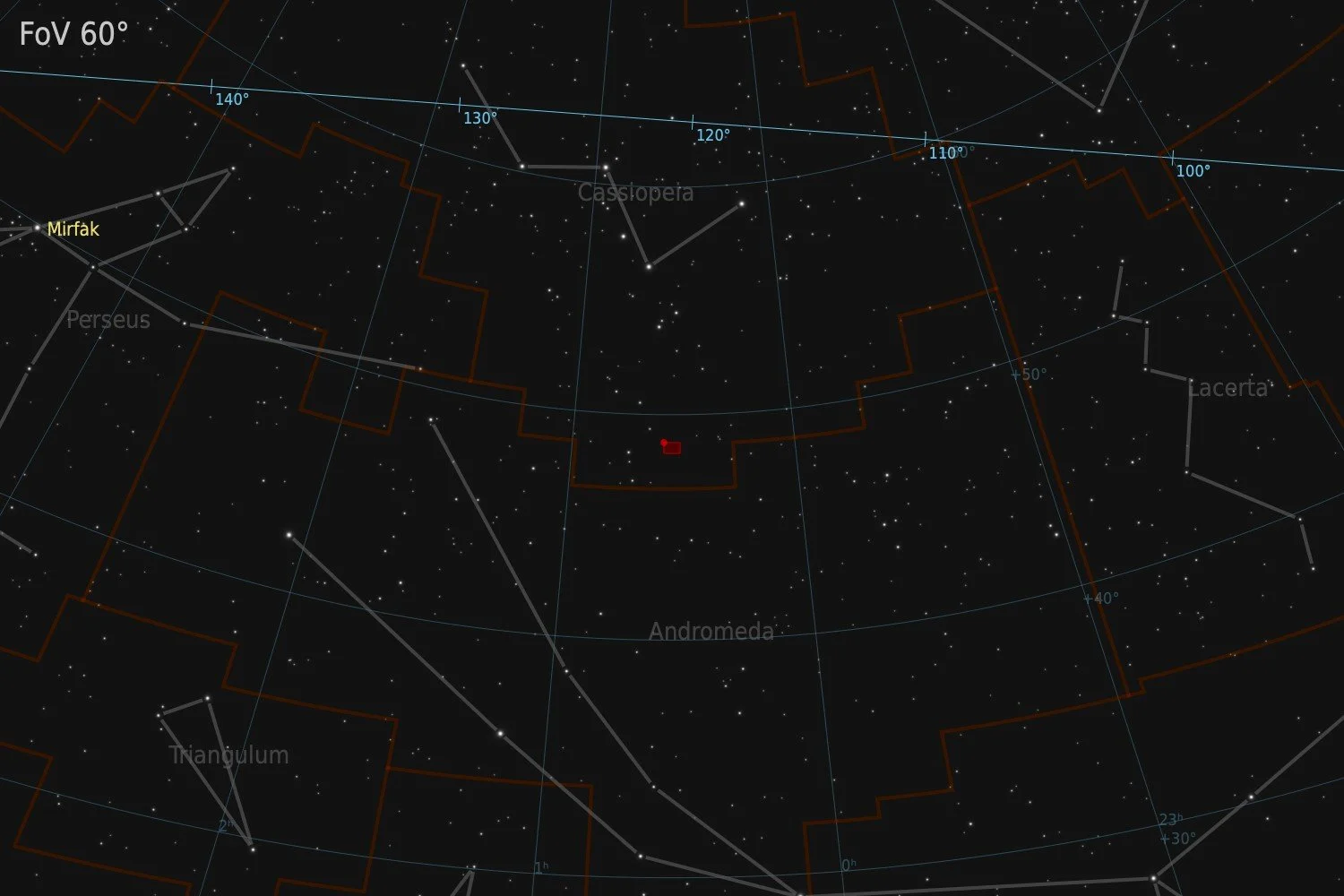
Cassiopeia
RA 0h 33m 06s Dec +48° 30’ 49” | 0°
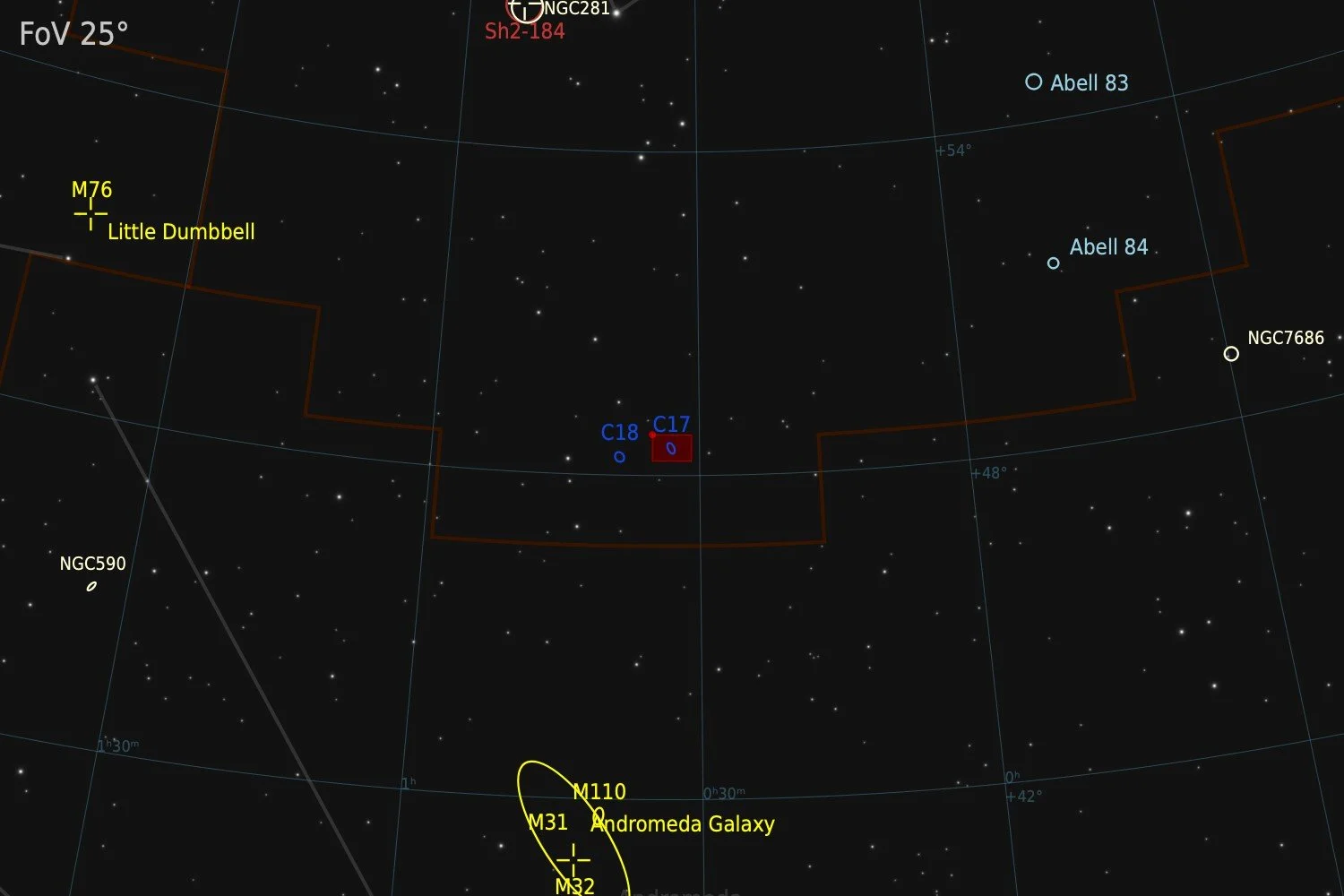
Caldwell 17, also known as NGC 147, is a dwarf spheroidal galaxy located in the constellation Cassiopeia, near its southern border with Andromeda. It was discovered by John Herschel on September 8, 1829. NGC 147 lies at a distance of approximately 2.5 million light-years from Earth and is a member of the Local Group of galaxies. It is a satellite galaxy of the Andromeda Galaxy and spans a true diameter of roughly 10,700 light-years. It lies approximately 300,000 light-years from M31 itself, roughly twice the distance between the Large Magellanic Cloud and the Milky Way. NGC 147 sits only about one degree to the west of its close neighbour NGC 185 (Caldwell 18), and the two are frequently discussed and imaged together. While sharing similar overall luminosities and half-light radii, the two galaxies differ markedly: NGC 147 is entirely devoid of gas and dust and shows no sign of recent star formation, in contrast to NGC 185, which retains some interstellar material and evidence of more recent stellar activity.
Extragalactic Star Clusters
It is very hard to identify individual objects in galaxies other than our own Milky Way. We see typically just the light distribution from billions of stars. This means intriguing patterns of light intensity and colour in typical galaxy shapes. Large clouds of hydrogen gas, especially in areas of high star formation, can be observed as well. For the rest we can see very little detail, just because they are so far away from us. About the best we can do is see some star clusters from very nearby galaxies.
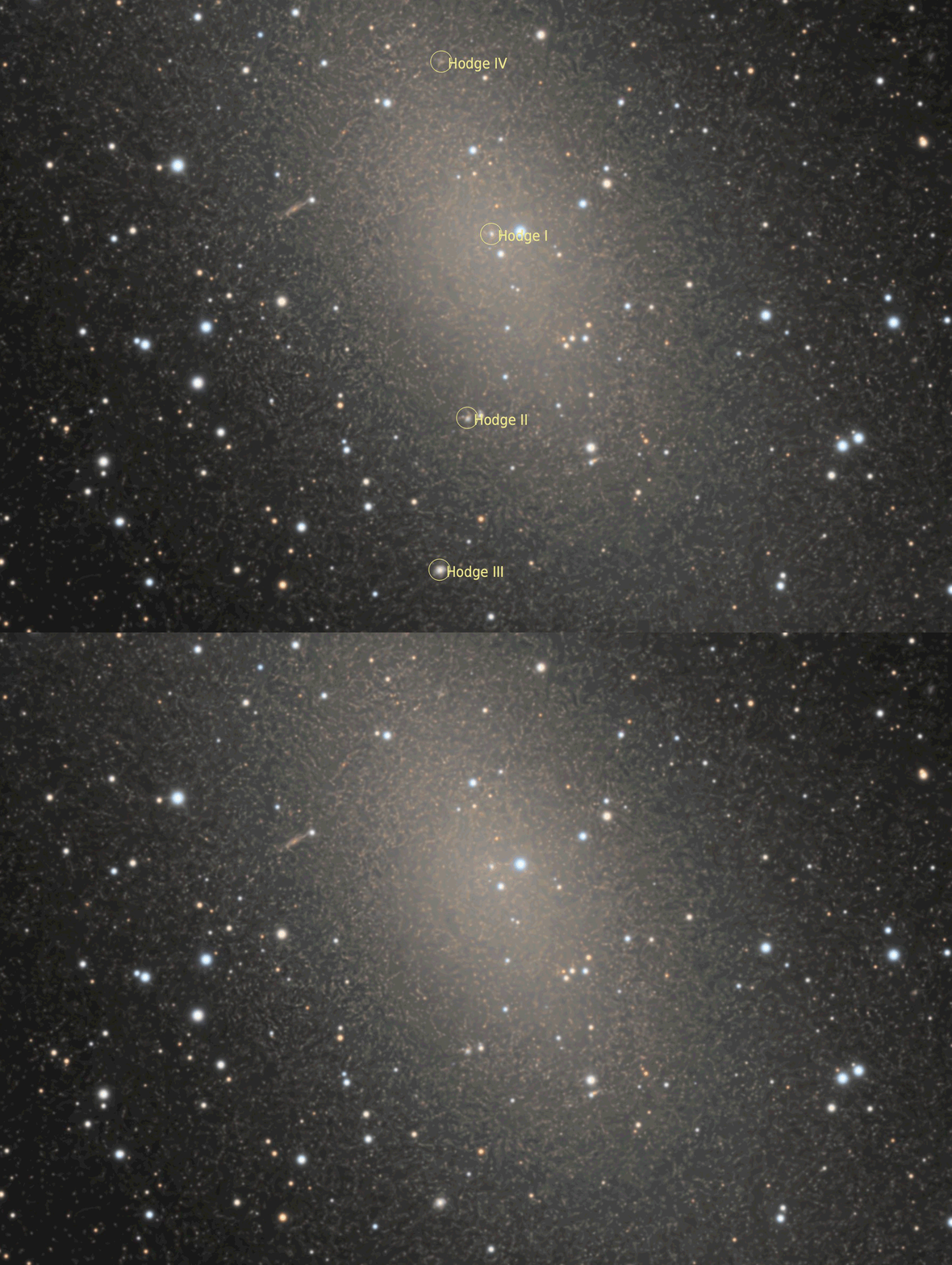
In 1944, Walter Baade, a German astronomer, published an article on Caldwell 17 based on data he collected from the Mount Wilson Observatory in Los Angeles. He was able to resolve NGC147 into individual stars. In that paper he also described two candidates for globular clusters. Later, in 1976, american astronomer Paul Hodge confirmed the objects to be globular clusters and identified a total of four of such clusters in NGC 147. They were named after him as Hodge I-IV.
When processing this image, I was curious if I could resolve these clusters. And it appeared that they were indeed visible. Hodge IV is super faint, but Hodge III is actually quite noticeable. It is a bit wider than a star, clearly does not have the shape of a star and shows some uneven colour distribution.
Source: miscellaneous
Data Acquisition
Data was collected during 9 nights in July and August 2026, using a 14” reflector telescope with full-frame camera at the remote observatory in Spain. Data was gathered using standard LRGB filters. A total of approximately 14 hours of data was finally combined to create the final image.
Location Remote hosting facility Roboscopes in Fregenal de la Sierra, Spain (38°N 6°W)
Sessions
Frames
Equipment
Telescope
Mount
Camera
Filters
Guiding
Accessoires
Software
Planewave CDK14 (2563mm @ f/7.2), Optec Gemini Rotating focuser
10Micron GM2000HPS, custom pier
Moravian C3-61000 Pro (full frame), cooled to -10 ºC
Chroma 2” LRGB unmounted, Moravian filterwheel L, 7-position
Unguided
Compulab Tensor I-22, Dragonfly, Pegasus Ultimate Powerbox v2
Voyager Advanced, Viking, Mountwizzard4, Astroplanner, PixInsight 1.9.5
Processing
All processing was done in Pixsinsight unless stated otherwise. Default features were enhanced using scripts and tools from RC-Astro, SetiAstro, GraXpert, CosmicPhotons and others. Images were calibrated using 50 Darks, 50 Flats, and 50 Flat-Darks, registered and integrated using WeightedBatchPreProcessing (WBPP). The processing workflow diagram below outlines the steps taken to create the final image.
This was the first image processed using PixInsight 1.9.5. One of the new tools in this version of PI is MLDenoise, a noise reduction tool based on Machine Learning algorithms. I tried MLDenoise on this image and compared it with NoiseXTerminator. It had a bit of a hard time to distinguish the stellar patterns in this galaxy from noise. So setting the parameters was tricky, but doable. However in the final result there were some panels not de-noised. I remember from earlier beta-version reports that this was an issue in earlier iterations. I have not seen this in any of the current reviews of MLDenoise, so perhaps it is specific to the Mac-Intel version of PI. It is to be expected that this will be corrected in future versions. For the time being, NoiseXTerminator gives excellent results.
The images were taken in a time when some dust motes were traveling over my filters and I had not spotted this early enough to properly calibrate it all out with fresh flat frames. So similar to when processing Caldwell 18, some dust motes were clone-stamped out in a starless version of the image.
The rest of the processing followed a very standard approach. The outline below shows a detailed breakdown of the processing steps applied to the image.
Processing workflow (click to enlarge)
This image has been published on Astrobin.