Abell 78
PN A66 78, PN G081.2-14.9
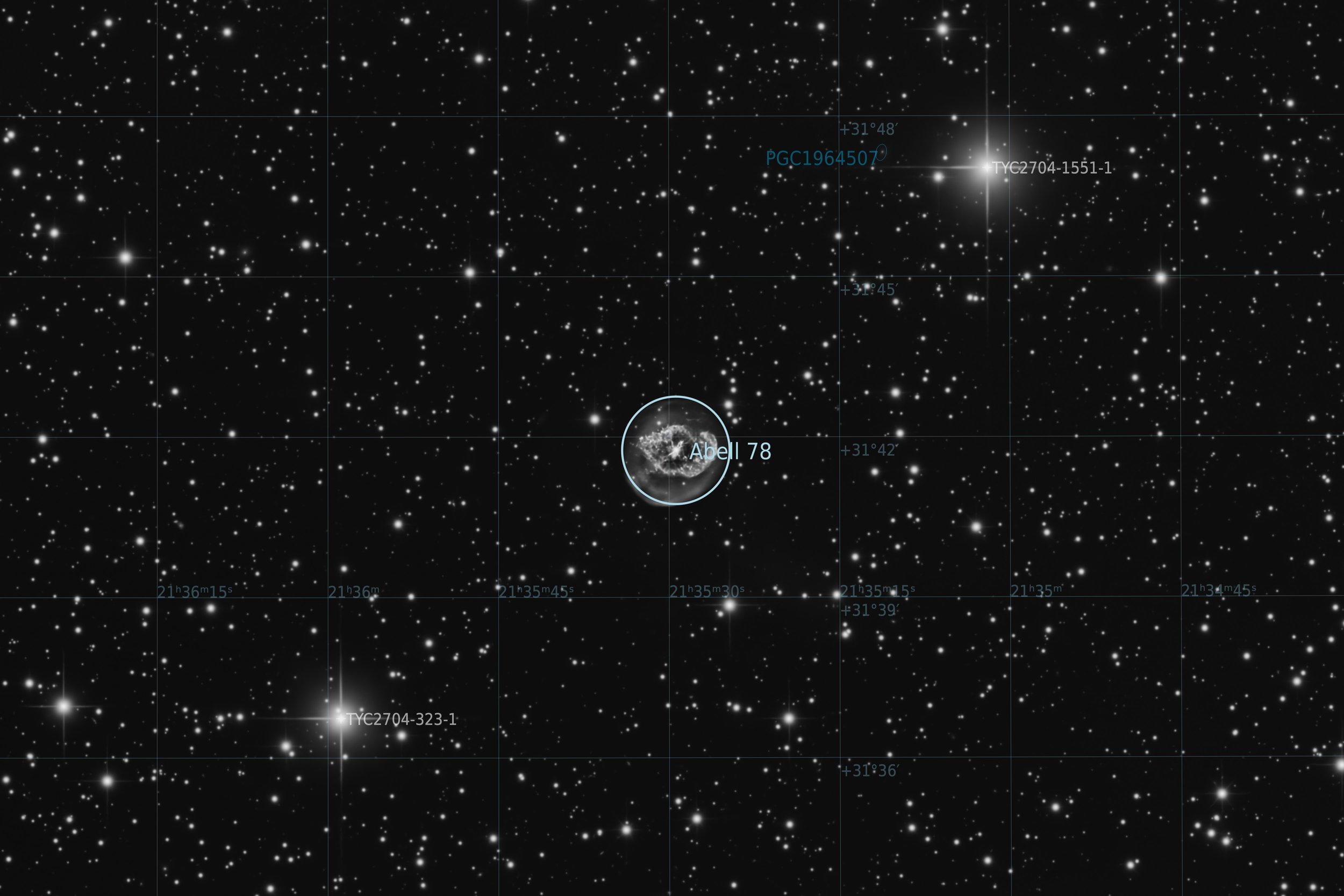
25’ x 16’ | 0.3”/px | 5000 × 3333 px
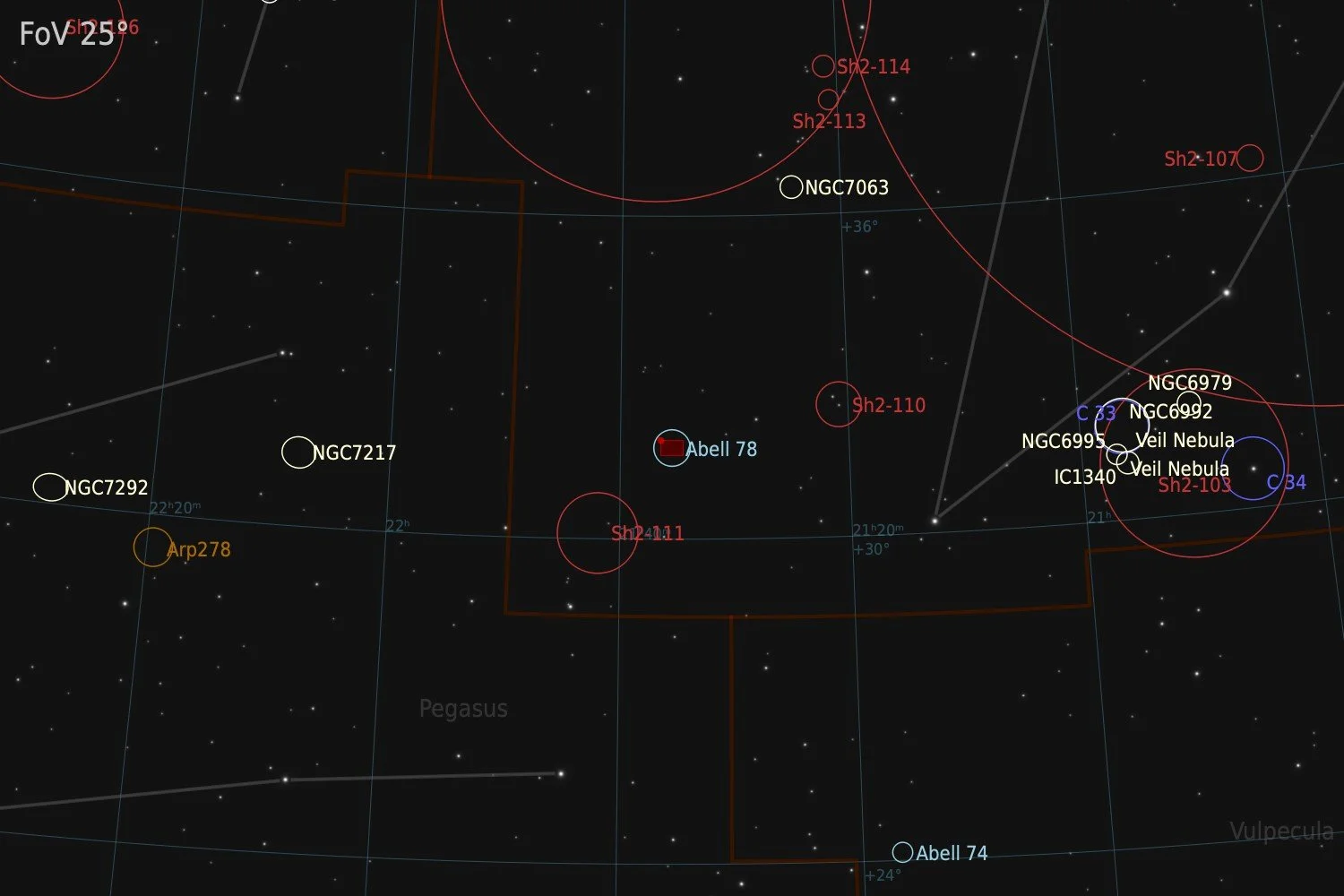
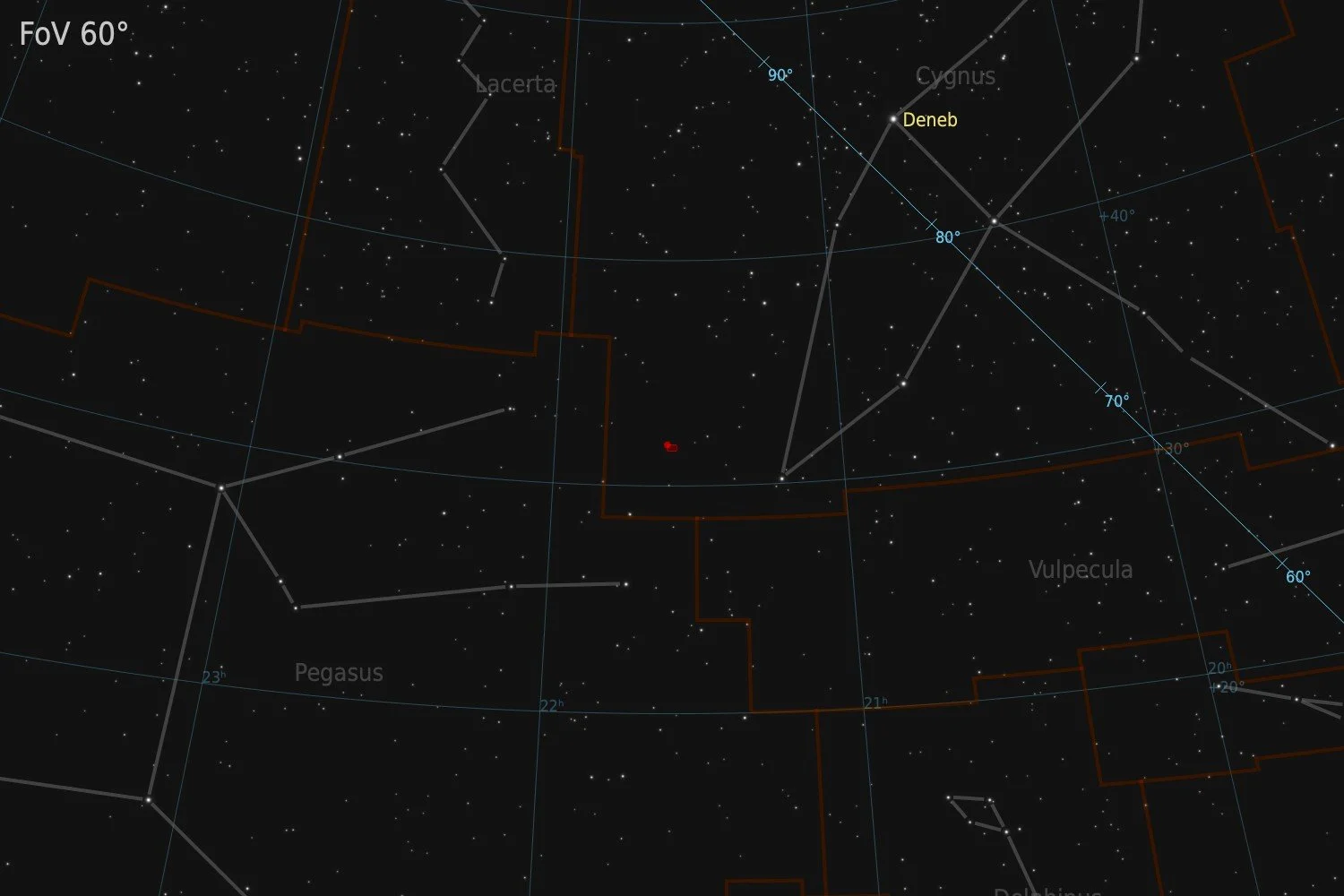
Cygnus
RA 21h 35m 30s Dec +31° 41’ 48” | 0°
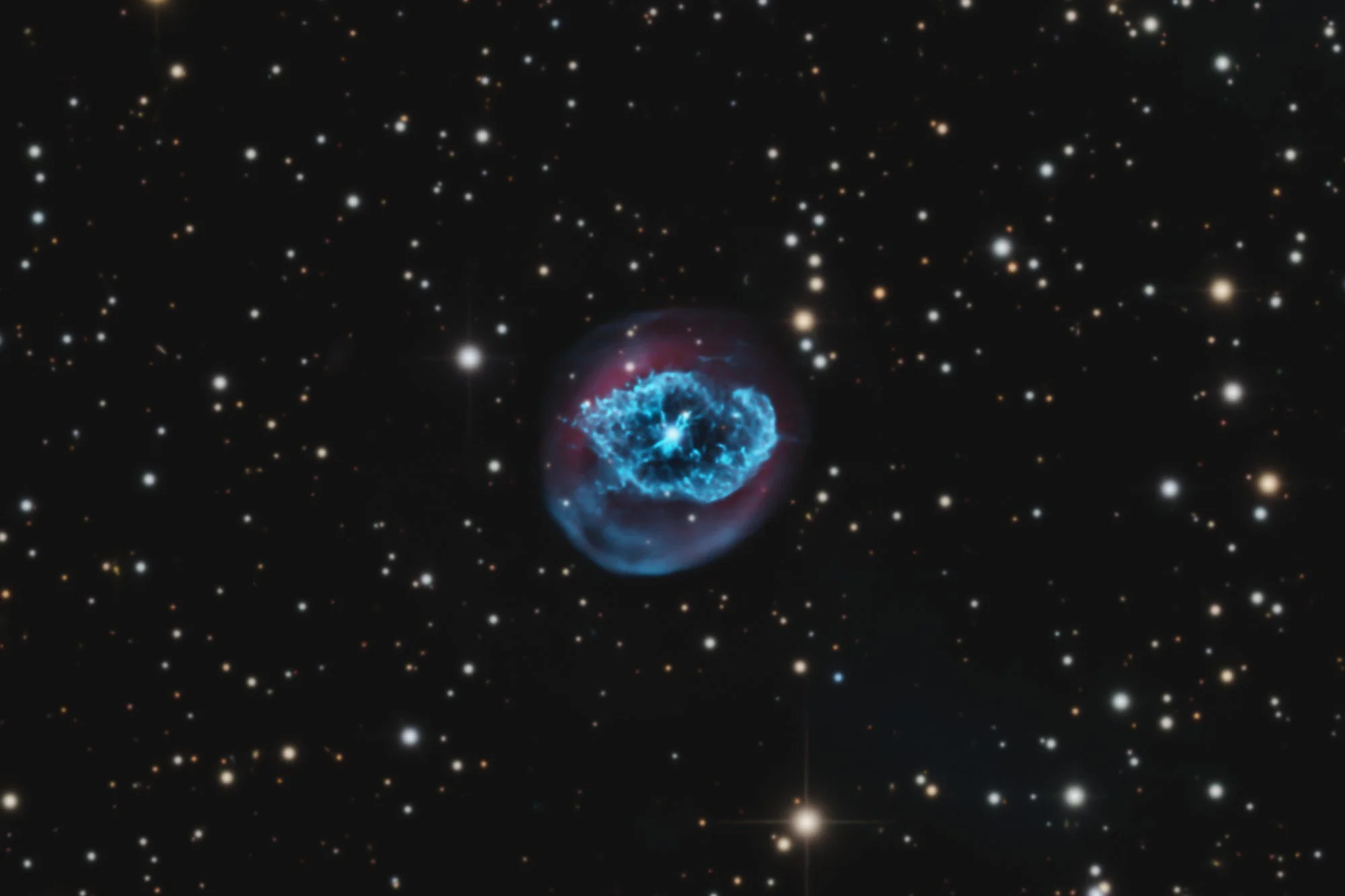
Abell 78 is a planetary nebula located in the constellation Cygnus. It was discovered by George Ogden Abell in 1955 and formally published as part of his catalogue of 86 planetary nebulae in 1966. Abell 78 lies at a distance of approximately 5,000 light-years from Earth and spans roughly 2.8 light-years in diameter, giving it an apparent size of around 1.8 arcminutes on the sky. Its outer shell consists of an ellipsoidal hydrogen-rich envelope expanding at approximately 40 kilometres per second, while a much more energetic inner region of hydrogen-poor material expands at velocities of up to 200 kilometres per second. In narrowband the inner region glows prominently in oxygen-III emission, appearing as blue-green loops and filaments surrounded by a broader shell of hydrogen-alpha emission.
Abell 78 belongs to a very rare class of objects known as born-again planetary nebulae. The current understanding is that after the original planetary nebula was shed, the central white dwarf underwent a very late thermal pulse — a sudden reignition of helium shell fusion — which caused it to temporarily expand back toward the asymptotic giant branch before contracting again. This process ejected a second wave of hydrogen-poor, carbon and oxygen-enriched material into the interior of the existing nebula, producing the unusual two-shell structure visible today. Abell 78 and its close twin Abell 30 are considered the most evolved and best-studied members of this rare born-again class, which also includes Abell 58 and Sakurai's Object. The central star is classified as a Wolf-Rayet type star.
Source: Claude.ai.
Data Acquisition
Data was collected during 10 nights in August and September of 2026, using a 14” reflector telescope with full-frame camera at the remote observatory in Spain. Data was gathered with 3nm Ha and OIII narrowband filters, as well as with broadband RGB filters for the stars. A total of approximately 17 hours of data was finally combined to create the final image.
Location Remote hosting facility Roboscopes in Fregenal de la Sierra, Spain (38°N 6°W)
Sessions
Frames
Equipment
Telescope
Mount
Camera
Filters
Guiding
Accessoires
Software
Planewave CDK14 (2563mm @ f/7.2), Optec Gemini Rotating focuser
10Micron GM2000HPS, custom pier
Moravian C3-61000 Pro (full frame), cooled to -10 ºC
Chroma 2” Ha, OIII (both 3nm), R, G and B unmounted, Moravian filterwheel L, 7-position
Unguided
Compulab Tensor I-22, Dragonfly, Pegasus Ultimate Powerbox v2
Voyager Advanced, Viking, Mountwizzard4, Astroplanner, PixInsight 1.9.4
Processing
All processing was done in Pixsinsight unless stated otherwise. Default features were enhanced using scripts and tools from RC-Astro, SetiAstro, GraXpert, CosmicPhotons and others. Images were calibrated using 50 Darks, 50 Flats, and 50 Flat-Darks, registered and integrated using WeightedBatchPreProcessing (WBPP). The processing workflow diagram below outlines the steps taken to create the final image.
Originally the capturing of some RGB data for proper star colours was left out and processing was done extracting star colours from the Ha and OIII data, using the SetiAstro script NB to RGB star combination. But the stars really did not come out well, they were very blueish, and generally not of good shape. So I decided to capture some separate RGB data. That was just a breeze to combine with the HOO image of the nebula. So going forward I will probably make this my default process again.
The stars were stretched the old-fashioned way, using a combination of ArcsinhStretch and HistogramTransformation. Unfortunately this combination can give some blown out star cores showing as little discs. A repair for that is fairly ease, and is explained here. With the creation of a special star mask and some convolution the star cores were repaired nicely.
Stretching the nebula was not too difficult, A combination of the more automated method MultiscaleAdaptiveStretch and a manual adjustment with GHS was a good basis for feeding the image into NarrowbandNormalisation. There the OIII signal was pushed a bit from a greenish tint to the blue.
The rest of the processing followed a very standard approach. The outline below shows a detailed breakdown of all processing steps applied to the image.
Processing workflow (click to enlarge)
This image has been published on Astrobin.