Caldwell 57
NGC 6822, Barnard’s Galaxy
32’ x 21’ | 0.3”/px | 6500 × 4333 px
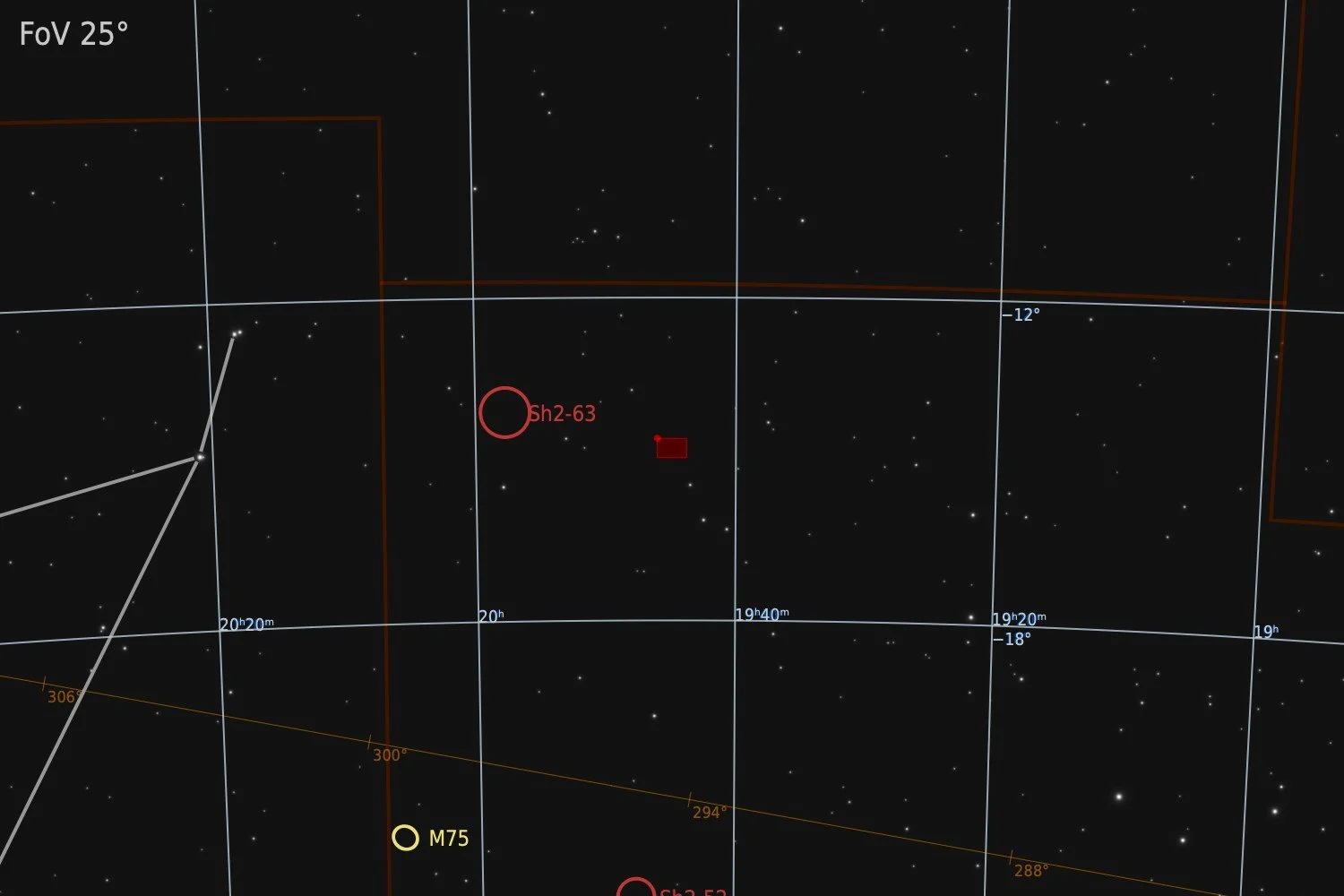
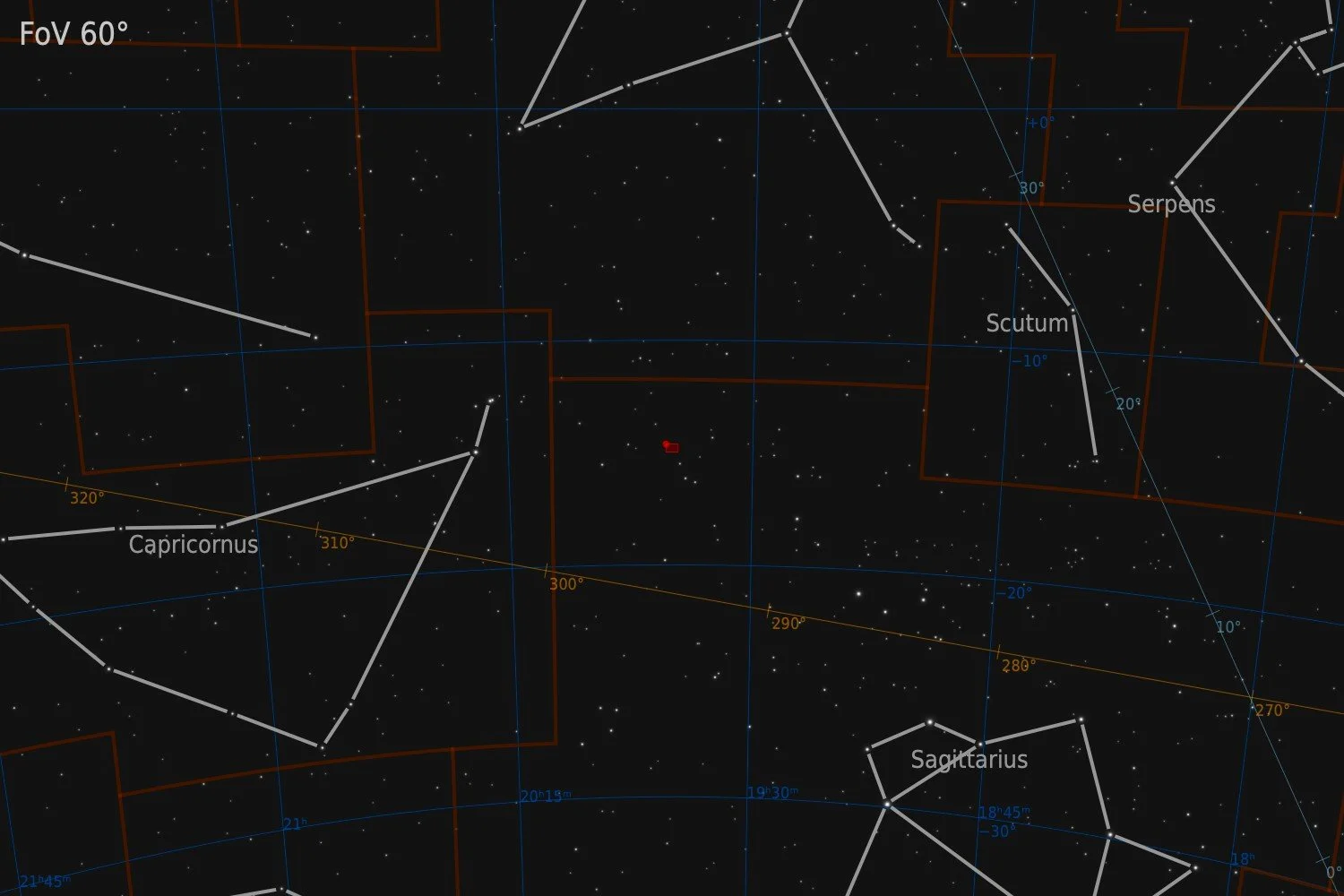
Sagittarius
RA 19h 44m 55s Dec -14° 47’ 47” | 0°
Caldwell 57, also known as NGC 6822, is a dwarf irregular galaxy located in the constellation Sagittarius. It was discovered by Edward Emerson Barnard in 1884, and is commonly known as Barnard's Galaxy in his honour, making it one of the relatively few deep sky objects to carry a discoverer's name in everyday use. Barnard's Galaxy lies at a distance of approximately 1.6 million light-years from Earth, within the Local Group and is one of the closest galaxies to the Milky Way. It spans a true diameter of roughly 7,000 light-years, making it considerably smaller than the Milky Way, and has an apparent size on the sky of around 15 by 14 arcminutes. Despite its proximity it has a relatively low surface brightness, spread across an irregular and loosely structured disc with no defined spiral arms or prominent core. The galaxy is of considerable scientific importance. In 1925, Edwin Hubble identified Cepheid variable stars within NGC 6822, allowing him to measure its distance and confirm for the first time that it lies far beyond the boundaries of the Milky Way. NGC 6822 contains several bright HII regions and star-forming nebulae visible in narrowband imaging. The Hubble Space Telescope photographed these individual nebulae and they carry a Hubble naming sequence.
Source: Claude.ai
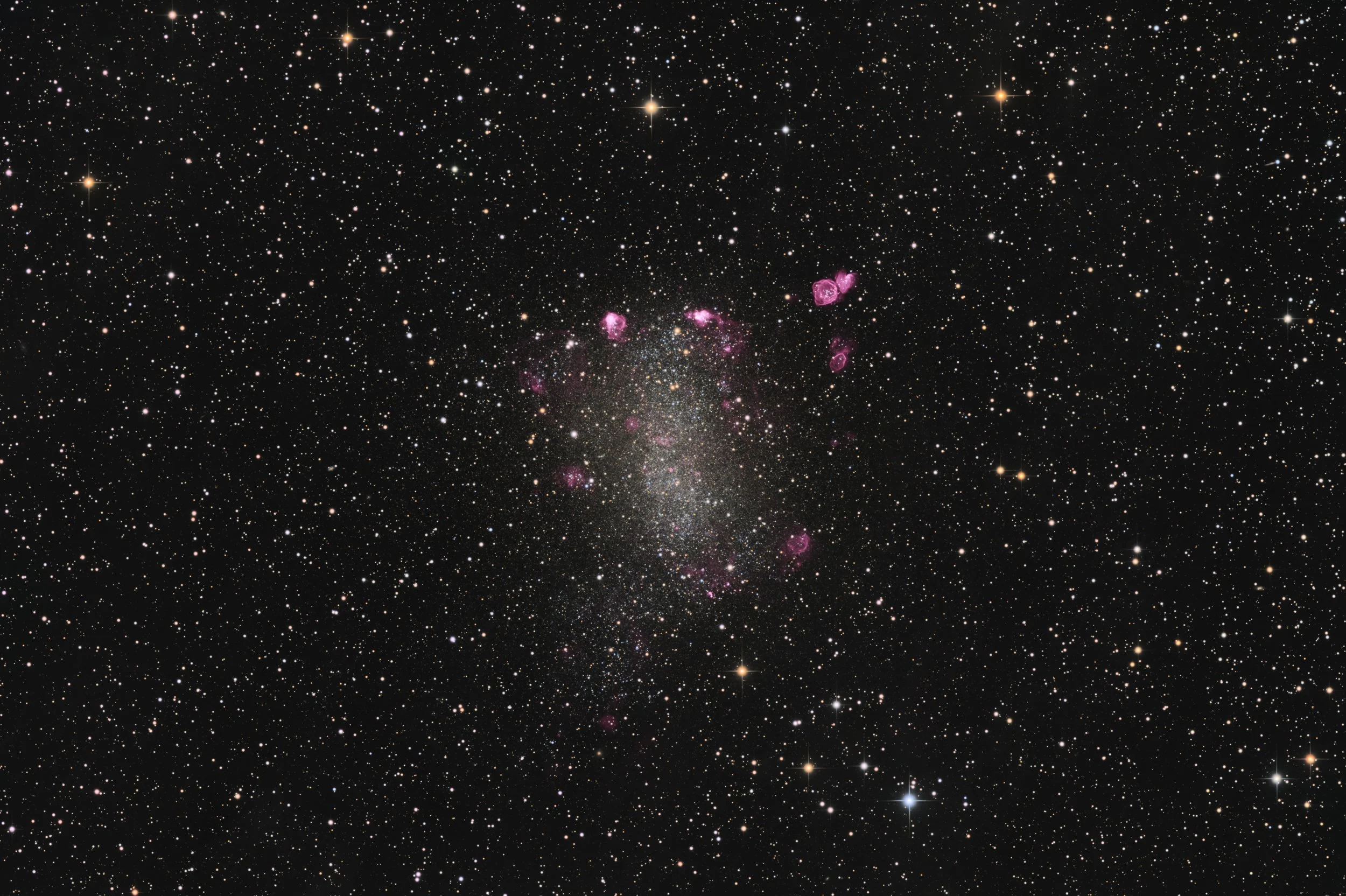
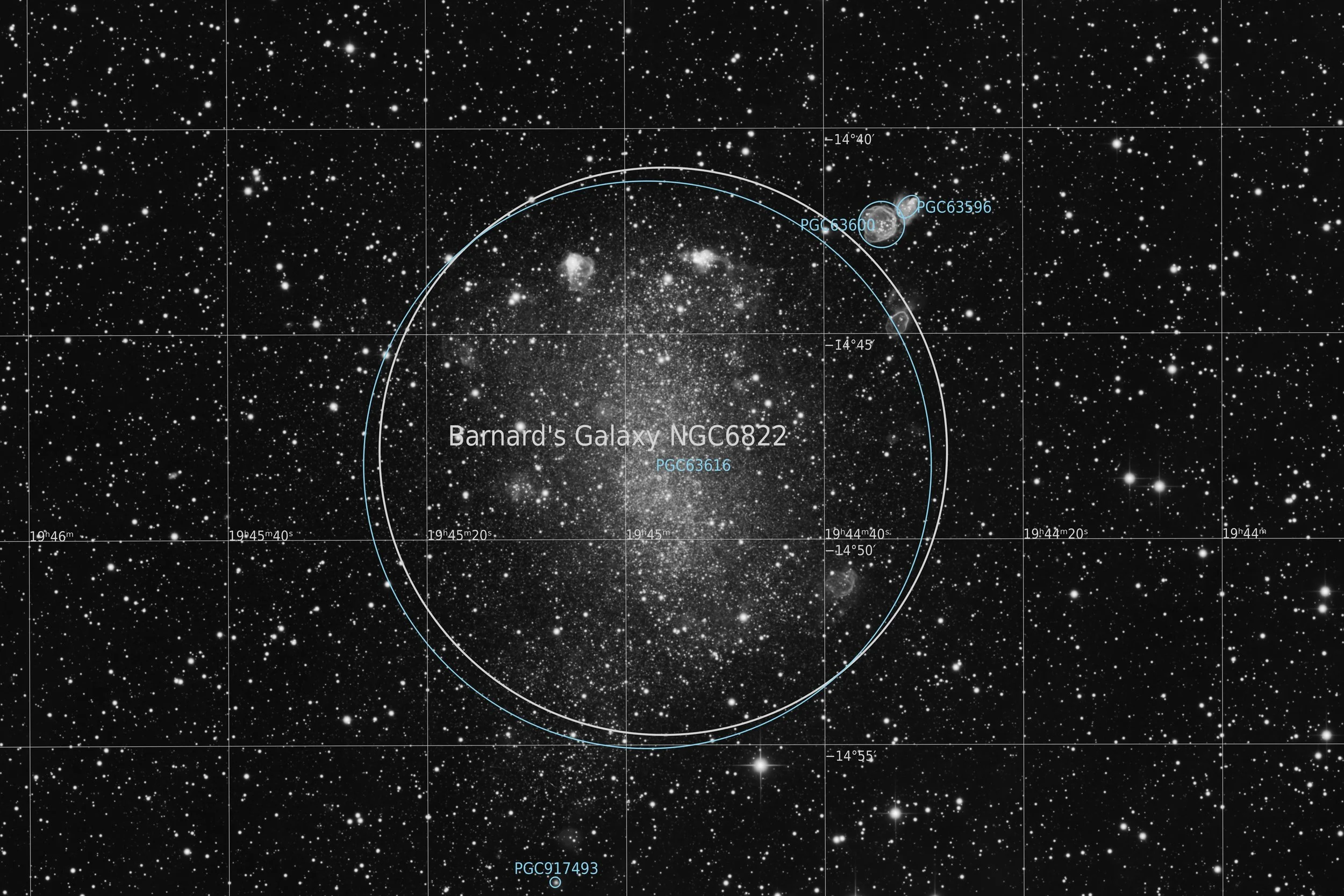
Together with the Magellan Clouds, Caldwell 57 is one of very few galaxies outside our Milky Way in which we can so clearly see star-forming HII clouds. They have been studied in great detail and the Hubble Space Telescope made close-up images of them. Thanks to the HST investigations, many nebulae now have a Hubble designation. The most popular ones are Hubble-V and Hubble-X. The latter is also classified as IC1308.
Data Acquisition
Data was collected during 9 nights in July and August of 2026, using a 14” reflector telescope with full-frame camera at the remote observatory in Spain. Data was gathered using standard HaLRGB filters. A total of approximately 16 hours of data was finally combined to create the final image.
Location Remote hosting facility Roboscopes in Fregenal de la Sierra, Spain (38°N 6°W)
Sessions
Frames
Equipment
Telescope
Mount
Camera
Filters
Guiding
Accessoires
Software
Planewave CDK14 (2563mm @ f/7.2), Optec Gemini Rotating focuser
10Micron GM2000HPS, custom pier
Moravian C3-61000 Pro (full frame), cooled to -10 ºC
Chroma 2” LRGB and Ha (3nm) unmounted, Moravian filterwheel L, 7-position
Unguided
Compulab Tensor I-22, Dragonfly, Pegasus Ultimate Powerbox v2
Voyager Advanced, Viking, Mountwizzard4, Astroplanner, PixInsight 1.9.4
Processing
All processing was done in Pixsinsight unless stated otherwise. Default features were enhanced using scripts and tools from RC-Astro, SetiAstro, GraXpert, CosmicPhotons and others. Images were calibrated using 50 Darks, 50 Flats, and 50 Flat-Darks, registered and integrated using WeightedBatchPreProcessing (WBPP). The processing workflow diagram below outlines the steps taken to create the final image.
In recent months the flats have not been able to fully correct for some reason. Dust motes appear, move and disappear rather quickly. Perhaps there is some dust trapped into the system, perhaps the environment is a bit more dusty. Whatever the reason, it will require much more frequent flat frame generation going forward. And in the existing datasets, I may have to resort to the clonestamp tool from time to time to deal with them, as was the case in this image.
The Ha signal was blended in using the technique of Continuum Subtraction. A full description of the technique applied can be found here. The hue was set at 331, with a saturation of 0.7. I applied it to the starry image, but decided later that this would not get the best outcome, so I removed stars from the subtracted Ha image, which went reasonably well. The Ha signal had some darker pixels dotter around. This was probably due to the lack of a proper pedestal setting during calibration. A very mild convolution dealt with this issue.
Stretching was applied to the starry image as well. And to be honest, when pushing the stretch to the limit with GHS, stars typically suffer from that. Especially the brighter ones can get some blown-out cores. Using a technique that was described here, star morphology improved by a reasonable margin.
The rest of the processing followed a fairly standard workflow. The full processing pipeline is outlined below.
Processing workflow (click to enlarge)
This image has been published on Astrobin.