M49 | Arp 134
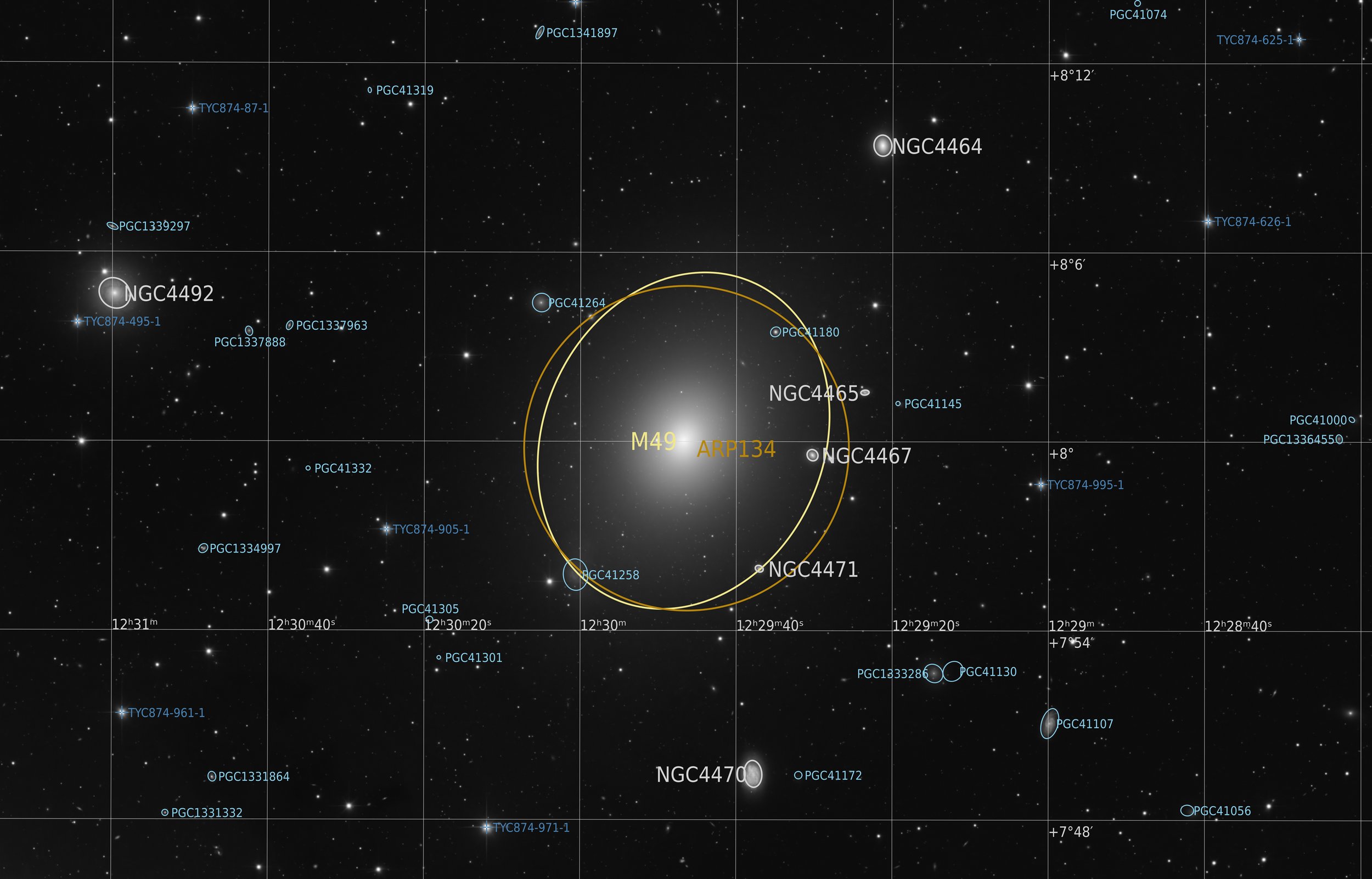
NGC 4472 | NGC 4464, NGC 4465, NGC 4467, NGC 4470, NGC 4471, NGC 4492
43’ x 27’ | 0.3”/px | 8659 × 5548 px
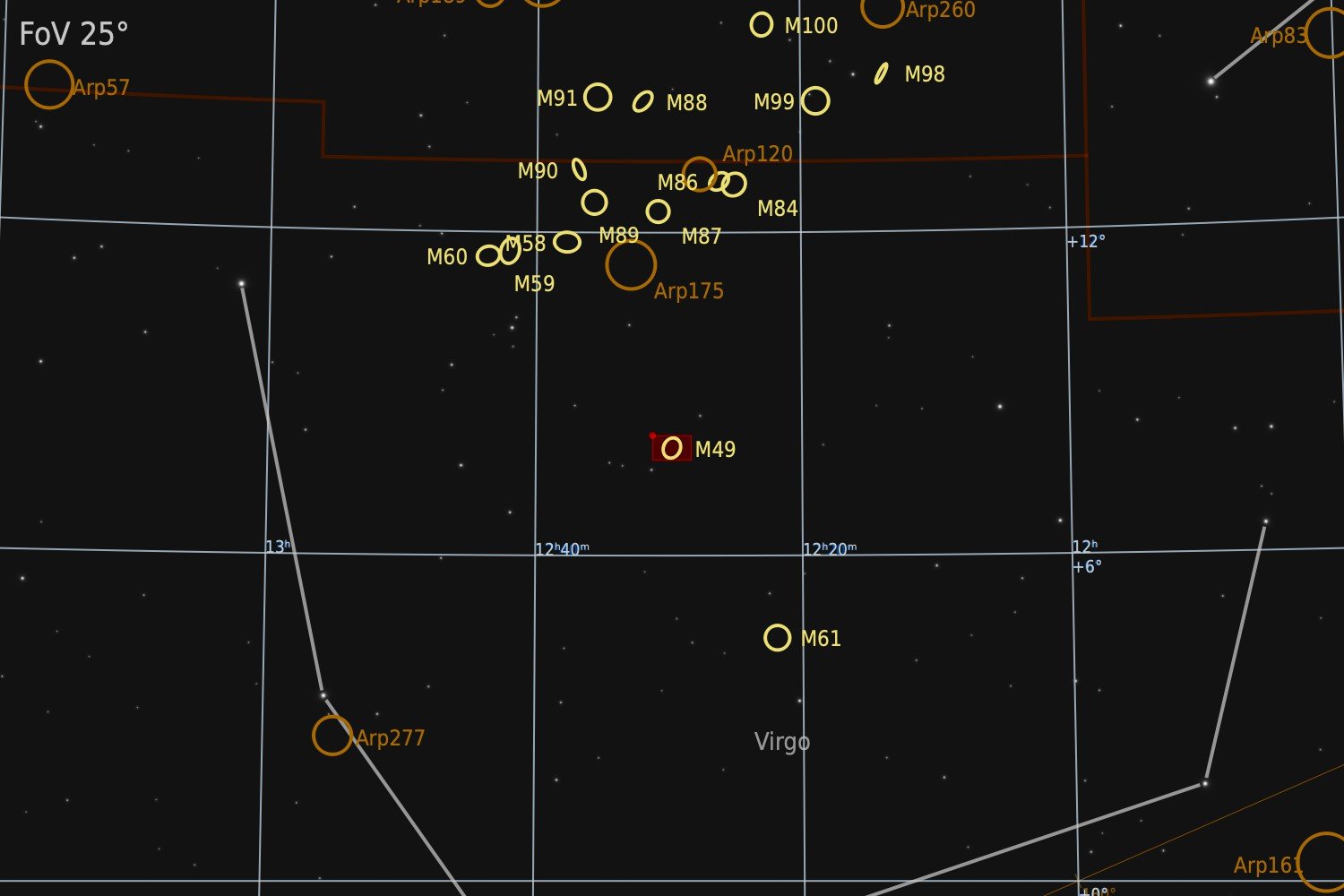
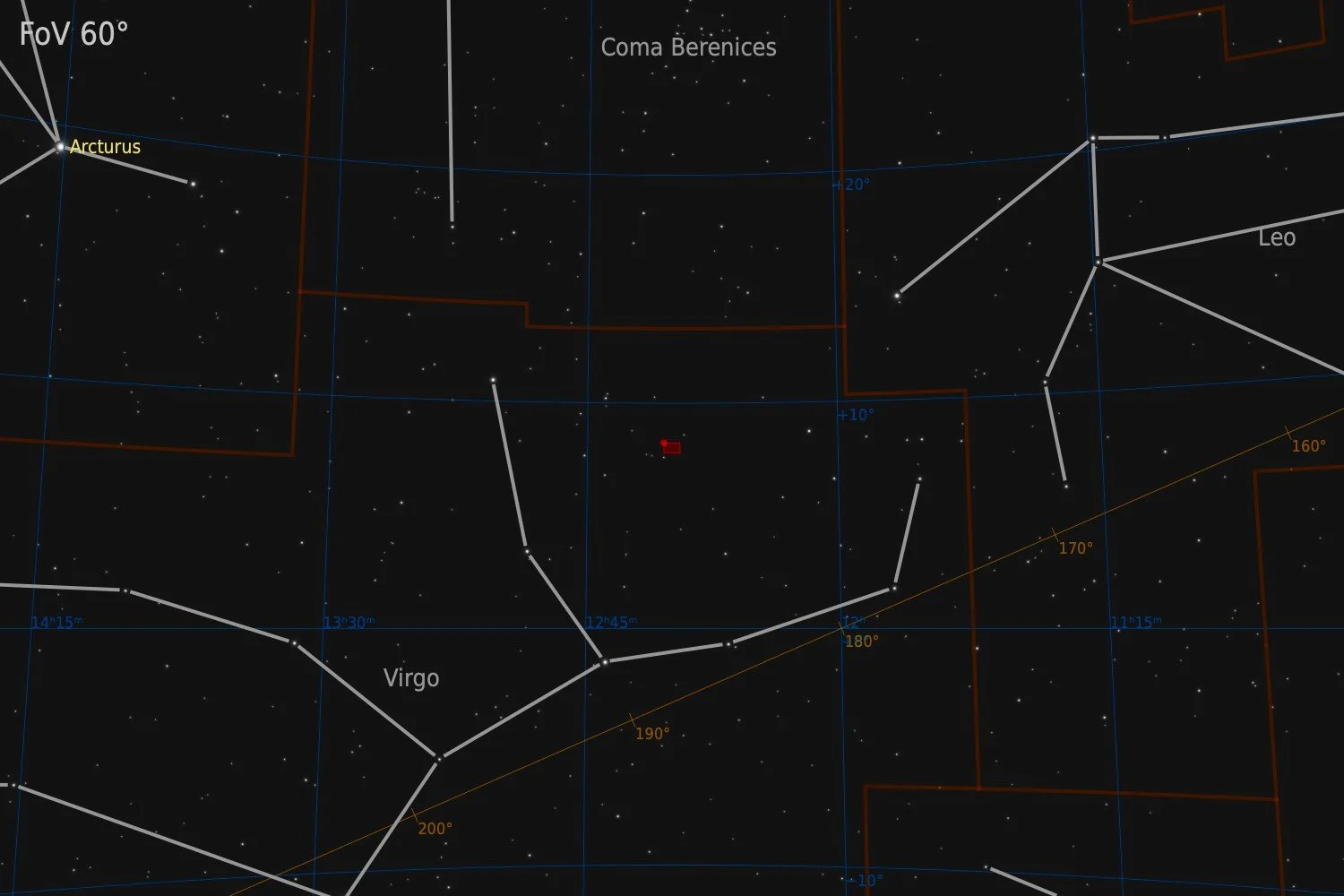
Virgo
RA 12h 29m 46s Dec +08° 00’ 04” | 0°
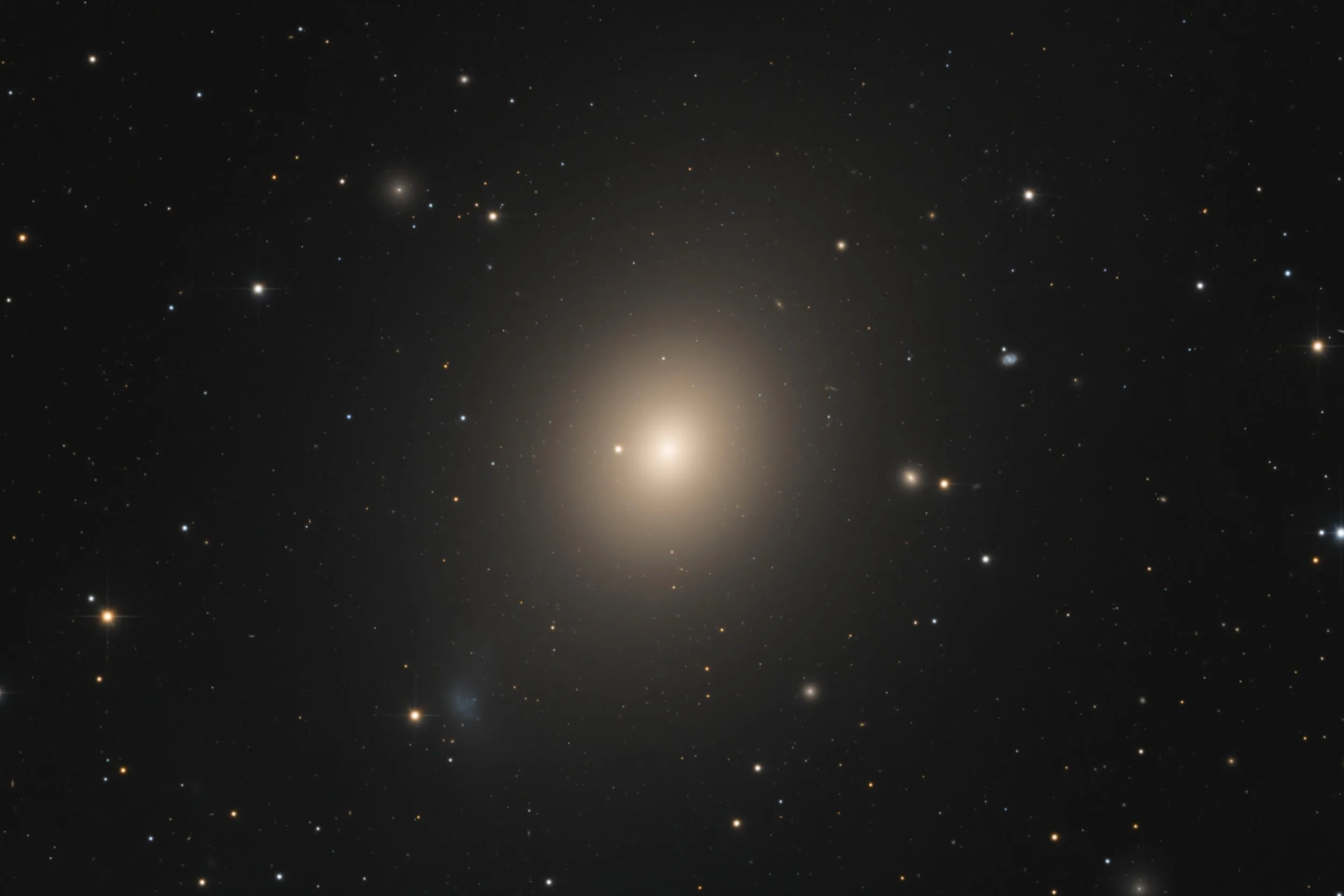
Messier 49 (NGC 4472) is an elliptical galaxy located in the constellation Virgo. It was discovered by Charles Messier on February 19, 1771, making it the first member of the Virgo Cluster to be catalogued. M49 lies at a distance of approximately 56 million light-years from Earth and is the brightest galaxy in the Virgo Cluster, outshining even the famous M87 in total luminosity. It is also one of the brightest galaxies in the entire Virgo Supercluster. The galaxy spans roughly 160,000 light-years in diameter, making it significantly larger than the Milky Way, and it contains an estimated one trillion stars. Like most giant elliptical galaxies, M49 consists predominantly of older, evolved stars and shows little active star formation. It hosts an exceptionally large population of globular clusters, estimated at around 5,900, which is far above average even for a galaxy of its size and mass. At its centre lies a supermassive black hole with a mass estimated at approximately 565 million solar masses. M49 has also been observed to be interacting gravitationally with a smaller dwarf irregular galaxy, VCC 1249, which appears to be falling into it and has left a detectable stream of neutral hydrogen gas as a result. The galaxy has hosted at least two recorded supernovae, SN 1969Q and SN 2021J.
M49 is also listed in the Halton Arp's Atlas of Peculiar Galaxies under number Arp 134. There it is categorised under “Elliptical and Elliptical-like galaxies” with the subclassification ‘With nearby fragments’.
Source: Claude.ai
Arp details
Halton Arp classified all objects based on their peculiarity. He used 5 major classifications and 39 subclassifications. Halton Arp also wrote a short note describing each object, and a challenge, a feature that can be somewhat difficult to identify. The following data is from the book “The Arp Atlas of Peculiar Galaxies: A Chronicle and Observer’s Guide” by Jeff Kanipe and Dennis Webb. The UGC companion is the blue-ish nebulosity to the lower-left of the galaxy, labelled PGC41258 in the annotated image.
| Number | Arp 134 |
| Common galaxy names | NGC 4472 (M49) |
| Main Classification | Elliptical and Elliptical-like Galaxies (102 - 145) |
| Subclassification | With nearby fragments (133 - 136) |
| Arp's note | not available |
| Challenge | Detect de UGC companion and any structure in it |
Data Acquisition
Data was collected during 3 nights in April 2026, using a 14” reflector telescope with full-frame camera at the remote observatory in Spain. This is the first published image that was fully captured at the new remote hosting site Roboscopes in Spain. Data was gathered using standard LRGB filters. A total of approximately 9 hours of data was finally combined to create the final image.
Location Remote hosting facility Roboscopes in Fregenal de la Sierra, Spain (38°N 6°W)
Sessions
Frames
Equipment
Telescope
Mount
Camera
Filters
Guiding
Accessoires
Software
Planewave CDK14 (2563mm @ f/7.2), Optec Gemini Rotating focuser
10Micron GM2000HPS, custom pier
Moravian C3-61000 Pro (full frame), cooled to -10 ºC
Chroma 2” LRGB unmounted, Moravian filterwheel L, 7-position
Unguided
Compulab Tensor I-22, Dragonfly, Pegasus Ultimate Powerbox v2
Voyager Advanced, Viking, Mountwizzard4, Astroplanner, PixInsight 1.9.4
Processing
All processing was done in Pixsinsight unless stated otherwise. Default features were enhanced using scripts and tools from RC-Astro, SetiAstro, GraXpert, CosmicPhotons and others. Images were calibrated using 50 Darks, 50 Flats, and 50 Flat-Darks, registered and integrated using WeightedBatchPreProcessing (WBPP). The processing workflow diagram below outlines the steps taken to create the final image.
This is the first image that was fully processed in the new PixInsight, version 1.9.4. Processing was done on an Intel-based Mac Pro so no issues were encountered running any of the scripts. The only hiccup was related to the AnnotateImage script. To create the above published annotated image, I use a saved icon of the AnnotateImage script. But as this script has been renewed, this saved icon did not work anymore, and I had to create a new one. For most scripts this is not a problem, but with the AnnotateImage script there are a lot of tiny details that are defined, such as colours, fonts, sizes, line-width, etc. all different for different layers. So it took a while to recreate it.
In usual processing of a galaxy, the stars are separated from the galaxy and processed and stretched individually. However, in this case I found that there was not much benefit doing it that way, and even worse, when stretching the stars separately it is easy to over-do it. The result of that is some very unreal looking stars shining through the galaxy. So I decided to process and stretch the image in the presence of stars at all times. The MultiscaleAdaptiveStretch allows nice control over the stretching amount while keeping star-shapes intact, and worked perfect for an image like this.
As I had not taken flats yet in the new observatory, the existing flats did not completely calibrate out for the full 100%. Especially in the luminance channel there was a blob still visible in the calibrated stack. I took this out during the final stages of processing, by taking out the stars (screening on), run the Clonestamp tool and screen the stars back in using ImageBlend.
The rest of the processing followed a fairly standard path. See the outline below for a detailed breakdown of the processing applied to the image.
Processing workflow (click to enlarge)
This image has been published on Astrobin and received Top Pick status.