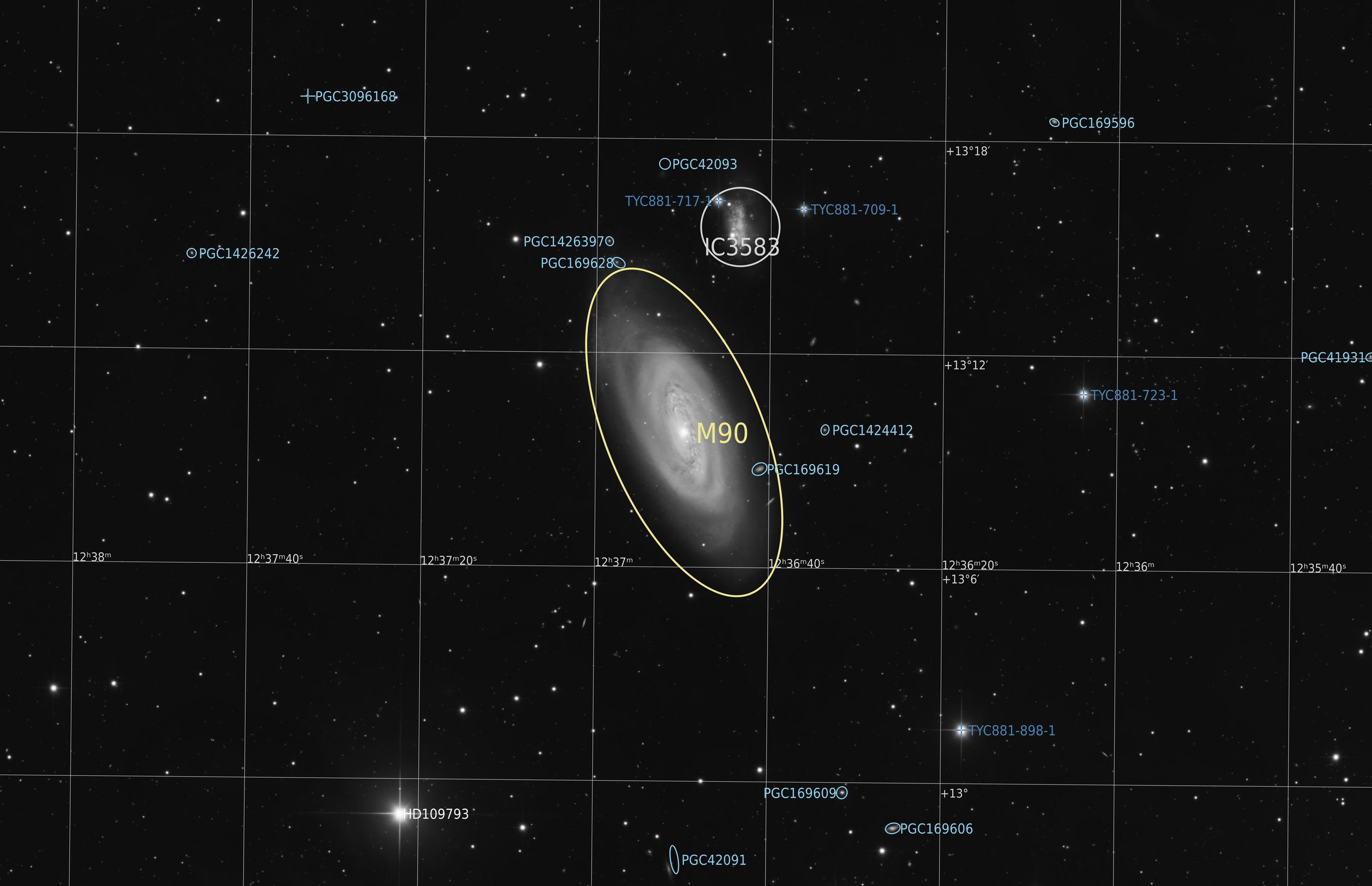
M90
NGC 4569
38’ x 24’ | 0.3”/px | 7646 × 4939 px
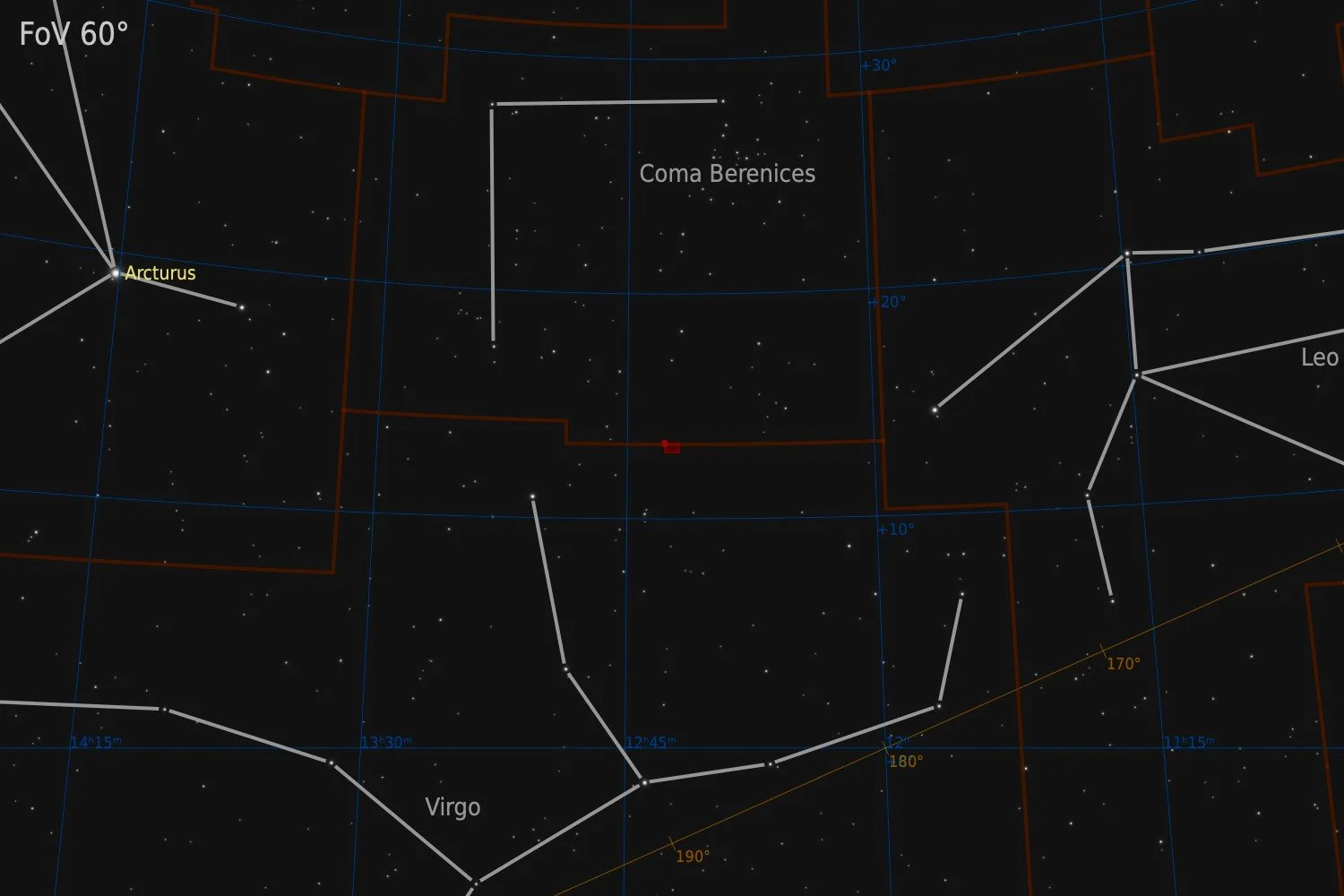
Virgo
RA 12h 36m 50s Dec +13° 09’ 29” | 0°
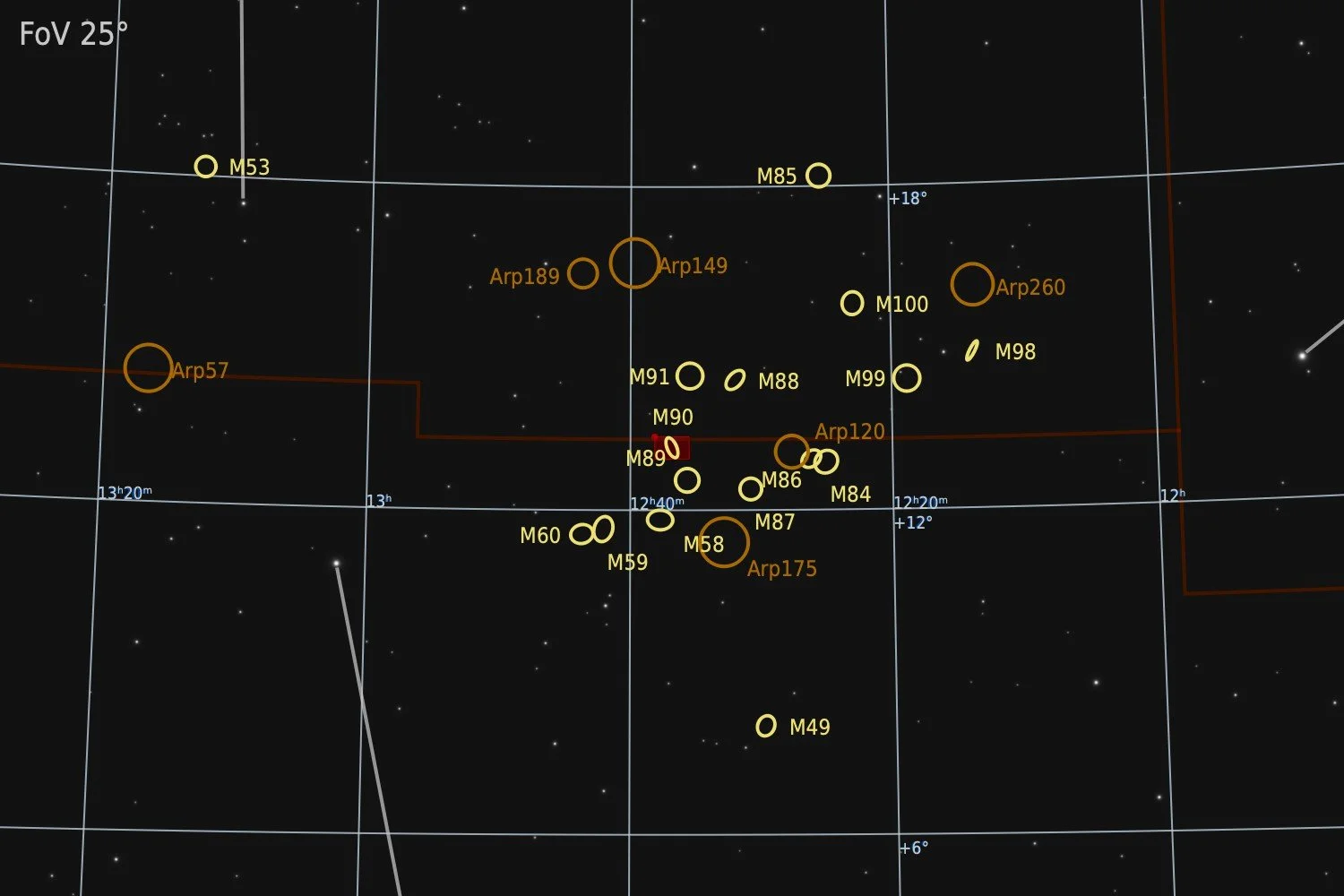
Messier 90, also known as NGC 4569, is a spiral galaxy located in the constellation Virgo. It was discovered by Charles Messier on March 18, 1781, during the same prolific observing session in which he catalogued several other Virgo Cluster members, including M88 and M91. M90 lies at a distance of approximately 59 million light-years from Earth and is one of the larger and brighter spiral galaxies in the Virgo Cluster. It spans roughly 130,000 light-years in diameter, making it somewhat larger than the Milky Way, and is inclined at a moderate angle to our line of sight, giving it an elongated appearance that reveals much of its spiral structure along with prominent dust lanes near its core. One of the most notable features of M90 is its unusual blueshift. Like M88, it is one of a small number of Virgo Cluster galaxies moving toward the Milky Way rather than away from it, but M90 stands out further for having an exceptionally high blueshift velocity, among the largest of any galaxy in the cluster. This is interpreted as the result of a close gravitational encounter with another massive galaxy within the cluster, which is thought to have stripped away much of M90's gas and dust through a process known as ram-pressure stripping. As a consequence, M90 shows reduced star formation activity compared to similarly sized spirals and is sometimes described as a galaxy caught in transition toward a more passive, lenticular-like state.
Source: Claude.ai
Data Acquisition
Data was collected during 9 nights in April and May of 2026, using a 14” reflector telescope with full-frame camera at the remote observatory in Spain. Data was gathered using standard LRGB filters. A total of approximately 10 hours of data was finally combined to create the final image.
Location Remote hosting facility Roboscopes in Fregenal de la Sierra, Spain (38°N 6°W)
Sessions
Frames
Equipment
Telescope
Mount
Camera
Filters
Guiding
Accessoires
Software
Planewave CDK14 (2563mm @ f/7.2), Optec Gemini Rotating focuser
10Micron GM2000HPS, custom pier
Moravian C3-61000 Pro (full frame), cooled to -10 ºC
Chroma 2” LRGB unmounted, Moravian filterwheel L, 7-position
Unguided
Compulab Tensor I-22, Dragonfly, Pegasus Ultimate Powerbox v2
Voyager Advanced, Viking, Mountwizzard4, Astroplanner, PixInsight 1.9.4
Processing
All processing was done in Pixsinsight unless stated otherwise. Default features were enhanced using scripts and tools from RC-Astro, SetiAstro, GraXpert, CosmicPhotons and others. Images were calibrated using 50 Darks, 50 Flats, and 50 Flat-Darks, registered and integrated using WeightedBatchPreProcessing (WBPP). The processing workflow diagram below outlines the steps taken to create the final image.
The original master RGB and Lum images did not really want to plate solve. The reason still remains unknown. As a backup I exported a fits version and plate solved in ASTAP. This worked well. Re-importing that fits-file back into the PixInsight project and copying the astrometric solution between images completed the trick. However, now SPCC did not come to a solution. There was not a single star recognised, which is very strange. Not sure whether the plate solving in ASTAP had gone right, I ran an image annotation. This came up with the proper M90 location, but the inclination of the galaxy did not match the annotation oval. And also other objects were not in their place. It turned out that the image had been mirrored. Perhaps this had happened during the roundtrip to ASTAP. Anyway, mirroring the image solved the issue with SPCC.
While I had new flats made before processing this image, the underlying captures did not all match the dust mote pattern. So still with the new flats I had to correct some remaining dust motes in the background. Much less so than with the recent M83.
For the rest processing followed a very standard workflow, as outlined below.
Processing workflow (click to enlarge)
This image has been published on Astrobin.