M54
NGC 6715
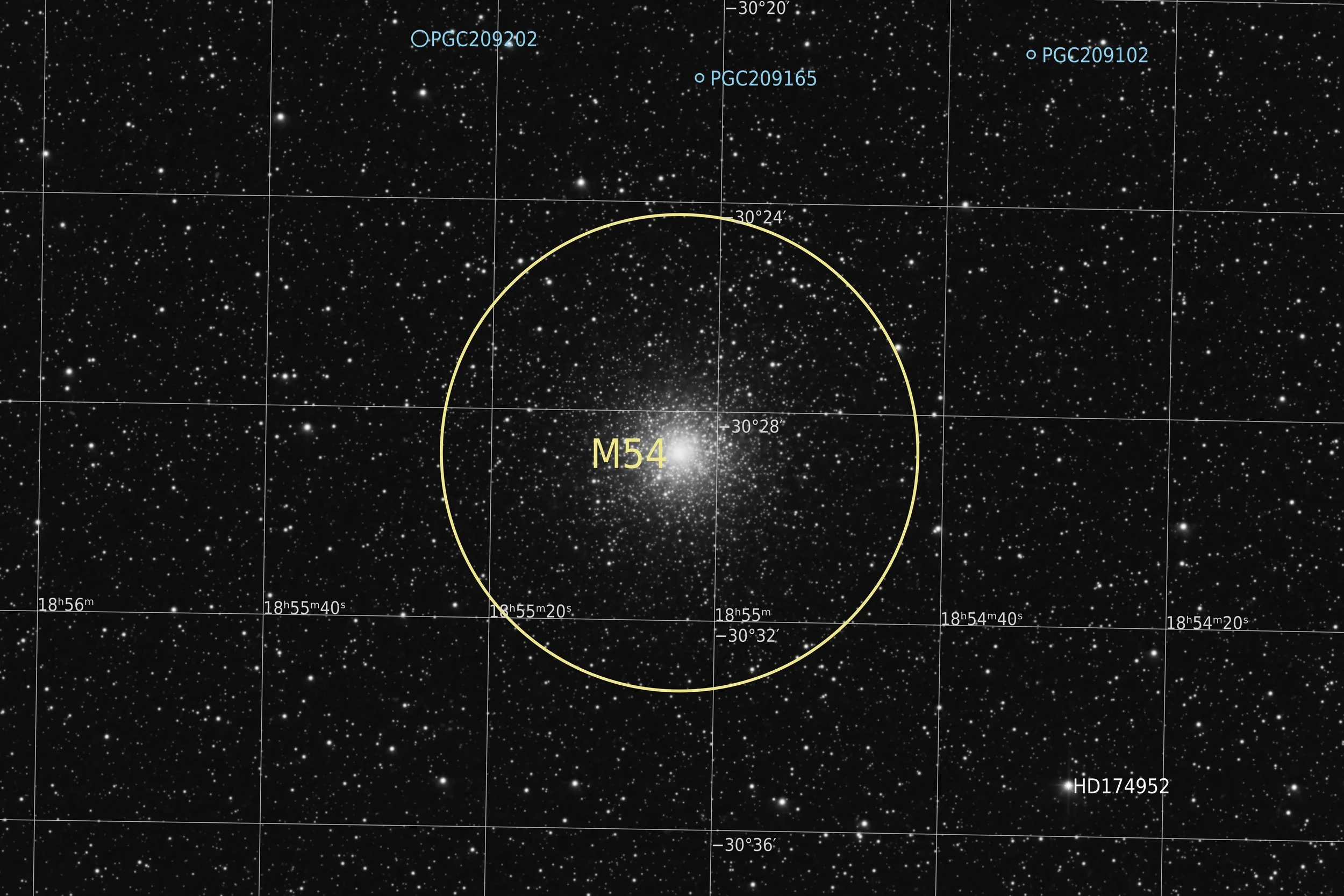
25’ x 17’ | 0.3”/px | 5100 × 3400 px
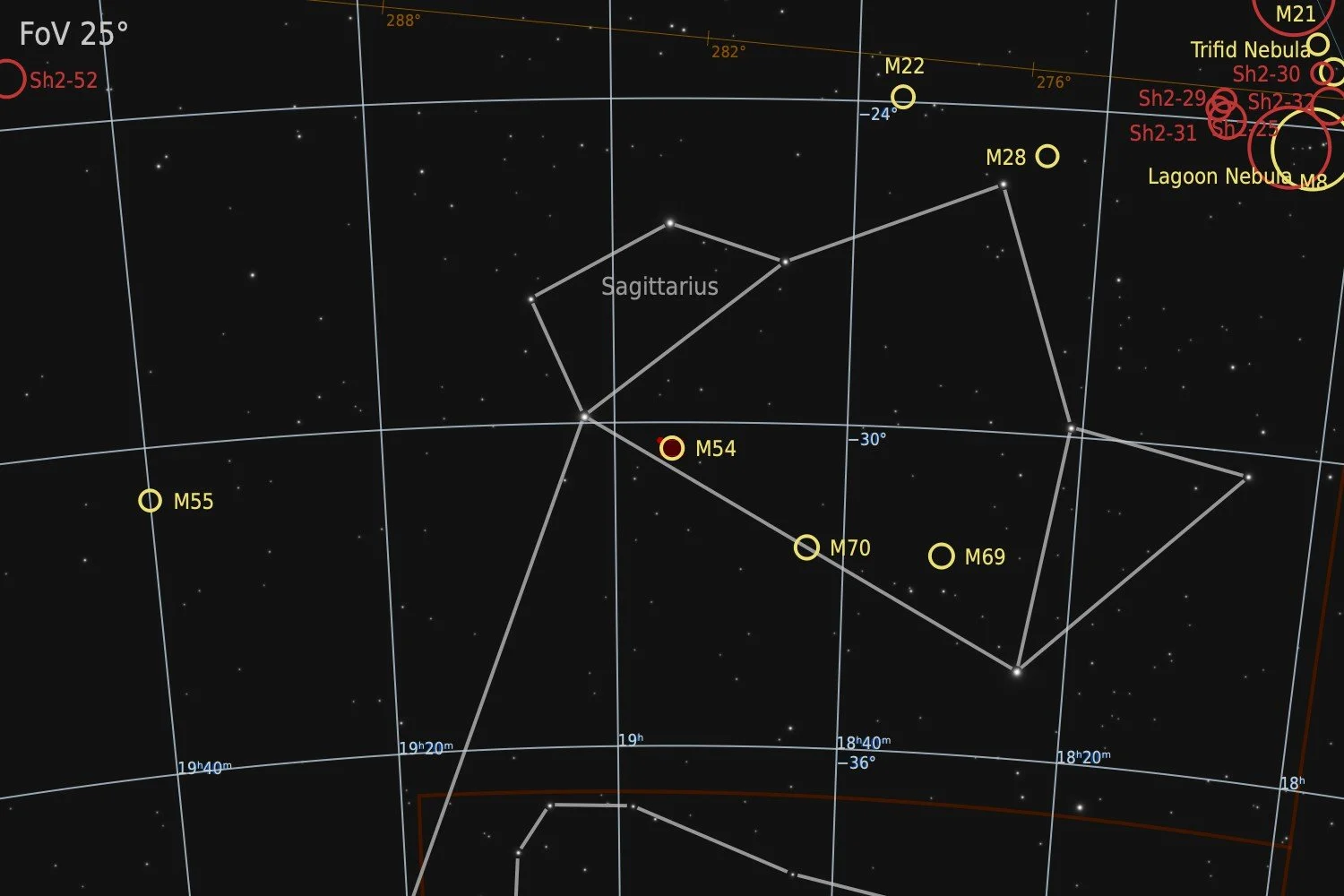
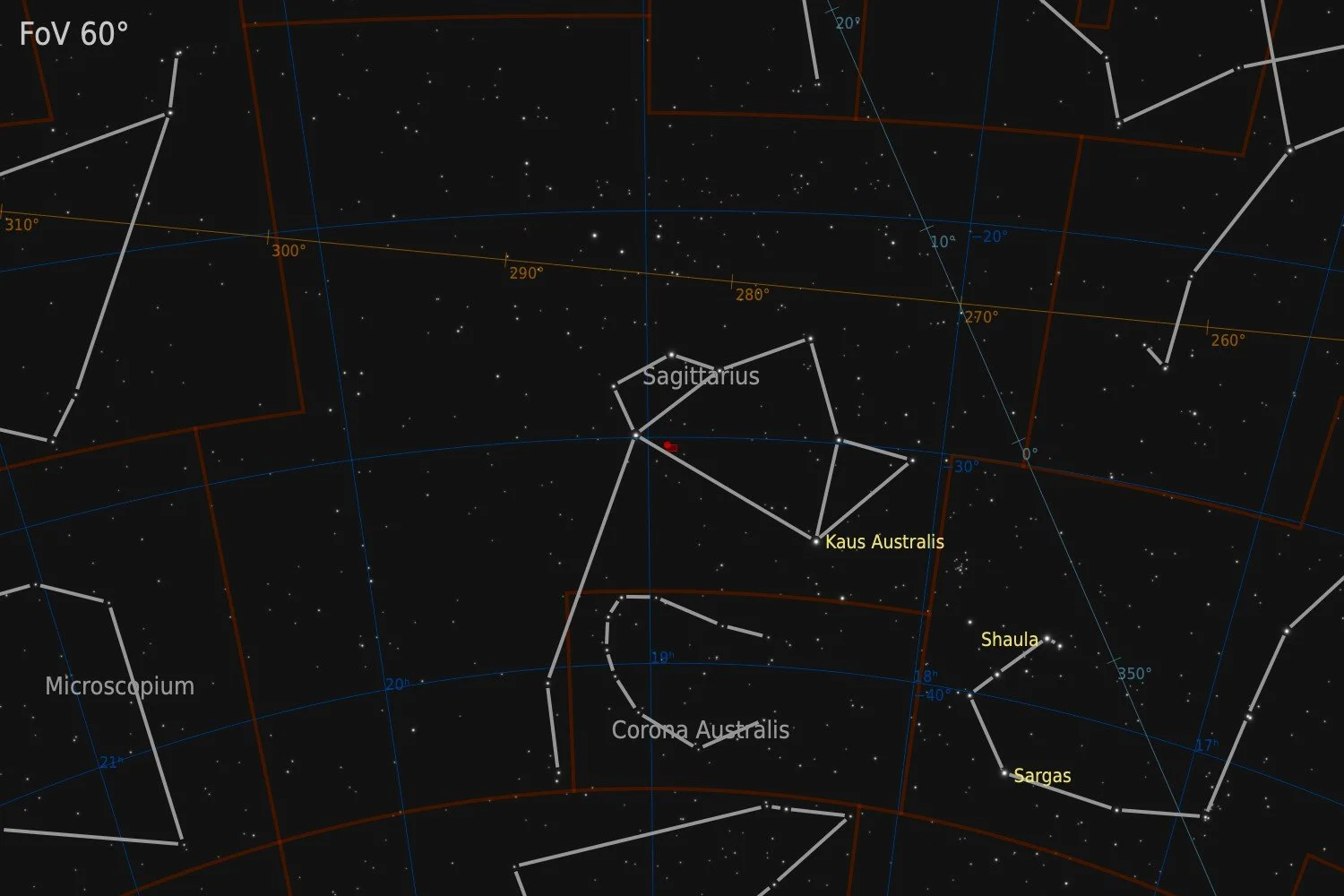
Sagittarius
RA 18h 55m 04s Dec -30° 28’ 42” | 0°
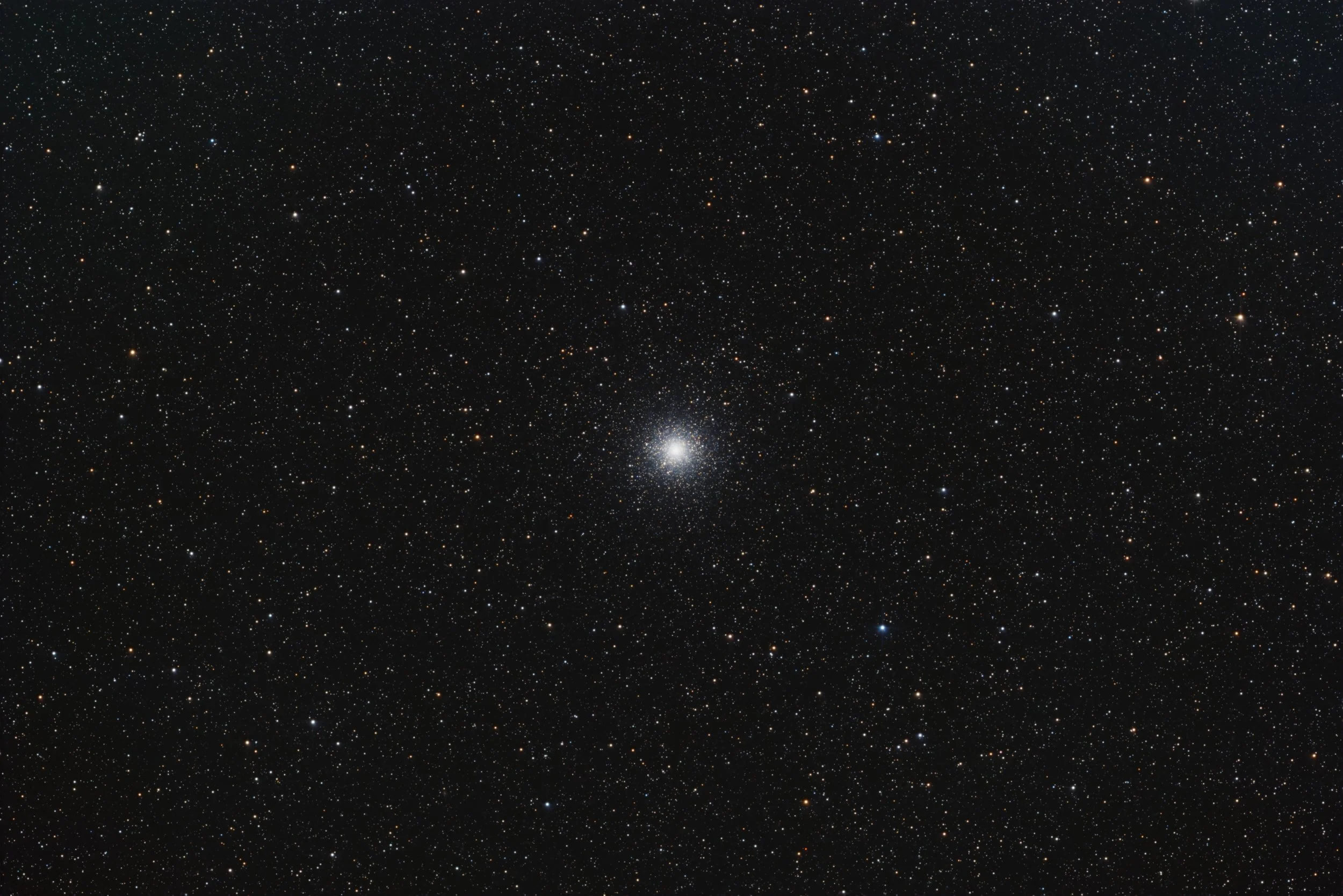
Messier 54, also known as NGC 6715, is a globular cluster located in the constellation Sagittarius. It was discovered by Charles Messier on July 24, 1778. M54 lies at a distance of approximately 87,000 light-years from Earth, making it considerably more distant than most other globular clusters in the Messier catalogue. It spans a true diameter of roughly 150 light-years and reaches an apparent magnitude of around 7.6, making it a moderately bright but compact target that requires reasonable aperture to begin resolving into individual stars. What makes M54 especially notable is that it does not actually belong to the Milky Way. In 1994, astronomers determined that the cluster is in fact a satellite of the Sagittarius Dwarf Spheroidal Galaxy, a small galaxy that is itself in the process of being torn apart and absorbed by the Milky Way through ongoing gravitational interaction. This makes M54 one of the few extragalactic globular clusters identifiable from Earth. Its stars are notably younger and more metal-poor in different respects compared to typical Milky Way globulars, consistent with their separate galactic origin. It is suggested that M54 may itself harbour an intermediate-mass black hole at its centre, based on the motions of stars observed near its core, adding to the scientific interest surrounding this already unusual object.
Source: Claude.ai
Data Acquisition
Data was collected during 4 nights in June 2026, using a 14” reflector telescope with full-frame camera at the remote observatory in Spain. Data was gathered using standard RGB filters. A total of approximately 6 hours of data was finally combined to create the final image.
Location Remote hosting facility Roboscopes in Fregenal de la Sierra, Spain (38°N 6°W)
Sessions
Frames
Equipment
Telescope
Mount
Camera
Filters
Guiding
Accessoires
Software
Planewave CDK14 (2563mm @ f/7.2), Optec Gemini Rotating focuser
10Micron GM2000HPS, custom pier
Moravian C3-61000 Pro (full frame), cooled to -10 ºC
Chroma 2” RGB unmounted, Moravian filterwheel L, 7-position
Unguided
Compulab Tensor I-22, Dragonfly, Pegasus Ultimate Powerbox v2
Voyager Advanced, Viking, Mountwizzard4, Astroplanner, PixInsight 1.9.4
Processing
All processing was done in Pixsinsight unless stated otherwise. Default features were enhanced using scripts and tools from RC-Astro, SetiAstro, GraXpert, CosmicPhotons and others. Images were calibrated using 50 Darks, 50 Flats, and 50 Flat-Darks, registered and integrated using WeightedBatchPreProcessing (WBPP). The processing workflow diagram below outlines the steps taken to create the final image.
The cluster is small as it is quite far away from Earth. But at the same time it is relatively bright, making it difficult to resolve stars into the center. During stretching some of this dynamic range was already flattened, but the dynamic range compression in MultiscaleAdaptiveStretch cannot be set too high, otherwise the stars will get a very unnatural pinpoint look. Towards the end it seemed like a good idea to pull out just a hair more dynamic range. A clone was made and HDRMultiScaleTransform was used to pull out a bit more detail in the center of the cluster. However this gave too much of an effect. To find the proper balance, a blend was made between the regular and the HDR version in 60/40% relative contribution.
Cropping such small targets is always a bit tricky. On one hand you can have the object more filling the frame, but that requires a pretty heavy crop. On the other hand, to show the small nature of the cluster, it also makes sense to keep quite a bit of space around it. In order to achieve a proper balance between these two criteria, the final frame was cropped to a Field of View of 25×17 arcmin.
For the rest the processing followed a very standard approach. See the outline below for a detailed breakdown of the processing applied to the image.
Processing workflow (click to enlarge)
This image has been published on Astrobin.