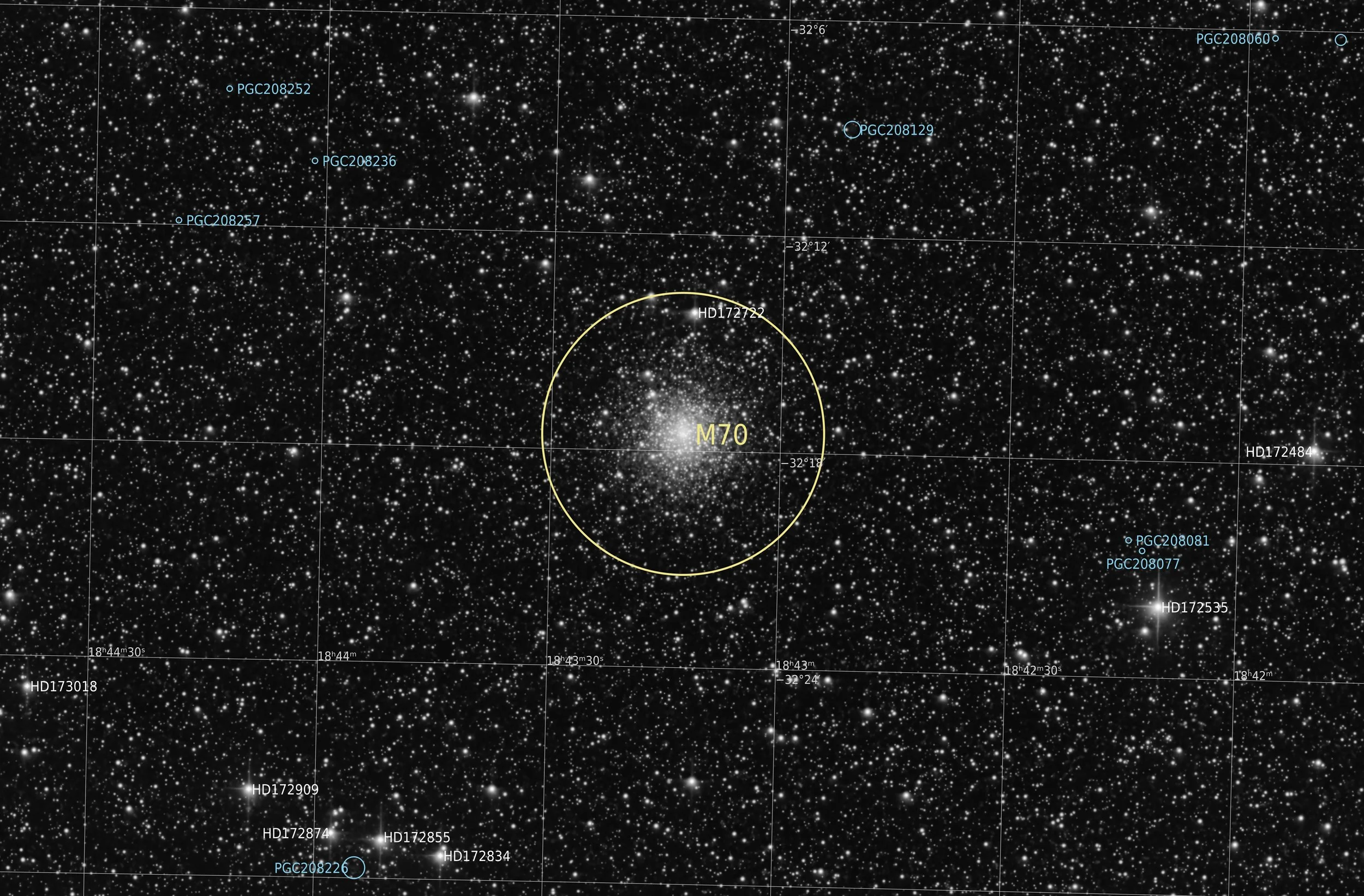
M70
NGC 6681
37’ x 24’ | 0.3”/px | 7499 × 4925 px
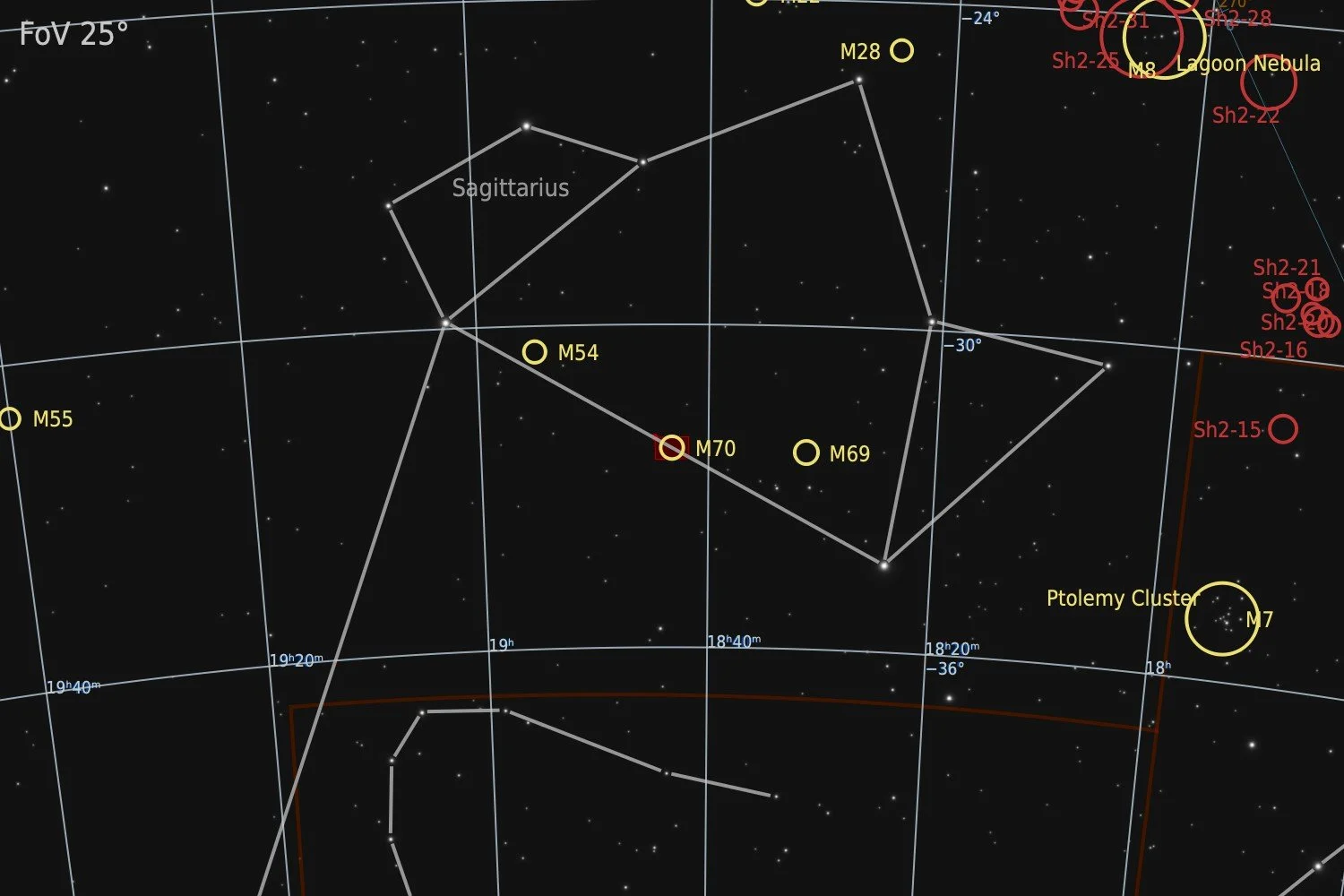
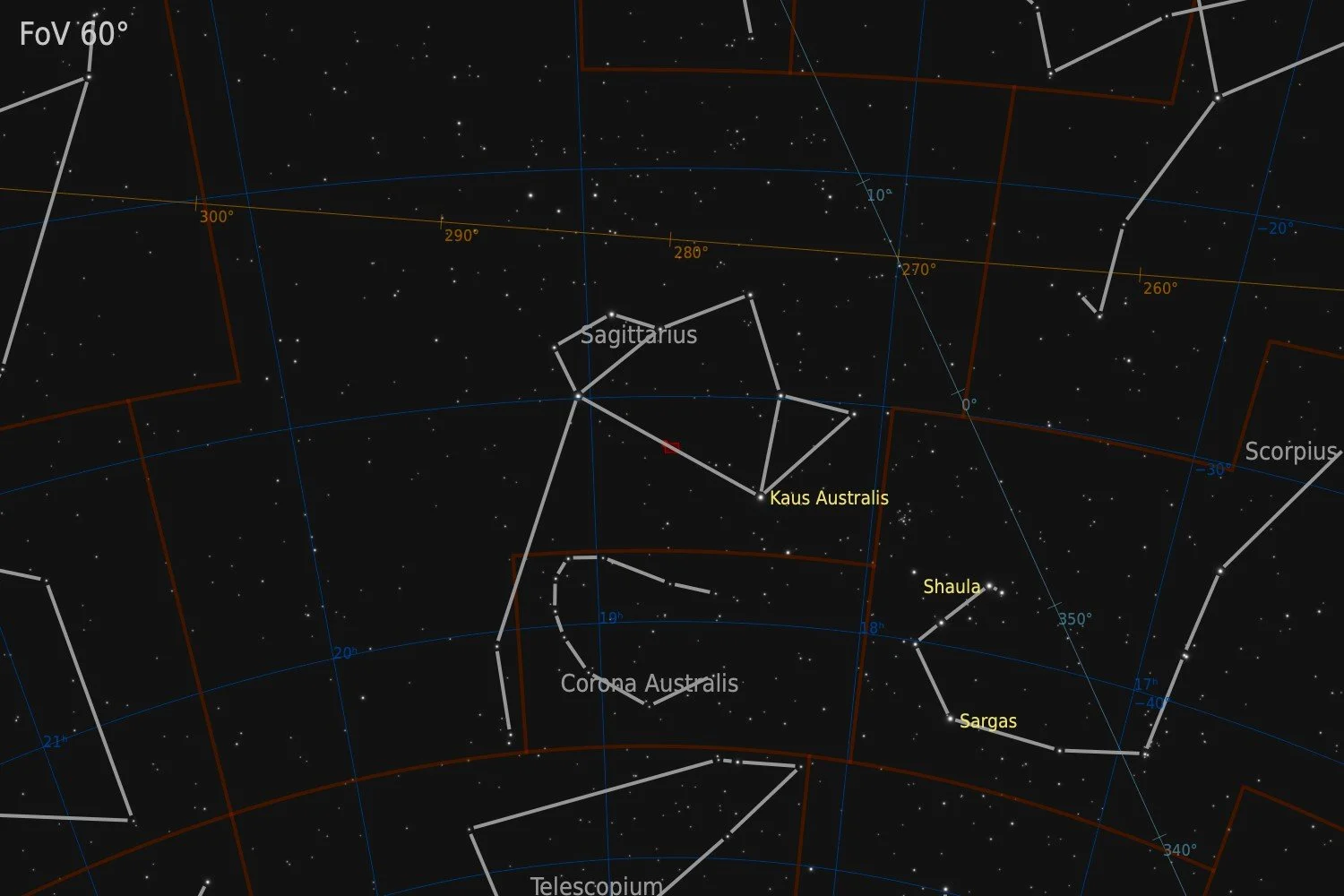
Sagittarius
RA 18h 43m 13s Dec -32° 17’ 55” | 0°
Messier 70, also known as NGC 6681, is a globular cluster located in the constellation Sagittarius. It was discovered by Charles Messier on August 31, 1780. M70 lies at a distance of approximately 29,400 light-years from Earth and spans a true diameter of roughly 68 light-years, making it one of the smaller and more compact globular clusters in the Messier catalogue. It reaches an apparent magnitude of around 7.9, placing it at the fainter end of the Messier globulars and requiring reasonably dark skies and moderate aperture. M70 was the backdrop behind comet Hale-Bopp when it was first discovered. Alan Hale and Thomas Bopp each found the comet in July 1995 while looking at the area around M70. Hale-Bopp went on to become one of the most widely seen comets of the 20th century. The southerly declination of M70 of around −32° makes it difficult to image from mid-northern latitudes.
Source: Claude.ai
Data Acquisition
Data was collected during 3 nights in June 2026, using a 14” reflector telescope with full-frame camera at the remote observatory in Spain. Data was gathered using standard RGB filters. A total of approximately 5 hours of data was finally combined to create the final image.
Location Remote hosting facility Roboscopes in Fregenal de la Sierra, Spain (38°N 6°W)
Sessions
Frames
Equipment
Telescope
Mount
Camera
Filters
Guiding
Accessoires
Software
Planewave CDK14 (2563mm @ f/7.2), Optec Gemini Rotating focuser
10Micron GM2000HPS, custom pier
Moravian C3-61000 Pro (full frame), cooled to -10 ºC
Chroma 2” RGB unmounted, Moravian filterwheel L, 7-position
Unguided
Compulab Tensor I-22, Dragonfly, Pegasus Ultimate Powerbox v2
Voyager Advanced, Viking, Mountwizzard4, Astroplanner, PixInsight 1.9.4
Processing
All processing was done in Pixsinsight unless stated otherwise. Default features were enhanced using scripts and tools from RC-Astro, SetiAstro, GraXpert, CosmicPhotons and others. Images were calibrated using 50 Darks, 50 Flats, and 50 Flat-Darks, registered and integrated using WeightedBatchPreProcessing (WBPP). The processing workflow diagram below outlines the steps taken to create the final image.
The gradients in this image were a bit harder to remove than normal. This is probably due to the low altitude of the object, including more of the horizon glow, on top of the gradient caused by the moon that was quite apparent. After initial GradientCorrection of each of the individual colour channels, an extra gradient correction using GraXpert was applied to the RGB image. This dealt with the complex gradients very smoothly.
MLDenoise
For noise reduction the new PixInsight process MLDenoise was used. This is a machine-learning based noise reduction tool, similar to NoiseXTerminator (NXT). MLDenoise is currently still in beta and only available for the Apple Silicon version of PixInsight, but will come standard with all PI versions this summer. I did a quick comparison with NoiseXTerminator, and the differences were extremely small. At the same intensity settings, NXT appears a bit stronger, so if you like NXT at 0.8, you may want to set MLDenoise to 0.85 or 0.9. The absolutely tiny differences had mostly to do with some structural elements, like a very faint star, or a very small detail in the background structure. And where that happened, NXT might have added some structure more than that MLDenoise removed some structure. I applied MLDenoise in the linear stage, as that is what is advised by PixInsight. Normally I apply noise reduction in the non-linear stage. After stretching a small bit of extra noise reduction was applied, this time with NXT.
For the rest, processing followed a very standard approach. See the outline below for a detailed breakdown of the processing applied to the image.
Processing workflow (click to enlarge)
This image has been published on Astrobin.