M50
NGC 2323, Heart Shaped Cluster
47’ x 31’ | 0.3”/px | 9401 × 6213 px | full resolution
Monoceros
RA 07h 02m 46s Dec -08° 22’ 19” | 0°
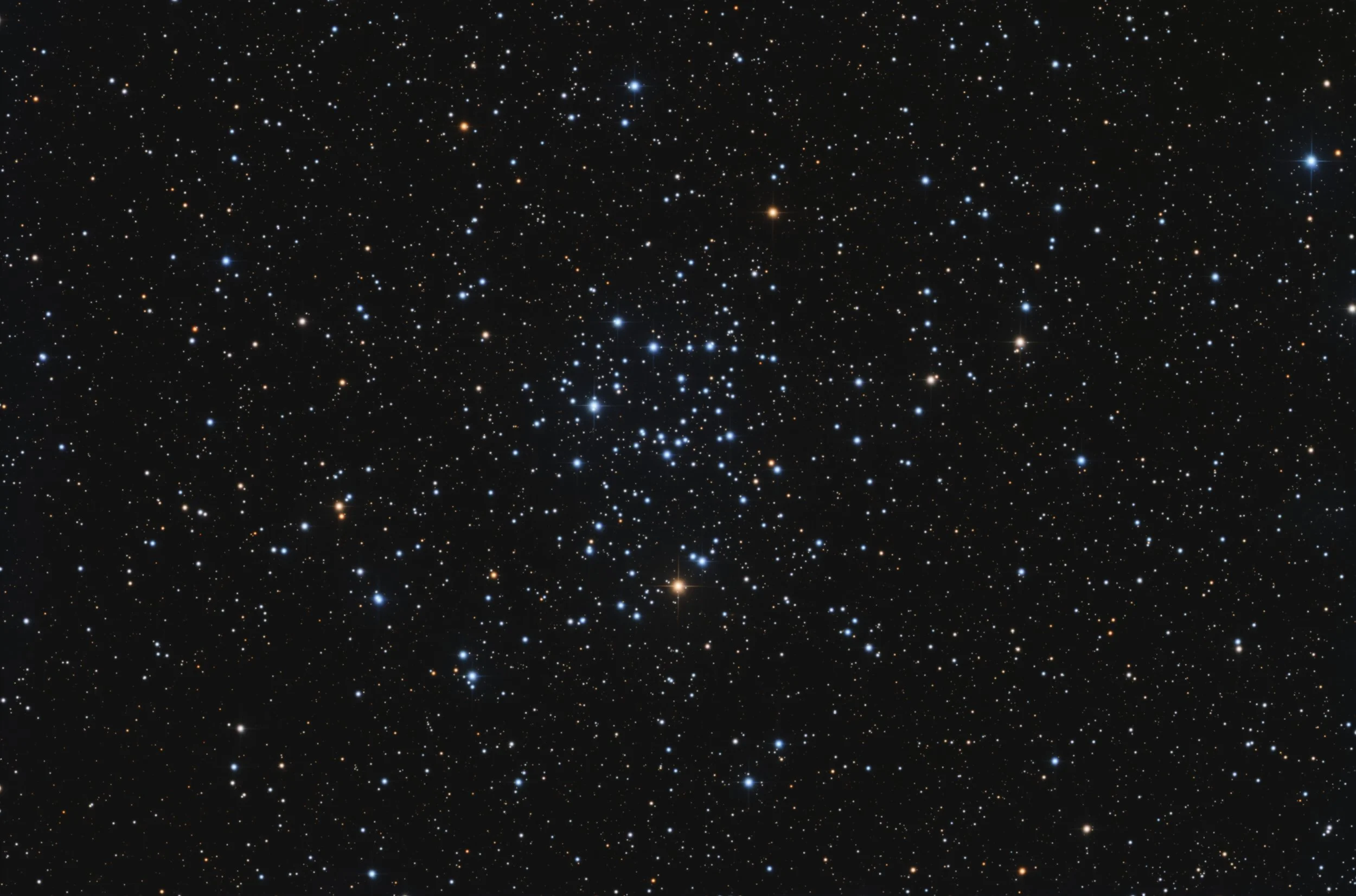
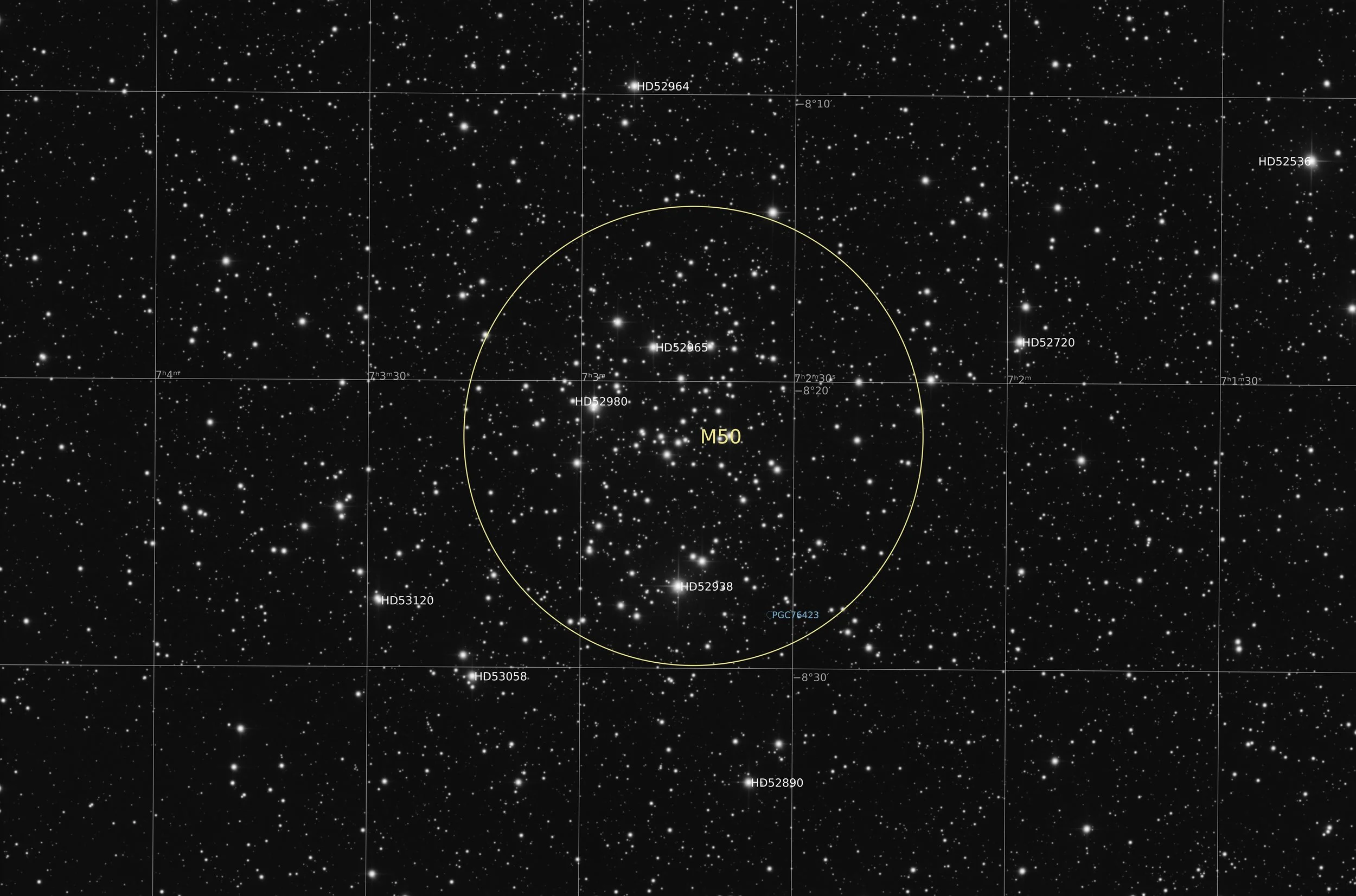
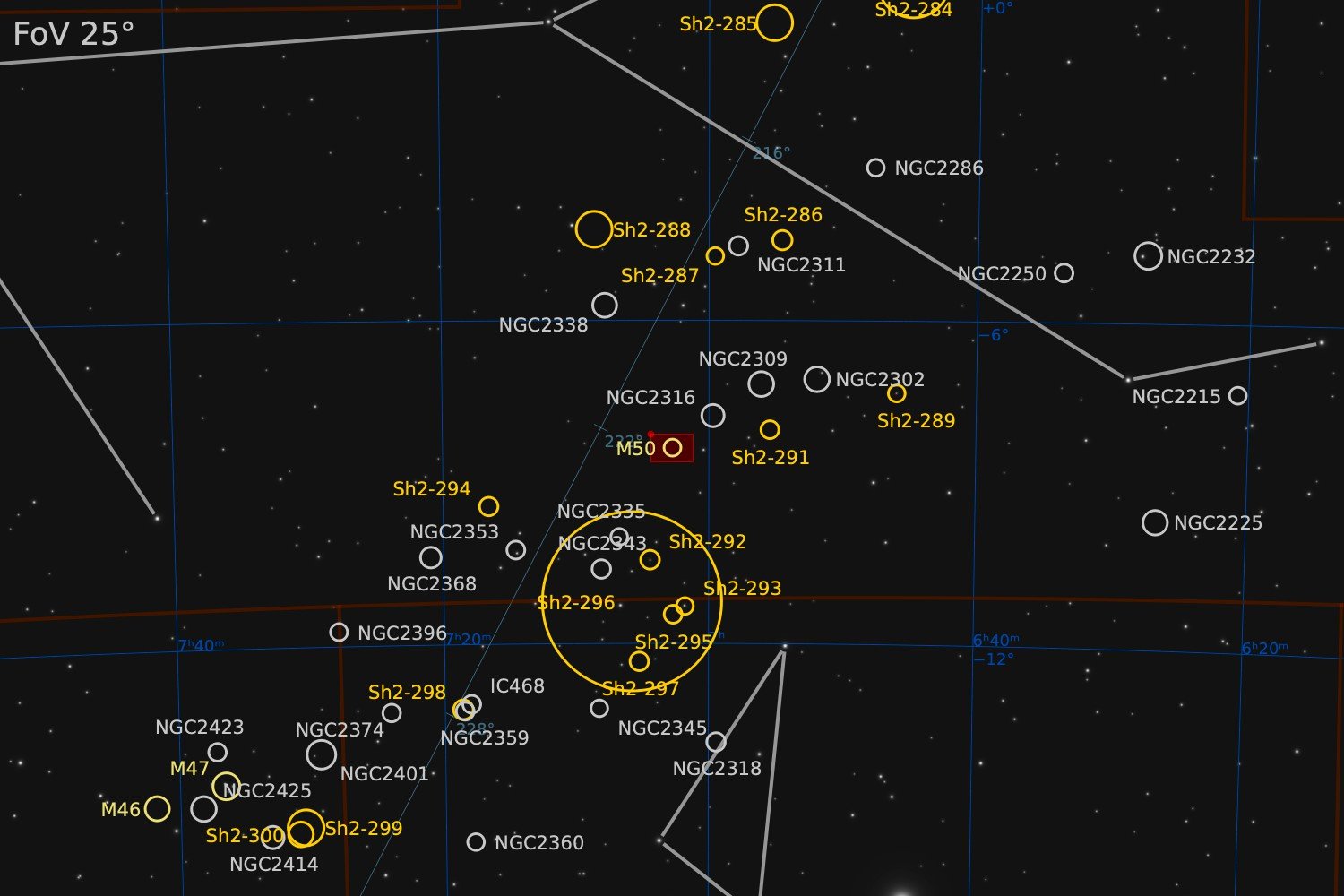
Messier 50, also known as NGC 2323 or the Heart-shaped Cluster, is an open cluster of stars in the constellation Monoceros. It was recorded by G. D. Cassini before 1711 and independently discovered by Charles Messier in 1772 while observing Biela's Comet. It is sometimes described as a 'heart-shaped' figure or a blunt arrowhead. M50 is about 2,900 light-years away from Earth and is near to but narrowly not estimated to be gravitationally tied to the Canis Major (CMa) OB1 association. It has a core radius of 5.9 light-years and spans 17.8 light-years. The cluster has 508 confirmed and 109 probable members – their combined mass is more than 285 solar masses. It is around 140 million years old, with two high-mass white dwarfs and two chemically peculiar stars. Traditionally considered to be a single star cluster, in 2025 it was found to consist of two separate sub-clusters (NGC 2323-a and NGC 2323-b), making it a binary cluster.
Source: Wikipedia
Data Acquisition
Data was collected during 3 nights in December 2025, using a 14” reflector telescope with full-frame camera at the remote observatory in Spain. Data was gathered using standard RGB filters. A total of approximately 7 hours of data was finally combined to create the final image.
Location Remote hosting facility IC Astronomy in Oria, Spain (37°N 2°W)
Sessions
Frames
Equipment
Telescope
Mount
Camera
Filters
Guiding
Accessoires
Software
Planewave CDK14 (2563mm @ f/7.2), Optec Gemini Rotating focuser
10Micron GM2000HPS, custom pier
Moravian C3-61000 Pro (full frame), cooled to -10 ºC
Chroma 2” RGB unmounted, Moravian filterwheel L, 7-position
Unguided
Compulab Tensor I-22, Dragonfly, Pegasus Ultimate Powerbox v2
Voyager Advanced, Viking, Mountwizzard4, Astroplanner, PixInsight 1.9.3
Processing
All processing was done in Pixsinsight unless stated otherwise. Default features were enhanced using scripts and tools from RC-Astro, SetiAstro, GraXpert, CosmicPhotons and others. Images were calibrated using 50 Darks, 50 Flats, and 50 Flat-Darks, registered and integrated using WeightedBatchPreProcessing (WBPP). The processing workflow diagram below outlines the steps taken to create the final image.
Stretching was done using a traditional initial ArcSinh stretch to maintain colour, followed by a regular mid tone-transfer stretch. This time however, both stretches were done using the GHS tool, which includes all these stretching algorithms. Also, after the first ’colour-stretch’, the burnt-out star cores were repaired using the technique described as for Caldwell 16. A mask representing the star cores had to be created from the extracted luminance of the RGB image.
The rest of the processing used a fairly standard approach, outlined below.
Processing workflow (click to enlarge)
This image has been published on Astrobin.